
Google’s “Universal Commerce Protocol” (UCP): Why AI Agents Will Change Shopping (NRF 2026)
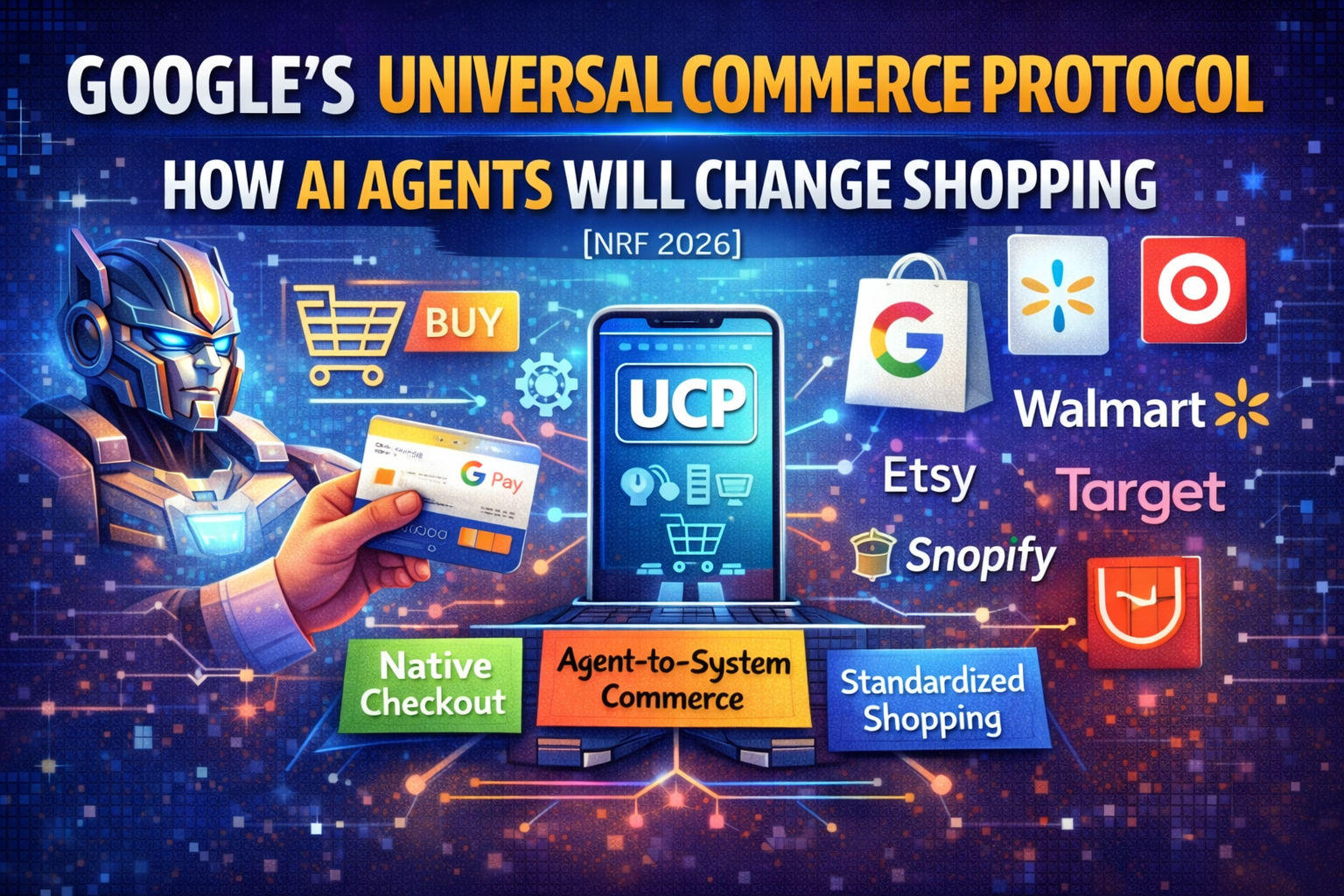
On January 11, 2026, Google made a pretty direct prediction:
AI agents will be a big part of how we shop soon — not just recommending products, but helping complete the purchase.
To make that possible, Google announced a new open standard called the Universal Commerce Protocol (UCP), co-developed with Shopify, Etsy, Wayfair, Target, and Walmart, and endorsed by a broader ecosystem of retail, payments, and platform partners. (blog.google)
The headline feature: UCP will power “native checkout” inside Google’s AI surfaces — meaning buying without bouncing between apps, product pages, and checkout screens. (blog.google)
What “AI shopping agents” actually means (in simple terms)
A shopping agent is the next step after “AI search.”
Instead of:
you search
you open 10 tabs
you compare
you pick
you fill forms
you check out
…an agent can do most of that work with you:
narrow options based on preferences
validate constraints (size, budget, delivery date, returns)
apply loyalty / new-member offers
build the cart
complete checkout with saved payment + shipping info (with permission)
Google’s framing is basically: shopping moves from keywords → conversations → actions. (blog.google)
The real problem: shopping is “multi-system,” so agents get stuck
Checkout isn’t one step.
It’s a chain of systems that all have to cooperate:
product catalog + variants
inventory + delivery constraints
pricing + promotions + taxes
identity (guest vs member) + loyalty
payment authorization
order confirmation + post-purchase support
Agents fail when any one link is proprietary, inconsistent, or requires a custom integration.
That’s what Google is targeting: a common language for agentic commerce. (blog.google)
What UCP is (and why it matters)
UCP is an open-source standard designed to let:
consumer AI surfaces (like Google Search AI Mode / Gemini)
retailer systems (catalog, checkout, order management)
payment providers
…talk to each other in a standardized way. (Google Developers Blog)
Google’s developer blog describes UCP as providing shared “primitives” (building blocks) so commerce flows don’t require one-off integrations for every AI platform and every retailer — the classic N×N integration mess. (Google Developers Blog)
In plain language:
Instead of building a custom connector for every agent and every store, you integrate once to the protocol.
“Native checkout” is the first big use case
Google says UCP will soon power a new checkout feature on eligible product listings inside AI Mode in Search and the Gemini app. (blog.google)
Key details Google highlighted:
Google Pay + saved info in Google Wallet for quick purchase completion (blog.google)
PayPal support is coming (blog.google)
Retailers remain the seller / merchant of record, keeping the customer relationship intact (blog.google)
initial availability is tied to eligible U.S. retailers, with plans to expand (blog.google)
Sundar Pichai’s NRF remarks also gave a concrete example: a shopper searching for a product could receive a personalized “new member” offer or loyalty enrollment, then complete purchase “without leaving the conversation.” (blog.google)
Why Shopify is involved (and why that’s a big signal)
Shopify’s position is straightforward:
AI channels are becoming new storefronts
merchants need a way to sell inside those conversations
checkout has to handle real-world complexity (discounts, loyalty, subscriptions, terms)
Shopify says UCP is meant to support those flows — discount codes, loyalty credentials, subscription cadence selection, terms confirmation — across AI platforms. (Shopify)
They also say these AI channel integrations are managed through Shopify’s admin tooling (“Agentic Storefronts”). (Shopify)
The hidden story: this is also Google protecting the future of shopping discovery
Google Search has historically been the “top of funnel” for shopping.
But if discovery shifts into AI assistants, the question becomes:
Where does the transaction happen?
UCP is Google saying: “If shopping becomes agent-led, Google wants to be a native place where the journey finishes.”
And they’re not alone — news coverage framed this as part of a broader race among Google, OpenAI, Amazon, and others to compress “browse → buy” into a single AI flow. (AP News)
What this changes for e-commerce brands and retailers
1) “AI Mode” becomes a distribution channel
Think of AI Mode and Gemini as a new kind of marketplace UI:
conversational
intent-heavy
purchase-capable
If you sell online, you should assume:
customers will increasingly expect to buy where they decide. (blog.google)
2) Your product data matters more than your landing page
Agents don’t “admire your homepage.”
They need:
clean structured product attributes
accurate variant data
inventory + shipping constraints
price + promo logic
3) Checkout UX becomes an API problem
A lot of brands still treat checkout like “a page.”
In an agentic world, checkout becomes:
identity linking
offers + loyalty logic
payment authorization
order creation
post-purchase actions
All as capabilities that an agent can call safely. (Google Developers Blog)
If you run an online store: how to prepare (practical checklist)
Make your catalog machine-readable
consistent titles, attributes, variants, images
Get serious about inventory accuracy
wrong stock info breaks agent trust fast
Standardize promotions + loyalty rules
agents need clear “can apply / cannot apply” logic
Reduce checkout friction
guest checkout, clear shipping rules, transparent returns
Treat AI shopping as a new “SEO layer”
not just ranking pages, but being eligible and trusted as a merchant
If you’re on Shopify, you’ll likely see this appear as platform-level capability more quickly (based on Shopify’s announcement). (Shopify)
One more piece: “Business Agent” for branded conversations
Google also announced a Business Agent experience: a branded, retailer-controlled chat inside Search that can answer product questions “in a brand’s voice,” with plans to connect it to offers and even direct purchase flows. (blog.google)
That’s basically: your “AI sales associate,” living on Google surfaces.
The bottom line
UCP is Google + major commerce players betting on a near future where:
customers shop via conversation
agents can execute steps, not just suggest
checkout becomes standardized across platforms
merchants keep control as seller of record
If this works, it’s not just “AI helps you shop.”
It’s a new internet layer for commerce: agent-to-system commerce. (Google Developers Blog)