
Why Small and Large Businesses Choose Shopify for Ecommerce
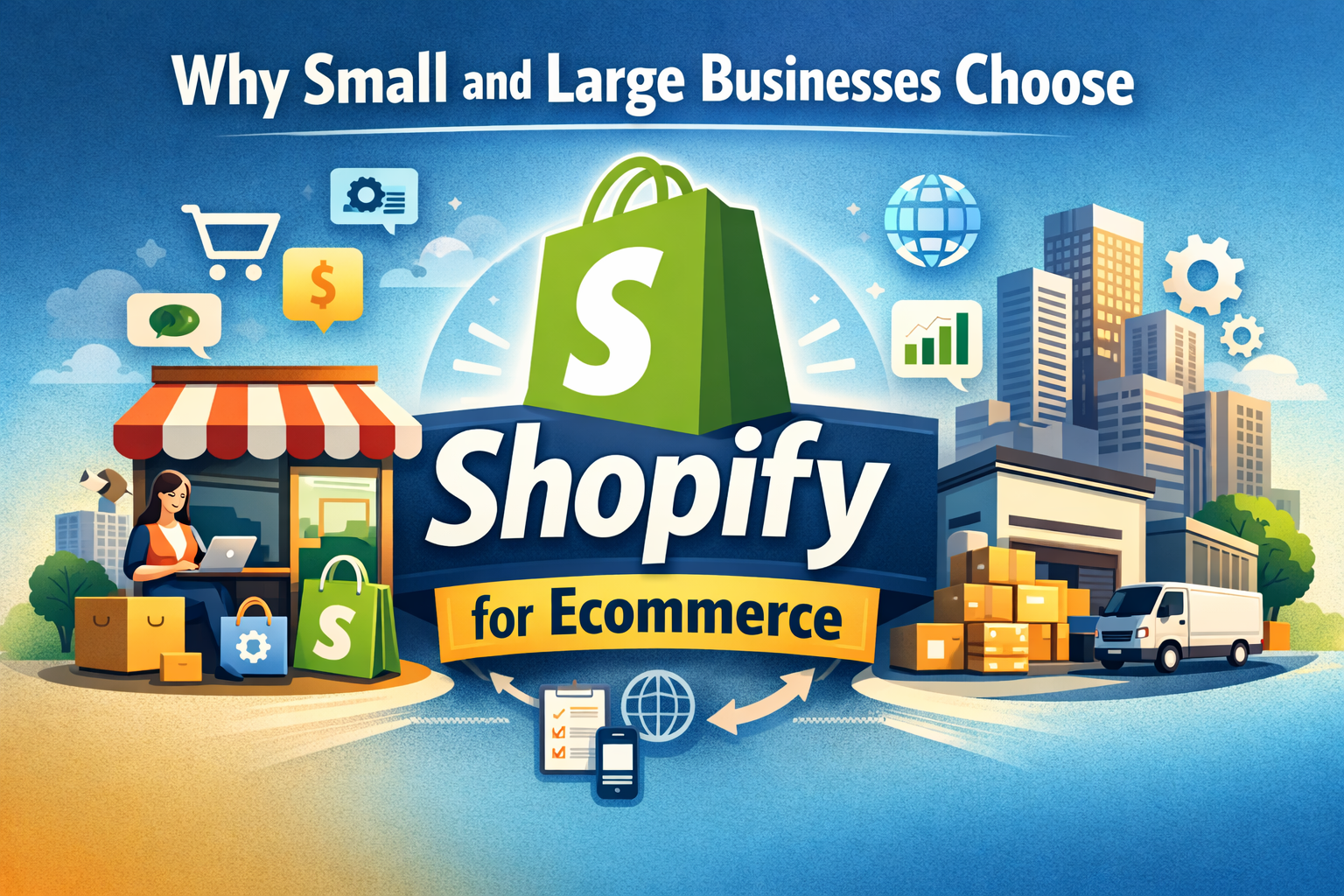
Shopify sits in a rare spot: it’s simple enough for a small business to launch quickly, but powerful enough to run serious volume at scale.
That “starts easy, scales far” story is a big reason Shopify has become one of the most widely adopted ecommerce platforms in the world. It’s used by millions of businesses globally and processes hundreds of billions in sales every year. That level of adoption doesn’t happen by accident.
Below is a practical breakdown of why both small and large businesses choose Shopify, and what they’re really getting when they do.
What Shopify gives you (in plain terms)
Shopify is a hosted ecommerce platform that bundles the core building blocks needed to sell online:
A storefront and theme system
Secure checkout and payments
Product and inventory management
Order processing and shipping workflows
Marketing and sales channels
Apps and integrations for added functionality
For most businesses, the value isn’t just one feature. It’s the all-in-one operating system that reduces complexity and keeps everything under one admin.
Why small businesses choose Shopify
1) Fast launch without a complex tech setup
Small teams don’t want to manage servers, security updates, or fragile plugin stacks. Shopify removes most of the technical overhead so business owners can focus on products, branding, and marketing instead of infrastructure.
2) A clear growth path as the business evolves
Many stores start simple and gradually add features such as:
product reviews
subscriptions
bundles and upsells
email and SMS marketing
analytics and reporting
shipping automation
Shopify allows this kind of gradual expansion without forcing a rebuild.
3) Automation that saves time
As order volume grows, manual work becomes a bottleneck. Shopify includes automation tools that help streamline inventory updates, order tagging, fulfillment rules, customer notifications, and more.
For small teams, automation often determines whether growth feels manageable or overwhelming.
4) Omnichannel selling without extra systems
Even online-first brands eventually sell in person at pop-ups, events, or retail locations. Shopify’s point-of-sale tools are designed to keep inventory, orders, and customer data in sync between online and offline sales.
5) Easier international expansion
Shopify supports selling in multiple regions with local currencies, translated content, and region-specific pricing. This allows small businesses to test international markets without building separate stores or switching platforms.
Why large businesses choose Shopify
Large companies don’t choose Shopify because it’s simple. They choose it because it can be standardized at scale while still allowing deep customization.
1) Proven scalability
Shopify runs high-traffic stores, flash sales, and global brands without merchants having to manage infrastructure. For large organizations, reliability and performance are non-negotiable.
2) Headless commerce for full design control
Enterprise brands often need custom front-end experiences, advanced performance optimization, and flexible content architectures. Shopify supports headless setups, allowing companies to build fully custom front ends while still using Shopify as the ecommerce engine.
3) B2B and DTC in one ecosystem
Many large companies sell both direct-to-consumer and wholesale. Shopify supports B2B workflows such as company accounts, custom pricing, and payment terms, while still running a standard DTC storefront in the same system.
4) International operations without platform sprawl
Managing multiple regions usually introduces complexity: different pricing, currencies, taxes, and content requirements. Shopify’s international tools allow large businesses to manage these differences centrally instead of maintaining dozens of separate stores.
5) A deep ecosystem of apps and partners
Larger organizations rarely rely on Shopify alone. They connect it to ERPs, CRMs, analytics tools, warehouses, and internal systems. Shopify’s ecosystem makes these integrations possible without locking businesses into a rigid structure.
Why Shopify works for both small and large businesses
One admin for the entire operation
From products and inventory to orders and sales channels, Shopify keeps everything centralized. This reduces operational friction and makes scaling smoother.
Payments are tightly integrated
Built-in payment processing simplifies checkout, reduces friction for customers, and eliminates the need for third-party payment gateways in many cases.
Continuous platform improvements
Shopify consistently invests in performance, checkout flexibility, automation, and international selling tools. Businesses benefit from these improvements without having to migrate platforms every few years.
When Shopify may not be the right fit
Shopify is powerful, but it’s not a perfect solution for every business model:
Extremely custom ecommerce logic may require a fully custom backend
Businesses with razor-thin margins should carefully evaluate app and transaction costs
Highly niche workflows might require custom development beyond standard Shopify patterns
That said, these cases are the exception, not the rule.
A simple way to decide
Shopify is usually a strong choice if you want:
A reliable ecommerce foundation you don’t need to babysit
A platform that works for both early-stage and mature businesses
International selling without rebuilding your stack
Omnichannel commerce from one system
The option to go headless later without leaving the platform