
SEO vs AIO: what Squarespace business owners should focus on
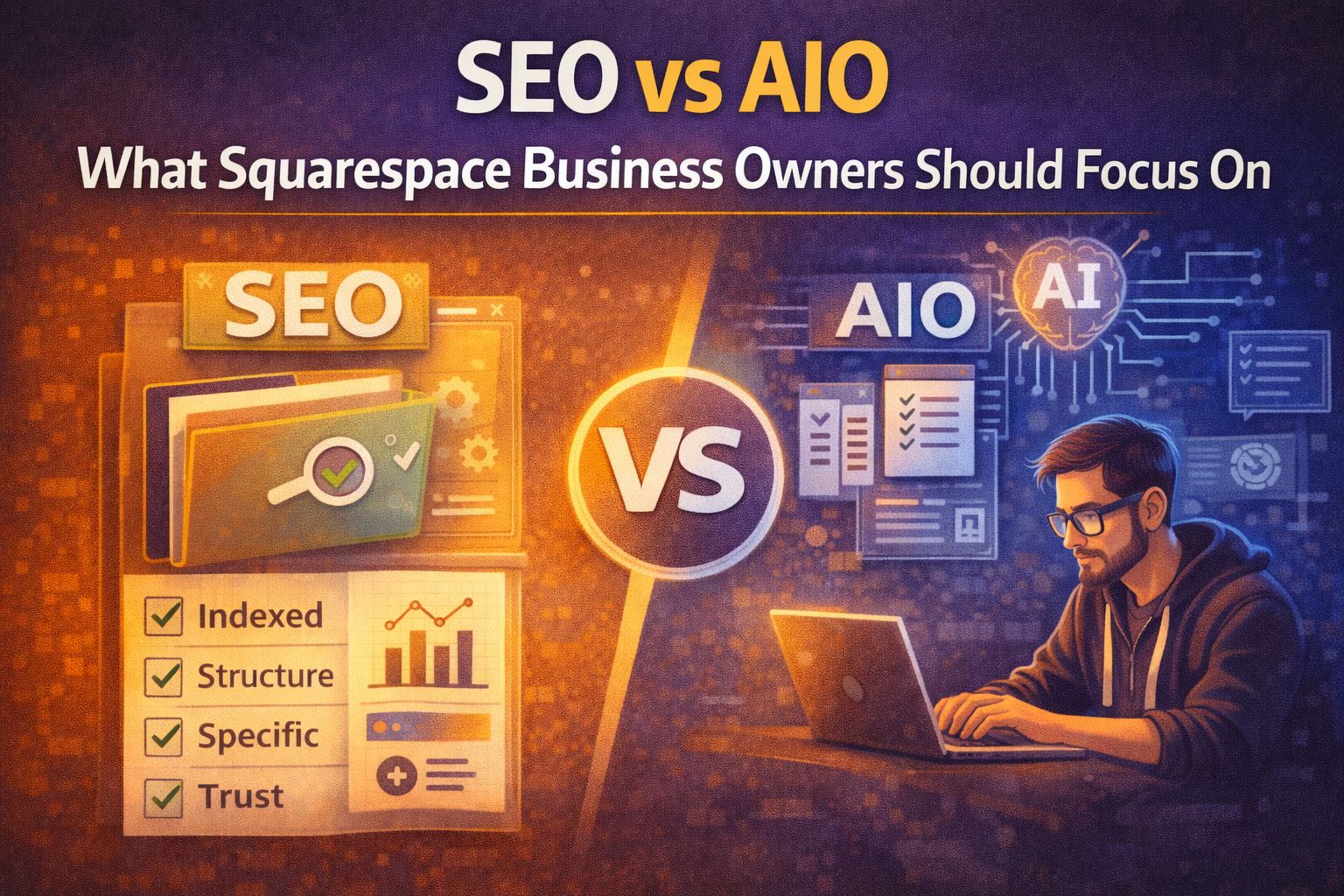
If you’ve been hearing “SEO is dead because AI answers everything,” here’s the practical reality:
AIO doesn’t replace SEO. AIO is built on top of SEO.
If your Squarespace pages aren’t crawlable, indexable, and clearly structured, AI-powered search systems have less to work with. That means weaker visibility in both traditional search results and AI-generated answers.
What SEO is (in plain terms)
SEO = making your pages discoverable, understandable, and worth ranking.
For a Squarespace website, that includes:
technical accessibility (pages can be crawled and indexed),
relevance (content matches real search intent),
content quality (clear, helpful, non-generic),
credibility (real business, real experience, real proof).
SEO hasn’t disappeared—it’s still the foundation.
What AIO actually means (without the hype)
AIO (AI Optimization) is about making your content easy for AI-driven search experiences to:
understand,
summarize,
and confidently reference.
People now search with longer questions, follow-ups, and context. AI systems prefer content that is structured, specific, and easy to extract insights from.
AIO doesn’t introduce new rules—it amplifies the importance of good ones.
The key truth: AIO depends on SEO fundamentals
There is no AIO shortcut.
If your content isn’t:
indexed,
well-structured,
specific,
trustworthy,
then it’s far less likely to be surfaced or summarized by AI systems.
SEO foundations come first. Always.
What Squarespace business owners should focus on (in the right order)
1) SEO foundations (this is most of the work)
Before worrying about AIO, make sure your Squarespace site has:
clear navigation and page hierarchy,
one clear main heading per page,
meaningful subheadings,
internal links between related pages,
SEO descriptions for key pages,
search console tracking set up.
Skipping this step and jumping straight to “AI optimization” usually leads nowhere.
2) Content that’s actually worth ranking (and summarizing)
Both SEO and AIO reward content that is:
specific instead of generic,
complete instead of shallow,
written from real experience,
easy to scan and understand.
If your content could apply to any business on any platform, it’s not strong enough.
3) Credibility and trust signals
This is where many business websites fail.
You need to clearly show:
who you are,
what you do,
why you’re qualified,
how to contact you,
proof of real work (case studies, examples, outcomes).
AI systems—and humans—trust content that looks real, grounded, and accountable.
How AIO changes the way you write (practical tips)
Once SEO basics are solid, AIO is mostly about clarity and structure.
Write answer-first sections
Start sections with a direct answer, then explain.
This makes content easier to understand and easier to summarize.
Use clear definitions
Define key concepts clearly and early.
Example:
A Squarespace developer is…
someone who can write custom code,
understands the platform’s limitations,
and builds solutions that survive redesigns.
Use step-by-step formats
“How to” content performs well because it’s:
clear,
scannable,
easy for AI and humans to follow.
Add structure, not fluff
Long content is fine. Messy content isn’t.
Headings, lists, and short paragraphs matter more now than ever.
SEO vs AIO: what to do right now
If your goal is leads (not just traffic), focus on this order:
Fix SEO fundamentals
Publish content that answers real business questions
Add proof and credibility
Format content for clarity and summarization
That’s the strategy that works for Squarespace business websites today.
Final takeaway
SEO is still the foundation of discoverability.
AIO rewards the sites that already do SEO well—and present information clearly.
If your Squarespace site is structured, useful, and credible, it will perform in both traditional search and AI-driven results.
SEO isn’t dead.
It has evolved—and Squarespace sites that adapt properly will continue to win.