
Apple + Google’s Gemini Deal: What It Means for Siri, “Apple Foundation Models,” and the AI Platform War (2026)
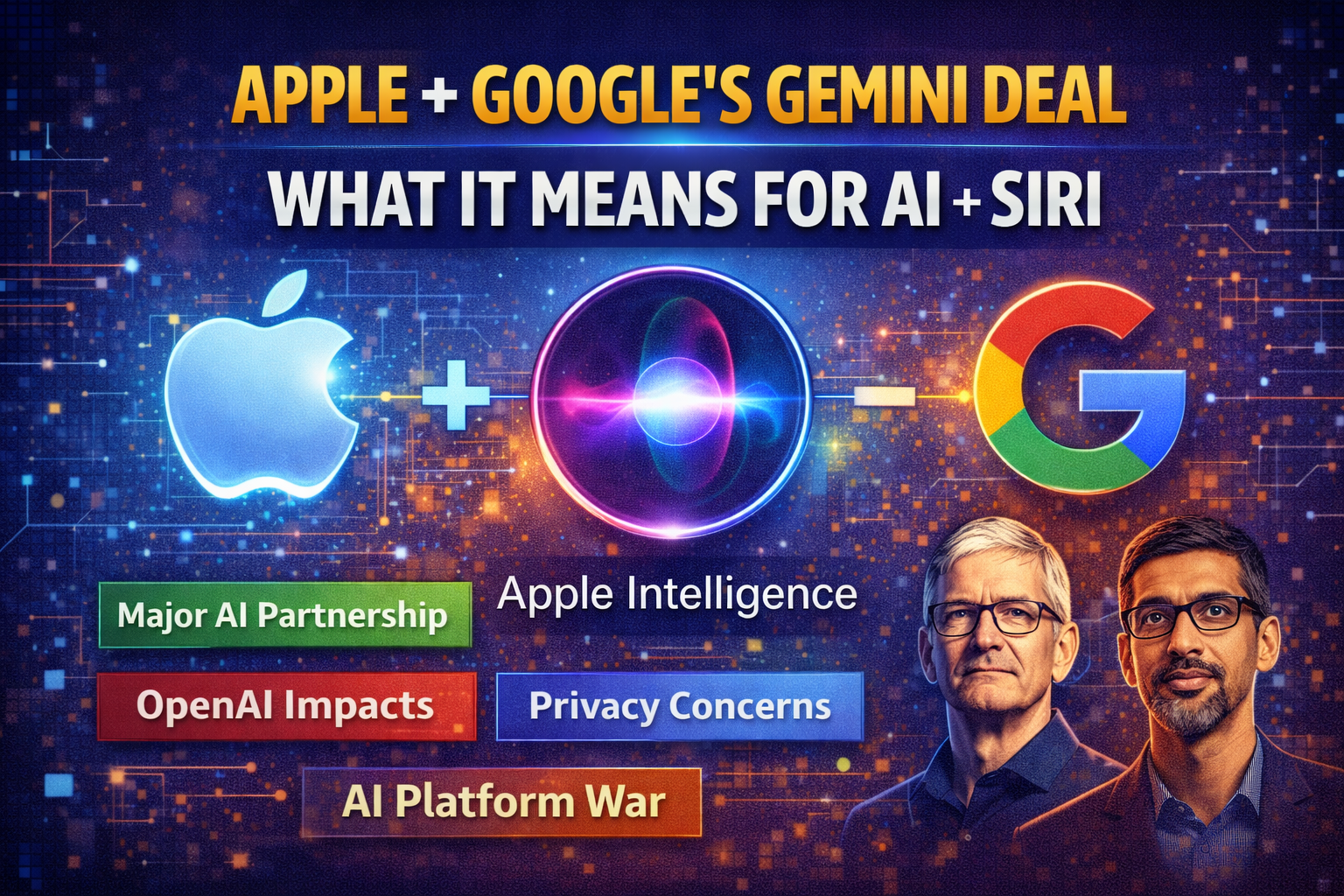
On January 12, 2026, Apple and Google confirmed a multi-year collaboration: the next generation of Apple Foundation Models will be based on Google’s Gemini models and cloud technology, and this will help power future Apple Intelligence features — including a more personalized Siri coming this year.
Apple and Google also emphasized that Apple Intelligence will continue to run on Apple devices and Apple’s Private Cloud Compute, with Apple’s privacy standards remaining in place.
What Google actually announced (in plain English)
This isn’t just “Siri uses Gemini sometimes.”
It’s closer to:
Apple’s “foundation layer” for AI (their core models) will be built on top of Gemini + Google’s cloud tech
Siri’s long-promised upgrade (more personalized, more context-aware) is one of the first visible outcomes
ChatGPT likely stays as an opt-in helper for certain complex queries, but Gemini becomes the default base layer
That’s a meaningful shift because Apple historically prefers vertical integration: build the core tech in-house, control the stack, and ship it tightly integrated.
Why this is a big deal
1) Apple is choosing “best model wins” over pure vertical integration
Apple basically said it evaluated options and decided Google provides the strongest foundation. That’s unusual language for Apple — and it signals how competitive the AI platform race has become.
2) Gemini instantly gets access to Apple’s scale
Apple has a massive active device base globally. Even partial rollout across Siri and Apple Intelligence massively expands Gemini’s reach as a default consumer AI layer.
3) This changes the “mobile AI map”
Google already has deep AI distribution through Android and partners (e.g., Samsung’s Galaxy AI). If Gemini also becomes a core layer for Siri, Google’s AI ends up influencing both major mobile ecosystems.
4) Privacy becomes a key battleground
Apple’s brand is privacy. So the messaging here matters: Apple Intelligence continues to run on-device and on Private Cloud Compute, rather than sending everything to a third party cloud by default. That’s Apple trying to get “frontier model capability” without losing the trust angle.
The “native Siri upgrade” angle
The headline user benefit is the promised more personalized Siri.
For Apple, this partnership is also a reset: Siri’s AI upgrade has been delayed and criticized for lagging behind competitors. A strong model backbone helps Apple ship the long-awaited jump in capability faster.
What other companies and people are saying
Here’s the signal from the early reactions:
Elon Musk (xAI) — competition + concentration concerns
Musk publicly criticized the partnership as concentrating too much power with Google, pointing to Google’s strength in Android and Chrome as part of the concern.
Analysts — OpenAI shifts into a supporting role
At least one research/market voice framed this as: Gemini becomes the default intelligence layer, while ChatGPT remains for complex, opt-in queries. That’s a major positioning change in consumer AI distribution.
Tech commentary — “quiet announcement” / awkward wording tells a story
Some Apple-focused commentators pointed out how unusually quiet and minimal the announcement felt, and how the wording (“foundation for foundation models”) subtly reveals how important this deal is: Apple needed a stronger baseline fast.
Industry context — markets treated it as a big win for Google
Coverage tied this partnership to Alphabet hitting major valuation milestones and renewed investor confidence in Google’s AI strategy.
The big strategic question: does this trigger antitrust scrutiny?
Apple and Google already have a long history together (especially around default search). A deeper AI partnership raises a predictable question:
If one company becomes dominant in search, browser, mobile OS and the default AI layer across ecosystems, regulators will pay attention.
Even if the consumer experience improves, the platform-power story is hard to ignore.
What this means if you build products (SaaS, e-commerce, apps)
This partnership is another sign that the next “distribution layer” is:
AI assistants + default OS surfaces.
If users start asking Siri/Gemini to do things for them, your product needs to be:
discoverable through AI answers (not just SEO)
easy to transact with (APIs, deep links, structured data)
clear about trust, privacy, and permissions
The winners won’t just have the best UI.
They’ll be the easiest for AI agents/assistants to correctly use on a user’s behalf.