
ChatGPT Is Testing Ads for Free Users - What OpenAI Actually Said (And What It Means)
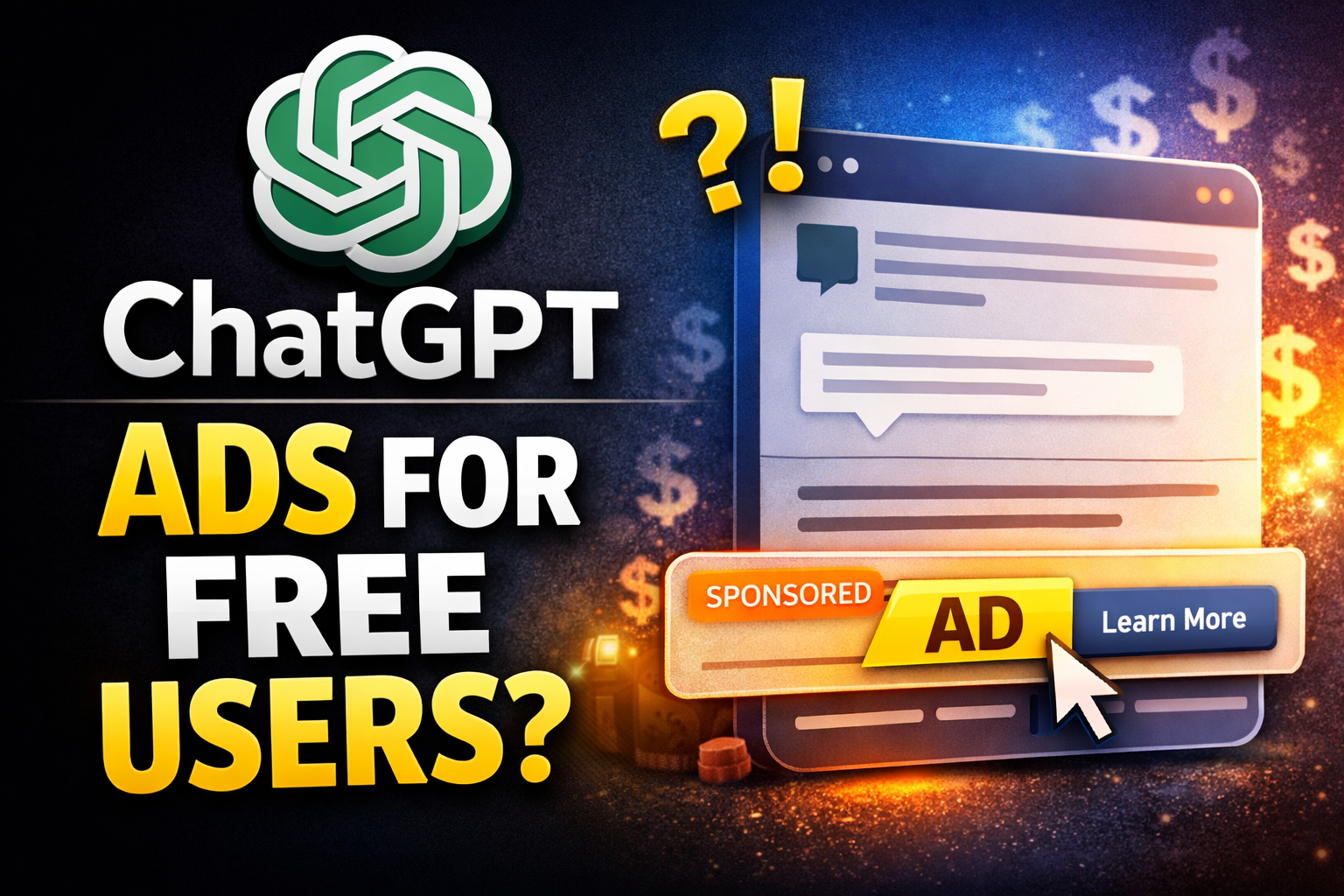
On January 16, 2026, OpenAI published a clear statement about something users have been debating for months: ads are coming to ChatGPT — but with strict rules, and only for certain tiers (at first).
This matters because ChatGPT isn’t a normal social app feed. People use it for deep work, personal decisions, learning, and sensitive life/admin tasks. So the real question isn’t “will there be ads?” — it’s:
Can a conversational assistant add ads without corrupting the answers?
OpenAI is trying to answer that with a “test-first” approach, and they put their principles in writing.
What OpenAI announced
1) Ads will be tested in the U.S. first (free + Go tiers)
OpenAI says it plans to start testing ads in the U.S. “in the coming weeks” for:
Free users
ChatGPT Go users (a new lower-cost plan)
And importantly:
Pro, Business, and Enterprise will not include ads.
2) Ads will appear separate from answers (at the bottom)
The initial ad format OpenAI describes is:
Ads at the bottom of answers
Only when there’s a relevant sponsored product/service based on the current conversation
Clearly labeled and separated from the organic answer
That placement detail is a big deal. OpenAI is explicitly rejecting the most dangerous version of advertising in AI:
“Sponsored answers” that quietly steer the assistant’s actual response.
OpenAI’s “ads principles” (the part that really matters)
OpenAI listed five principles that define how this will work.
Principle A: Ads must not influence answers
OpenAI says ads do not influence the answers and that answers are optimized for what’s helpful — with ads clearly separate.
If OpenAI sticks to this, it protects the core value of ChatGPT: trust in the assistant’s output.
Principle B: Conversations stay private (and aren’t sold to advertisers)
OpenAI states:
Advertisers don’t get your conversations
OpenAI says it will never sell your data to advertisers
This is the line in the sand. It’s also the one users will scrutinize hardest over time.
Principle C: User control (personalization off + clearable ad data)
OpenAI says users will be able to:
Turn off ad personalization
Clear the data used for ads
Always have a way to avoid ads via a paid, ad-free tier
Principle D: No “optimize for time spent”
OpenAI says it will not optimize for time spent in ChatGPT — prioritizing trust and UX over revenue.
This is a direct response to the incentive problem that broke many social platforms.
Principle E: Limits: adults only, and no sensitive topics
During the test, OpenAI says it will not show ads when a user is under 18 (self-reported or predicted), and ads won’t appear near sensitive/regulated topics like:
Health
Mental health
Politics
Why OpenAI is doing this now
OpenAI frames advertising as part of a broader goal: expand access to powerful AI, without forcing everyone into higher-priced plans.
At the same time, OpenAI launched ChatGPT Go at $8/month, positioned between Free and Plus, as a “low-cost” way to increase limits and access.
So the business picture looks like:
Subscriptions remain the cleanest model
Go captures users who want more but won’t pay $20/month
Ads help subsidize Free/Go so OpenAI can raise limits without raising prices
What this changes for users
Free users: you may “pay” with attention, not money
If ads appear at the bottom of answers, this will feel less intrusive than banners or mid-response sponsorships — but it still changes the experience.
The biggest risk isn’t visual clutter.
It’s second-guessing:
“Was this suggestion truly best?”
“Or did an ad ecosystem shape what I’m seeing?”
OpenAI is trying to prevent that by enforcing answer independence.
Paid users: the “ad-free” tier becomes more valuable
Once ads exist for free users, the value proposition of paid plans gets simpler:
Pay to remove limits
Pay to remove ads
Pay for a cleaner, more focused workflow
What this means for businesses and marketers
1) “Search intent” is moving into conversations
If the ad unit is triggered by what someone is actively talking about, that’s closer to high-intent search than social discovery.
It’s not “brand impressions.”
It’s “I’m literally asking for help choosing.”
2) The ad format will likely start with shopping-style placements
Early reporting around the test describes shopping-link-like placements at the bottom of answers.
That suggests the first wave is “commercial queries”:
products
services
bookings
subscriptions
Not general branding.
3) Expect heavy emphasis on labeling + transparency
OpenAI explicitly says ads will be clearly labeled, and users can learn why they’re seeing an ad (and dismiss it).
If you’ve ever run performance marketing, you know what that means:
Weak offers won’t survive
Low-quality landing pages won’t survive
Misleading claims won’t survive
Because the user is already in a “decision” mindset and can reject the ad instantly.
What this means for product teams and web agencies
If you build websites, funnels, SaaS onboarding, or e-commerce experiences (like we do at abZ Global), this shift matters in very practical ways:
1) Your landing page will be judged faster than ever
Conversational ads compress the decision cycle:
user asks
user sees options
user clicks one
That means your page must deliver clarity instantly:
what it is
who it’s for
why it’s better
what to do next
2) “Trust UX” becomes part of conversion optimization
If AI ad ecosystems emphasize transparency and user control, your site needs to match that tone:
clear pricing
clear policies
clear “what happens next”
no dark patterns
3) Content that answers questions will win
If ads appear only when relevant to the conversation, then relevance is the currency.
The brands that benefit most will be the ones already producing:
comparison pages
use-case pages
“best for X” pages
straightforward FAQs
The real test: can OpenAI keep incentives aligned?
OpenAI’s principles are the right ones — especially:
Answer independence
Conversation privacy
No time-spent optimization
But the hard part is maintaining those principles once advertising revenue becomes meaningful.
So the story to watch in 2026 isn’t “ads exist.”
It’s:
Do ads stay clearly separated?
Do answers remain genuinely independent?
Does user control remain real (not buried)?
Does the platform avoid becoming engagement-driven?
OpenAI is asking for trust — and, to their credit, they wrote down the rules they’ll be judged by.