
Elon Musk’s “Moonshots” Interview (Peter H. Diamandis): The Big Predictions, AI Timeline, and Key Takeaways
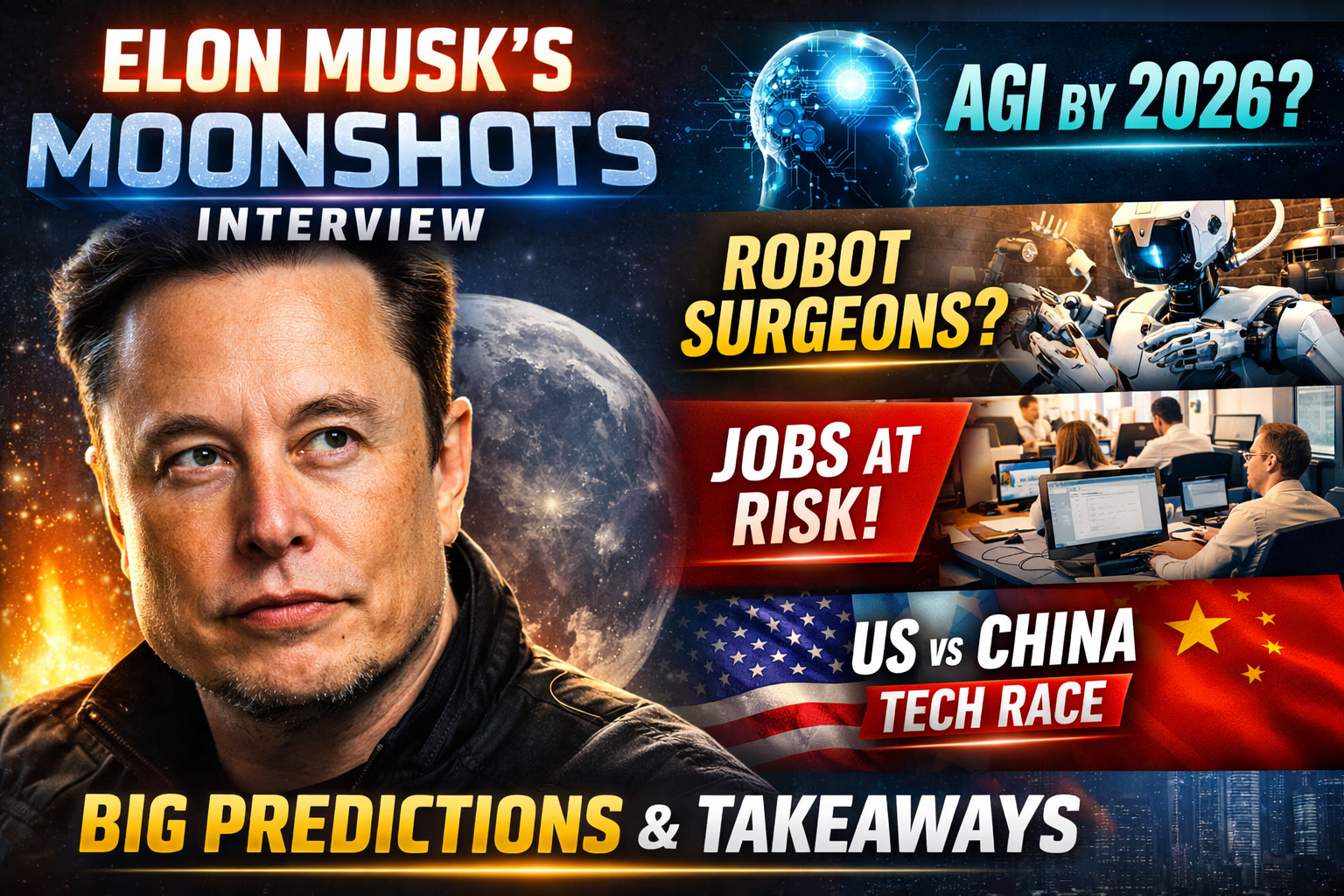
Elon Musk joined Moonshots with Peter Diamandis (with Dave Blundin) for a long, wide-ranging conversation recorded Dec 22, 2025 and released in early Jan 2026.
If you’re looking for the “most searchable” parts: it’s the AGI timeline, white-collar job disruption, humanoid robots, China’s solar lead, and the compute/energy arms race.
What this episode is (quick context)
The episode is titled “Elon Musk on AGI Timeline, US vs China, Job Markets, Clean Energy & Humanoid Robots | 220” and runs almost 3 hours.
The conversation mixes:
near-term predictions (2026–2030)
infrastructure realities (gigawatts, training clusters, cooling, power smoothing)
“Star Trek vs Terminator” framing: abundance vs instability
The 12 biggest predictions and takeaways (high-signal summary)
1) “AGI next year” (2026)
Musk says he thinks they’ll hit AGI in 2026.
2) By ~2030, AI > “all humans combined”
He also states he’s confident that by 2030 AI exceeds the combined intelligence of all humans.
3) White-collar goes first (including education)
He argues “bits work” (digital tasks) is easiest to replace—so white-collar is first, and he explicitly includes education in that bucket.
4) “Half of jobs” are close to replaceable already (white collar)
He claims that even with current AI, you’re “pretty close” to replacing half of all jobs (in the white-collar / information domain).
5) Universal High Income… and social unrest
He predicts a “bumpy ride,” where some form of universal high income coexists with social unrest due to fast change.
6) “Universal high income” might look like price collapse (deflation)
Instead of “tax and redistribute,” the idea presented is: radical productivity → prices drop, and output grows faster than money supply (deflation dynamics).
7) Optimus: “better surgeon” in ~3 years (at scale)
One of the spiciest, most clip-worthy claims: Optimus could outperform the best surgeons in ~3 years (he adds “at scale”).
8) China’s solar manufacturing is “running circles” around the US
He praises China’s solar execution and cites an estimated ~1,500 GW/year production capacity.
9) Compute is now an energy problem (gigawatts, not megawatts)
The episode repeatedly frames AI progress as constrained by power, cooling, and infrastructure—not just algorithms.
10) Tesla training cluster scaling: Cortex 2 at ~0.5 GW
Musk says Cortex 2 is being built out and targets half a gigawatt, “operational middle of next year.”
11) xAI’s “first gigawatt training cluster” (Colossus 2)
He claims xAI will have a gigawatt training cluster at Colossus 2 (Memphis), with talk of scaling beyond that.
12) AI safety framing: “Truth, curiosity, and beauty”
His safety/values recipe is unusual and very searchable: truth, curiosity, beauty—and he argues forcing AI to lie can make it “go insane.”
Deep dive and why they matter
AGI timeline: why 2026/2030 is a big claim
Even if you don’t buy the exact dates, the real signal is that Musk is treating AGI as near-term engineering + infrastructure, not a distant research problem.
That’s why so much of the talk is about:
training cluster scale
power delivery delays
cooling transitions (air → liquid)
“coherent training” capacity
Jobs: “digital work disappears first”
A practical reading of his argument:
If it’s mostly information + decisions + writing + analysis, AI hits it first.
If it’s “shaping atoms,” you need robotics—so that wave lands slightly later.
This is why the episode keeps tying “AI” and “humanoid robots” together as one combined shockwave.
Universal High Income: abundance doesn’t automatically feel good
The “most human” part of the conversation is the admission that abundance can still create:
loss of identity (if your work becomes unnecessary)
fear and instability
political/social backlash
The key idea is not “free money utopia.” It’s: output explodes, prices fall, and society scrambles to adapt.
Humanoid robots: why the “robot surgeon” claim is so viral
This is the type of prediction that spreads because it compresses a whole future into one sentence:
“best surgeon” as a benchmark
“available everywhere” as the moral payoff
“3 years” as the accelerant
Whether it happens on that timeline or not, it’s a strong indicator of how Musk frames robotics: not as “factory automation,” but as general-purpose physical labor, including medicine.
US vs China: solar and compute as the real competition
A lot of “AI race” coverage focuses on models and chips. This conversation leans into something more basic:
If you can manufacture solar at insane scale, you can power more compute.
Musk explicitly praises China’s solar execution and gives a huge production number.
Later, there’s also discussion implying China could exceed others in AI compute if trends continue.
“Truth, curiosity, beauty”: the most quotable AI-safety segment
Musk’s argument (paraphrased) is:
don’t force AI into contradictions (lies)
optimize it toward truth-seeking
give it curiosity and a sense of beauty so it “values” the kind of complex world humans represent
This section is especially searchable because it’s not the usual “alignment” jargon—it’s philosophical and meme-able.
Key takeaway (the useful, non-hype version)
If you strip out the spectacle, the interview is really saying:
AI progress is now bottlenecked by infrastructure (power, cooling, cluster scale).
The first shock is white-collar automation, not robots in warehouses.
Energy + manufacturing capacity (especially solar) becomes a strategic advantage.
Society needs a plan for meaning + stability, not just productivity.
FAQ
Did Elon Musk say AGI will happen in 2026?
Yes—he states he thinks they’ll hit AGI “next year in 2026.”
Did he really claim robots will be better surgeons in 3 years?
He answers “three years,” and clarifies “three years at scale.”
What is “universal high income” in this conversation?
It’s framed less as direct redistribution and more as radical abundance where goods/services get dramatically cheaper (deflationary pressure).
What did he say about China and solar?
He praises China’s solar performance and cites roughly 1,500 GW/year solar production capacity.
What did he say about AI safety values?
He highlights “truth, curiosity, and beauty,” and argues forcing AI to lie can create instability.