
From .com and .net to .ai: Where Internet Domains Came From - and Why “.ai” Is Hot Now
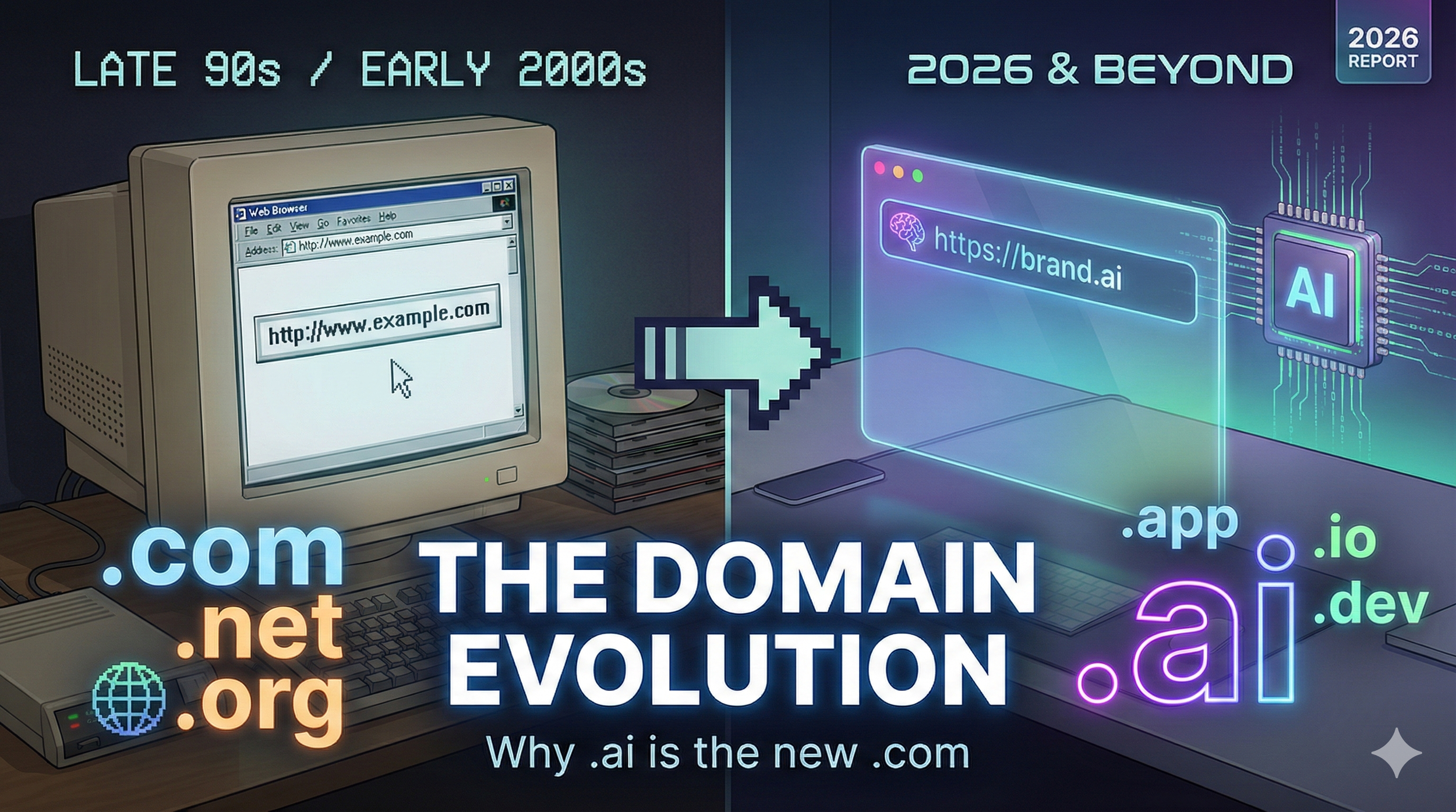
If you built websites in the late 90s or early 2000s, the world felt simple:
serious businesses used .com
networks/ISPs and tech services often used .net
nonprofits used .org
In 2026, the internet looks different. The “default” is still .com, but we’re in an era where new domain endings are normal — and .ai has become one of the most desirable.
So where did all these domains come from, and why does the hype cycle keep shifting?
1) The origin story: domain names were built to replace IP addresses
The Domain Name System (DNS) was created so humans could use names like example.com instead of remembering numeric IP addresses.
Very early internet naming was practical, not branding-driven. The idea was: create a structured namespace so organizations could register memorable, unique names.
That structure eventually became two big categories:
Top-level domains (TLDs) like
.com,.net,.orgCountry code TLDs (ccTLDs) like
.uk,.de,.ro
2) Where .com, .net, and .org came from
The classic domains (.com, .net, .org) are part of the original “generic” top-level domains created in the early DNS era.
.com
Short for “commercial.”
It was intended for businesses and commercial entities, but it quickly became the general-purpose default — because people remembered it easily and it sounded like “the internet.”
.net
Short for “network.”
Originally for network providers, ISPs, and infrastructure-related organizations. In practice, it became the “second choice” when .com wasn’t available.
.org
Short for “organization.”
Often associated with nonprofits, communities, and mission-driven organizations (even though anyone can register it).
In the late 90s and early 2000s, if you wanted to look legitimate online, .com was the gold standard. If you couldn’t get the .com, you either paid for it, changed your name, or settled for .net.
That era created a lasting mental model:
“Real companies have a .com.”
And honestly, that’s still partly true.
3) Why .com dominated the late 90s and early 2000s
1) The dot-com boom trained everyone’s brain
The boom wasn’t just financial. It created a cultural default:
startups = .com
online business = .com
websites = .com
2) There were fewer alternatives
Back then, your mainstream options were basically:
.com
.net
.org
country domains
There wasn’t a huge menu of modern endings like .app, .dev, .io, .xyz, etc.
3) Trust and memorability
People typed addresses manually more often. If your name ended in .com, users guessed it correctly.
This matters less today (Google, social links, app stores), but it still matters for direct navigation and brand trust.
4) The “new TLD” era: the internet got more endings
Over time, the internet expanded from a handful of TLDs into hundreds.
That shift created a new branding behavior:
use a domain ending that signals your category
use an ending that matches your product (like
.appfor apps)use a shorter or cleaner name when .com is taken
Some examples:
.iobecame popular in tech/startups.devbecame popular with developers.appbecame common for consumer apps.xyzbecame a default “startup” alternative in some circles
This is the era where the domain ending becomes part of the brand, not just plumbing.
5) So why is .ai hot in 2026?
Here’s the simple reason:
“.ai” instantly communicates “AI company.”
It’s brand positioning in one character.
Why founders like it
the .com version of their name is often taken or expensive
.ai feels modern and category-aligned
it can make a startup look “current” even before people understand what you do
Why marketers like it
Because it’s a shortcut in crowded feeds:
you see
.aiand your brain expects AI
Why it’s exploding now
AI moved from “feature” to “platform shift.”
So owning the “AI identity” became valuable in the same way owning a .com identity was valuable in 1999.
6) The important nuance: .ai is a country domain (not a generic one)
This surprises a lot of people:
.ai is actually a country-code domain.
It became popular because “AI” is a perfect acronym for artificial intelligence — not because it was designed for tech.
(And that’s part of the trend: tech adopts domains for meaning, not geography.)
7) Should you choose .com or .ai today?
Here’s a practical decision framework:
Choose .com when:
you want maximum trust with non-technical audiences
you’re building a mainstream brand
you’re doing long-term marketing where “default guessability” matters
Choose .ai when:
your product is clearly AI-forward
the .com is unavailable or overpriced
you want category signaling and modern positioning
The best strategy for serious companies:
If you can afford it: own both.
Use one as the primary domain and redirect the other.
That way you get:
the trust of .com
the signaling of .ai
protection from copycats and confusion
The takeaway
.com, .net, and .org are legacy pillars from the early DNS era, and .com became the default through habit, trust, and the dot-com boom.
The web expanded into many new domain endings, making the TLD part of branding.
.ai is hot in 2026 because it’s a clean, global signal: “we’re an AI product.”
Domain endings are now identity. In the early internet, they were just infrastructure.