
How Many Programmers Are There Globally? (By Continent, with Real-World Data)
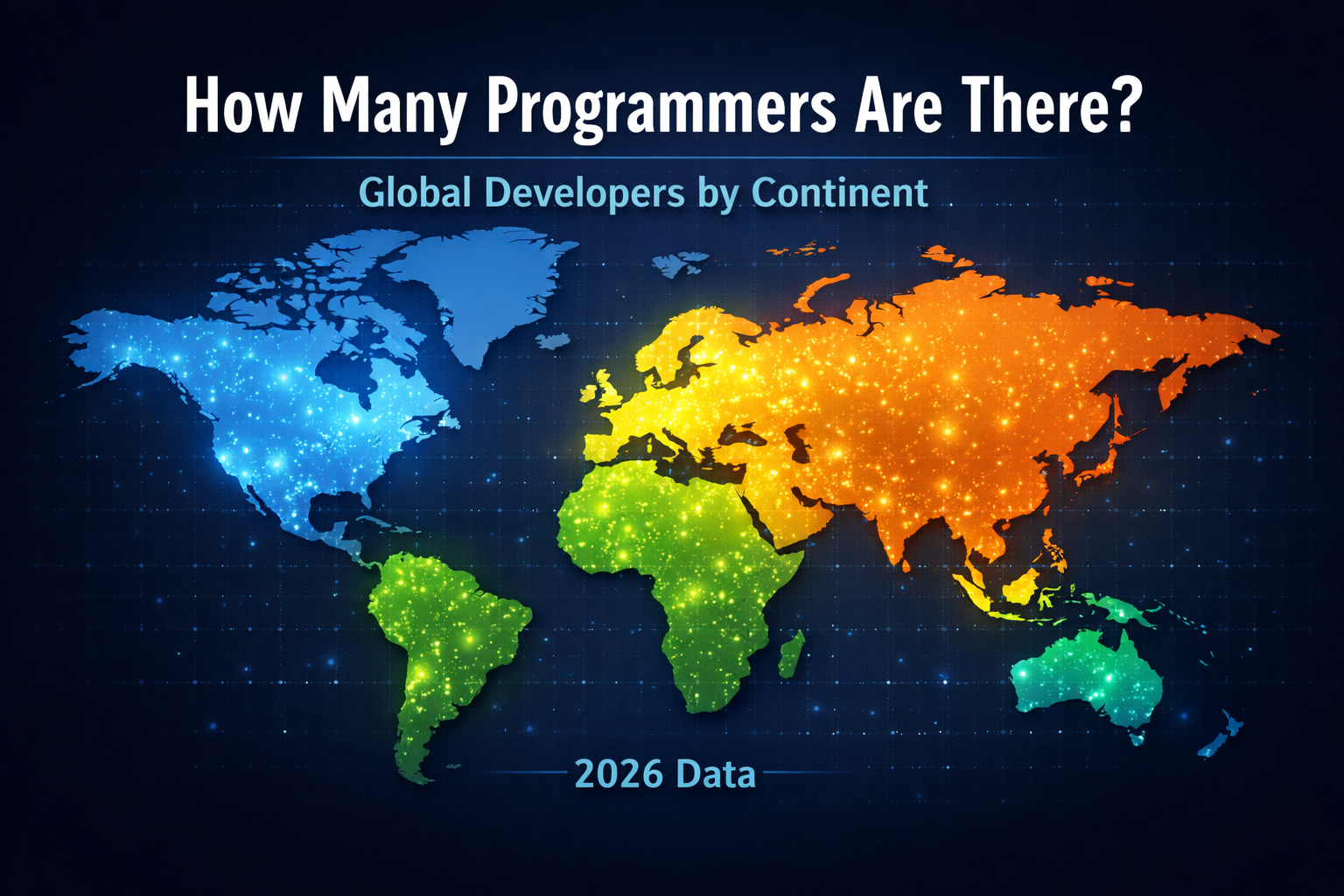
“How many programmers exist?” looks like a simple question – until you try to measure it.
Different research firms use different definitions:
“Developers / programmers” (broad): includes professionals and people who build software as part of school, side projects, low-code/no-code workflows, or occasional coding.
“Professional developers” (narrow): people who code as a primary job.
That’s why you’ll see different totals across reputable sources – and why a perfect continent-by-continent split is harder than it sounds.
The best global estimate (latest published)
One of the most cited global developer studies estimates:
Around 48 million developers worldwide (late 2025)
Around 47 million developers worldwide at the beginning of 2025
For a 2026-facing article, a realistic and safe headline is:
Roughly 50 million developers globally (high 40-millions range).
A second perspective: “professional developers” (smaller total)
Another well-known developer population report focuses more on professionals and estimates:
About 27 million professional developers worldwide (2024)
This number is much lower because it excludes students, hobbyists, and people who code occasionally or as part of another role.
Developers by continent (what can be stated confidently)
Publicly available regional data clearly identifies several large regions:
North America – ~9.5 million
Western Europe – ~9.5 million
South Asia – ~7.5 million
Greater China – ~5.8 million
South America – ~3.4 million
These figures are published as regions, not perfect continent splits. However, they allow us to construct a conservative continent-level view.
Developers by continent (minimum confirmed numbers)
| Continent | Developers (minimum confirmed) | Notes |
|---|---|---|
| North America | ~9.5 million | Fully included |
| South America | ~3.4 million | Fully included |
| Europe | ~9.5 million+ | Western Europe only; other European regions not included |
| Asia | ~13.3 million+ | South Asia + Greater China only |
| Africa | Not separately disclosed | Part of global remainder |
| Oceania | Not separately disclosed | Part of global remainder |
The “+” symbol is important. Europe and Asia are definitely larger than these minimums, but public summaries don’t always split every sub-region cleanly.
What about Africa and Oceania?
When you subtract the explicitly published regional numbers from the global total, you’re left with roughly 11–12 million developers worldwide that belong to:
Africa
Oceania
Eastern Europe
Southeast Asia
East Asia (excluding Greater China)
Middle East
Because these areas are grouped together in public summaries, Africa and Oceania can’t be cleanly isolated without paid datasets.
Where developer growth is happening fastest
While North America and Western Europe remain very large and mature markets, the fastest growth over the last few years has come from:
South Asia, nearly doubling in size since the early 2020s
Greater China, with rapid expansion across platforms and ecosystems
South America, driven by remote work, outsourcing, and startup growth
This trend shows that global software development talent is becoming more geographically distributed than ever.
Why these numbers matter
Hiring and outsourcing
Developer population size strongly affects:
Hiring costs
Talent availability
Remote and nearshore strategies
North America and Western Europe offer deep specialization but higher costs. South Asia and South America provide rapidly growing talent pools with increasing experience levels.
The definition of “programmer” is changing
Modern software teams include:
Traditional engineers
Platform specialists
Automation builders
Low-code and no-code contributors
That’s why broader “developer” counts are rising faster than strictly professional coding roles.
Summary (numbers you can quote safely)
~50 million developers worldwide (broad definition, 2025–2026 range)
~27 million professional developers worldwide
North America: ~9.5M
Europe: ~9.5M+
Asia: ~13.3M+
South America: ~3.4M
Africa & Oceania: included in global remainder, not cleanly separated