
How Social Media Influencers Make Their Money (Beyond “Platform Ads”)
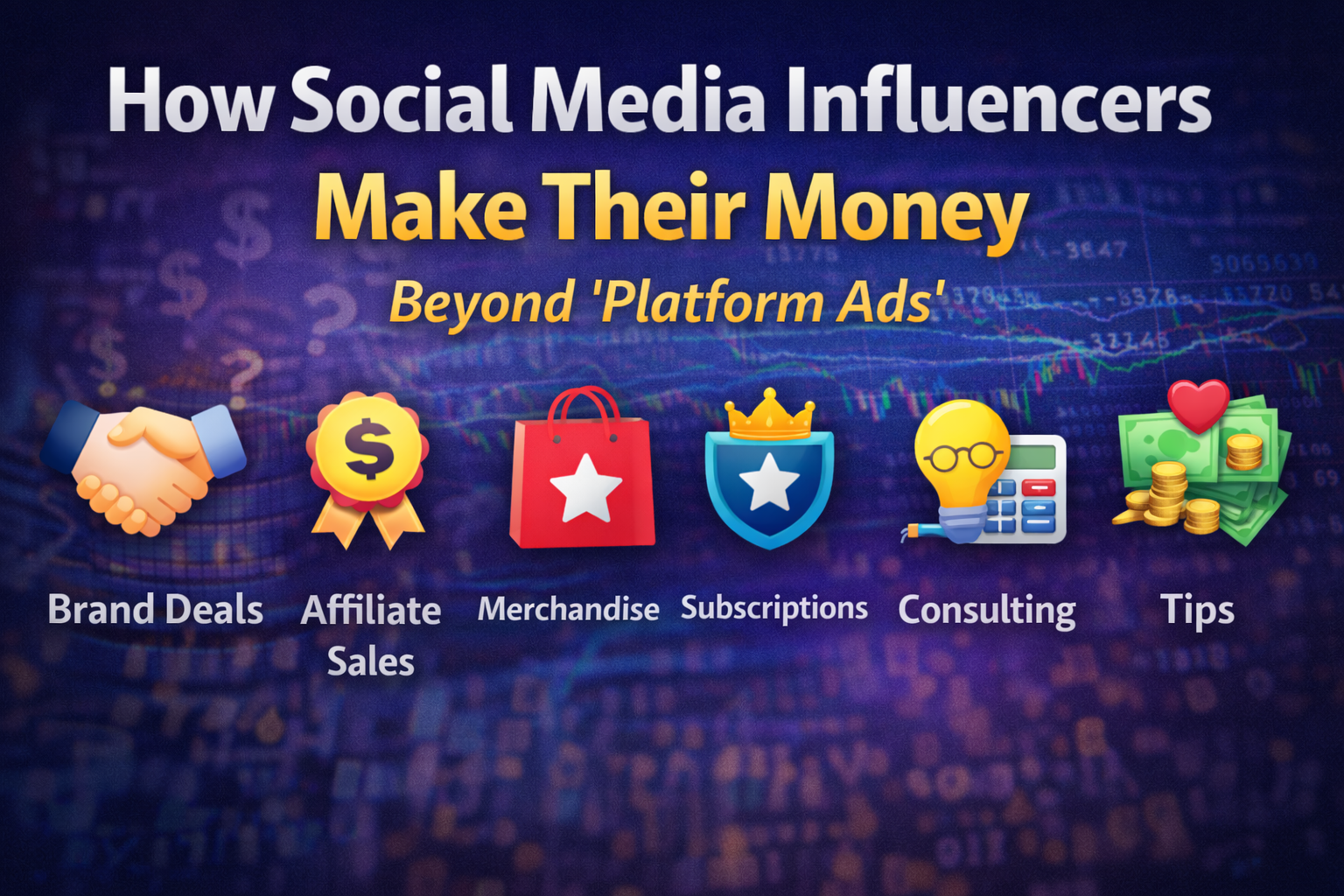
Most people think influencers make money mainly from YouTube ads or platform payouts.
In reality, for many creators, ads are only one line item—and often not even the biggest one.
Influencers are basically running a media business + personal brand, and they monetize attention through multiple “revenue layers,” some of which are far more predictable than ad revenue.
Below is a complete, practical breakdown of how influencers actually make money today.
1) Brand deals and sponsorships (the biggest one for most creators)
This is the classic “paid collaboration,” but it’s broader than people think.
Common formats:
Dedicated posts (Instagram/TikTok)
Integrated segments (YouTube sponsor reads)
Story packages (3–10 frames)
UGC-style ads (creator makes content the brand runs as paid ads)
Livestream shoutouts
“Takeovers” and event appearances
Why brands love it:
They buy trust and distribution.
The creator provides a “native” message that looks like content, not an ad.
What determines price:
Niche + audience buying power
Performance history (clicks, conversions)
Content quality and production effort
Usage rights (organic post vs paid advertising rights)
2) Affiliate marketing (commission per sale)
Affiliate is when creators earn money when someone buys via their link or code.
How it works:
A brand gives a tracking link or coupon code.
Creator earns a commission (often 1%–30% depending on category).
Where it’s strongest:
Software/SaaS tools
Online courses
Amazon-style product recommendations
Skincare, supplements, fitness gear (high volume)
Why creators like it:
It scales without renegotiating each month.
It can become “semi-passive” if the content ranks on search or keeps circulating.
3) Selling their own products (the real leverage)
This is where influencers can make serious money because they keep most of the upside.
Examples:
Courses, workshops, coaching programs
E-books, templates, Notion packs, design assets
Fitness programs, meal plans, training apps
Merch (shirts, hats, accessories)
Physical products (private label brands)
Why it’s powerful:
They’re no longer renting income from brands.
A strong creator can turn attention into a brand with repeat customers.
4) Subscriptions and memberships (recurring revenue)
Recurring revenue is the dream because it’s stable and predictable.
Common membership models:
Patreon-style memberships
Private communities (Discord, Circle, Slack)
Paid newsletters (Substack-style)
“Premium tier” content and behind-the-scenes
Member-only Q&A calls or office hours
What makes it work:
A clear “ongoing value” promise (education, community, accountability, early access).
5) UGC creation (paid content that isn’t posted on their own channel)
This is one of the biggest “quiet” income streams now.
A creator may have a small audience but still get paid well to produce content for brands.
UGC is basically:
The influencer acts like a production studio.
The brand runs the content as ads on TikTok/Meta/YouTube Shorts.
Why it pays:
Brands need endless creative variations for ad testing.
Great UGC can outperform polished commercials.
6) Licensing and usage rights (getting paid again for the same content)
Influencers often charge extra for:
The brand using the video in paid ads
Whitelisting (brand runs ads through the creator’s handle)
Using content on the brand’s website, email campaigns, Amazon listings
Geographic exclusivity (no competing brand sponsorships)
This is where deals go from “$X for a post” to “$X + rights + exclusivity.”
7) Creator funds and platform programs (not “ads,” but still platform money)
Even without classic ads, platforms may pay creators via:
creator funds,
bonuses,
“performance pools,”
live gifts and tipping systems.
This varies wildly by platform and changes often, which is why creators don’t like relying on it as the main income source.
8) Fan payments, tips, and livestream gifts
Some platforms have built-in monetization:
tips,
gifts,
paid stickers,
“send stars” style mechanics,
livestream gifting.
Where it works best:
creators with strong parasocial connection,
consistent livestream presence,
entertainment/interactive formats.
9) Speaking, appearances, and event fees
Influencers are increasingly treated like:
entertainers,
educators,
niche experts.
They get paid for:
conference talks,
hosting brand events,
workshops,
meetups,
brand trips (sometimes paid, sometimes comped).
10) Consulting, coaching, and done-for-you services
Many “business/tech” creators monetize their credibility by selling services:
coaching
consulting retainers
audits
implementation
agency services
This is extremely common with:
marketing creators,
finance creators,
fitness creators,
productivity creators,
dev/tech creators
It’s basically: audience → trust → high-ticket service.
11) Revenue share and equity deals (the highest upside, rare but real)
Bigger creators sometimes negotiate:
revenue share on a product line,
equity in a startup,
affiliate + guaranteed minimum,
“co-founder-style” partnerships.
This happens when the creator can move serious demand and is willing to attach their brand long-term.
12) Building “media assets” that pay long after posting
This is the most underrated part.
Creators who understand distribution build assets that keep earning:
YouTube evergreen videos
Blog posts that rank on Google
TikTok videos that resurface
Pinterest pins
Email lists that convert repeatedly
Influencing becomes less about “daily posting” and more about building a library of compounding content.
The influencer money stack (simple model)
Think of it like layers:
Attention (views, followers, reach)
Trust (relationship + credibility)
Monetization layers
Brand deals (cash now)
Affiliate (cash per sale)
Products (high margins)
Subscriptions (recurring)
Services (high ticket)
Licensing/equity (leverage)
Most successful influencers don’t pick one.
They combine 3–6 streams so they’re not dependent on one algorithm or one brand.
Practical takeaway
If you want to understand an influencer’s real business model, don’t ask:
“How many followers do they have?”
Ask:
“What do they sell?”
“Do they own the customer relationship (email/community)?”
“Do they have recurring revenue?”
“Can they turn content into product demand?”
That’s the difference between:
a creator who posts,
anda creator who runs a business.