
How We Ended Up With Software (and Where We Go Next)
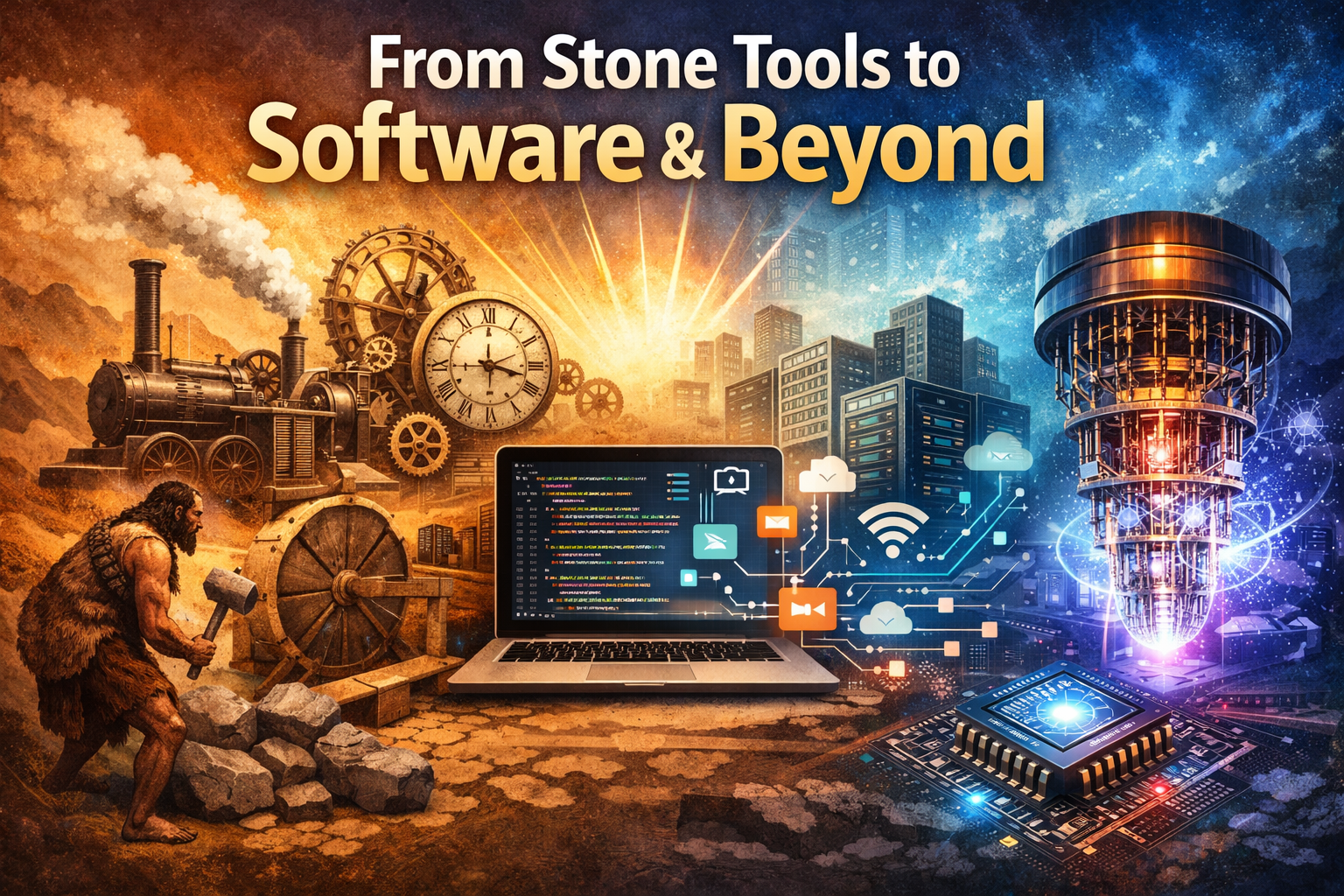
Software didn’t suddenly appear. It’s the result of thousands of years of humans learning how to control force, then precision, then automation, then logic, and finally information—at massive scale.
1) The first engineering: force, leverage, and repeatability
Before writing, math, or machines, humans were already engineers.
Early tools like sharpened stones, ropes, wedges, and ramps solved practical problems by:
increasing force
improving efficiency
making outcomes predictable
This is the core idea behind all engineering: turning chaotic reality into repeatable results.
Simple machines: the first abstraction layer
Levers, pulleys, screws, wheels, and inclined planes were the first standardized components. They allowed humans to reuse solutions instead of reinventing them every time.
This mindset—reusable building blocks with predictable behavior—is exactly how modern software libraries and frameworks work.
2) Precision changes everything: mechanical systems and time
Mechanical clocks: controlling systems through structure
Mechanical clocks were revolutionary not because of timekeeping, but because they required:
precise gears
stable oscillators
controlled energy release
The escapement mechanism transformed continuous motion into discrete, predictable steps. This idea—breaking a continuous process into controlled states—is conceptually very close to how digital systems work today.
3) The Industrial Revolution: power, automation, and feedback
Scalable power
Steam engines removed human and animal limits. For the first time, machines could deliver consistent power at scale.
This allowed factories, transportation systems, and production lines to emerge.
Feedback loops: machines that self-correct
One of the most important ideas in system design appeared here: feedback.
Mechanical governors automatically adjusted engine speed by monitoring output and correcting input. This is the ancestor of:
thermostats
cruise control
automated manufacturing
modern monitoring and autoscaling in software systems
Feedback is what turns machines into systems.
4) Logic becomes mechanical
Boolean logic: thinking in true and false
In the 19th century, logic was formalized mathematically. Ideas like true/false, AND/OR, and logical rules became algebraic expressions.
This was the moment when reasoning itself became something you could model, not just perform mentally.
Logic meets hardware
Once engineers realized that logical states could be represented by electrical switches, computing stopped being theoretical and became physical.
This was the bridge from abstract reasoning to real machines.
5) Digital computers: programmability is born
Instructions as data
One of the biggest breakthroughs was the idea that instructions could live in memory just like data. Instead of rewiring machines, you could change behavior by changing stored instructions.
This is the foundation of modern computing.
Early electronic computers
Early electronic computers proved that complex calculations and logical operations could be done far faster than any human or mechanical system.
They were expensive and large—but they worked.
6) The silicon acceleration: scale changes everything
Transistors replace vacuum tubes
Transistors made computers:
smaller
faster
cooler
more reliable
This turned computing from a laboratory experiment into an industry.
Integrated circuits
Putting many components onto a single chip made mass production possible. Performance increased while costs dropped.
Microprocessors
Once a full CPU fit onto one chip, computers could be embedded anywhere. At this point, hardware stopped being the differentiator.
Software became the value.
7) Software becomes the product
Naming the discipline
By the late 1950s and 1960s, “software” and “software engineering” emerged as real concepts because systems had become too complex to manage informally.
This led to:
programming languages
operating systems
databases
networking
structured development practices
Networking changes everything
Once computers connected, software stopped being a static artifact and became a living system:
always running
constantly updated
shared across the world
This is where services, platforms, and cloud computing originate.
8) Modern software systems: systems of systems
Today’s software is rarely “just code.” It’s an ecosystem:
distributed services
cloud infrastructure
automation pipelines
monitoring and observability
security layers
AI-assisted development
We recreated the Industrial Revolution digitally:
standardized components
automated workflows
massive scale
extremely low marginal cost
9) What comes next: quantum and beyond
Quantum computing
Quantum computers promise new classes of computation that are impractical on classical machines. The main challenges remain:
stability
error correction
scalability
Progress is real, but practical, general-purpose quantum computing is still a long-term story.
Preparing for quantum impact
Even before quantum computers are widespread, software systems are adapting:
post-quantum cryptography
new security models
hybrid classical-quantum research
Classical computers still have a long future
The most realistic next decade is about pushing classical computing further:
specialized accelerators
better memory architectures
energy-efficient designs
massive parallelism
smarter software orchestration
Hardware will keep improving, but software will remain the main multiplier.
Final takeaway
We ended up with software by repeating the same pattern for thousands of years:
Build tools
Standardize components
Improve precision
Add feedback
Formalize logic
Scale manufacturing
Move value up the stack
Software is simply the most flexible layer we’ve ever built.
And whatever comes next—quantum computing, new hardware paradigms, or something we haven’t named yet—the winners won’t just have better machines. They’ll have better systems, better tooling, and better ways for humans to work with complexity.