
Project Genie: Google DeepMind’s “World Model” Just Became a Real Web App (What It Means for Interactive Media)
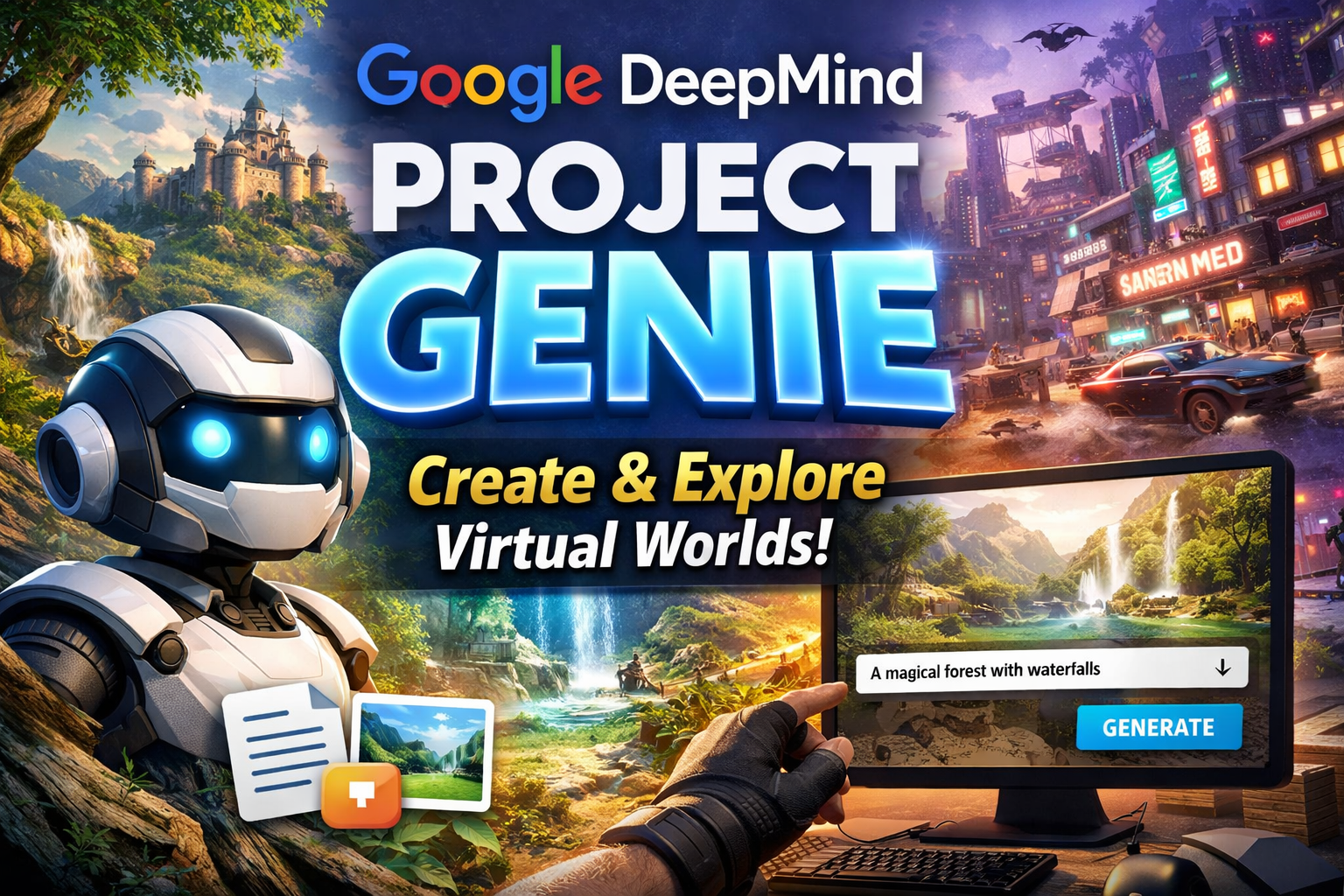
On January 29, 2026, Google started rolling out Project Genie — an experimental prototype that lets people create and explore interactive worlds directly from text prompts or images. Access begins with Google AI Ultra subscribers in the U.S. (18+), with broader availability planned over time. (blog.google)
This matters because it’s a glimpse of the next shift in generative AI: not just images or videos, but worlds you can move through.
What is Project Genie?
Project Genie is a prototype web app in Google Labs, built on top of Genie 3 (Google DeepMind’s “world model”). It lets you:
Sketch a world using text + images (uploaded or generated),
Explore it in real time while the path ahead is generated as you move,
Remix other worlds by building on their prompts,
And download videos of your exploration.
Google describes it as a research prototype with known limitations (world realism, controllability/latency), and a hard cap of 60 seconds per generation in the current product experience.
What is a “world model” (in normal language)?
A world model is AI that tries to simulate an environment: how it changes over time, and what happens when you take actions inside it.
Google’s framing: world models predict how the environment evolves and how actions affect it.
The key difference vs. typical “3D generation” is that it isn’t just producing a static scene — it’s trying to produce an environment that stays coherent as you navigate.
Genie 3: the engine behind Project Genie
Google DeepMind introduced Genie 3 as a general-purpose world model that can generate interactive environments from text, navigable in real time at 24 FPS, with “a few minutes” of consistency at 720p resolution.
Project Genie is basically the “hands-on” product wrapper around that research — so more people can actually try the concept instead of just watching demos.
How Project Genie actually works (the 3 core modes)
Google breaks the experience into three actions:
1) World sketching
You prompt with text and/or images to create an expanding environment. You can define the style of exploration (walking, flying, driving) and choose camera perspective (first-person / third-person).
2) World exploration
As you move, the system generates what’s ahead in real time, and you can adjust the camera while traversing. (blog.google)
3) World remixing
You can take an existing world and “branch” it by changing prompts and constraints, which is a big deal for iteration (think: version control for interactive scenes).
Current limitations (this is important)
Google is very clear that this is early and imperfect:
Worlds may not look fully true-to-life or obey physics perfectly.
Character control can be inconsistent and/or laggy.
The prototype currently limits generations to 60 seconds.
Independent hands-on reporting also describes the experience as impressive but not “game-quality” yet, highlighting input lag, inconsistency, and the strict time limit.
Why this matters for web developers and digital products
If you build websites, landing pages, product experiences, or interactive marketing — Project Genie is a signal of where the web is going:
1) Interactive content becomes as easy as “prompt → publish”
For years, the web went:
text → image → video → interactive
We’re now seeing the early shape of:
prompt → interactive world
Even if Project Genie itself stays limited, the direction is clear: interactive media is becoming “generatable,” not just “buildable.”
2) New category: “Playable landing pages”
Imagine:
A product demo you can walk through,
A real estate listing you can explore as a world,
A travel page that becomes a mini experience,
An education page that turns into an interactive scene.
Today, those require 3D pipelines, assets, dev time, and QA. World models hint at a future where this becomes faster, cheaper, and far more experimental.
3) Previsualization for creators (and agencies)
Even now, Google positions this tech as relevant to animation/film pre-viz, education, and robotics research. (blog.google)
For agencies: faster ideation loops, mood-boards that you can “step into,” and interactive pitch concepts.
What to watch next (practically)
If you’re tracking this as a builder, the big questions aren’t “is it perfect?” (it’s not). The questions are:
Do sessions become longer than 60 seconds?
Does controllability improve enough to support real interactions?
Do we get export formats beyond video (e.g., assets, meshes, scenes)?
Do browsers become the default runtime for these experiences?
Because once those change, interactive AI stops being a novelty and starts becoming a real distribution channel.
Bottom line
Project Genie is not the finished product. But it is a public, browser-based preview of something bigger: AI moving from generating media to generating environments.
If you build digital experiences, it’s worth paying attention — because the moment “world generation” becomes reliable and exportable, the web’s idea of content will expand again.