
The Biggest News in Tech in 2025 (and why it mattered)
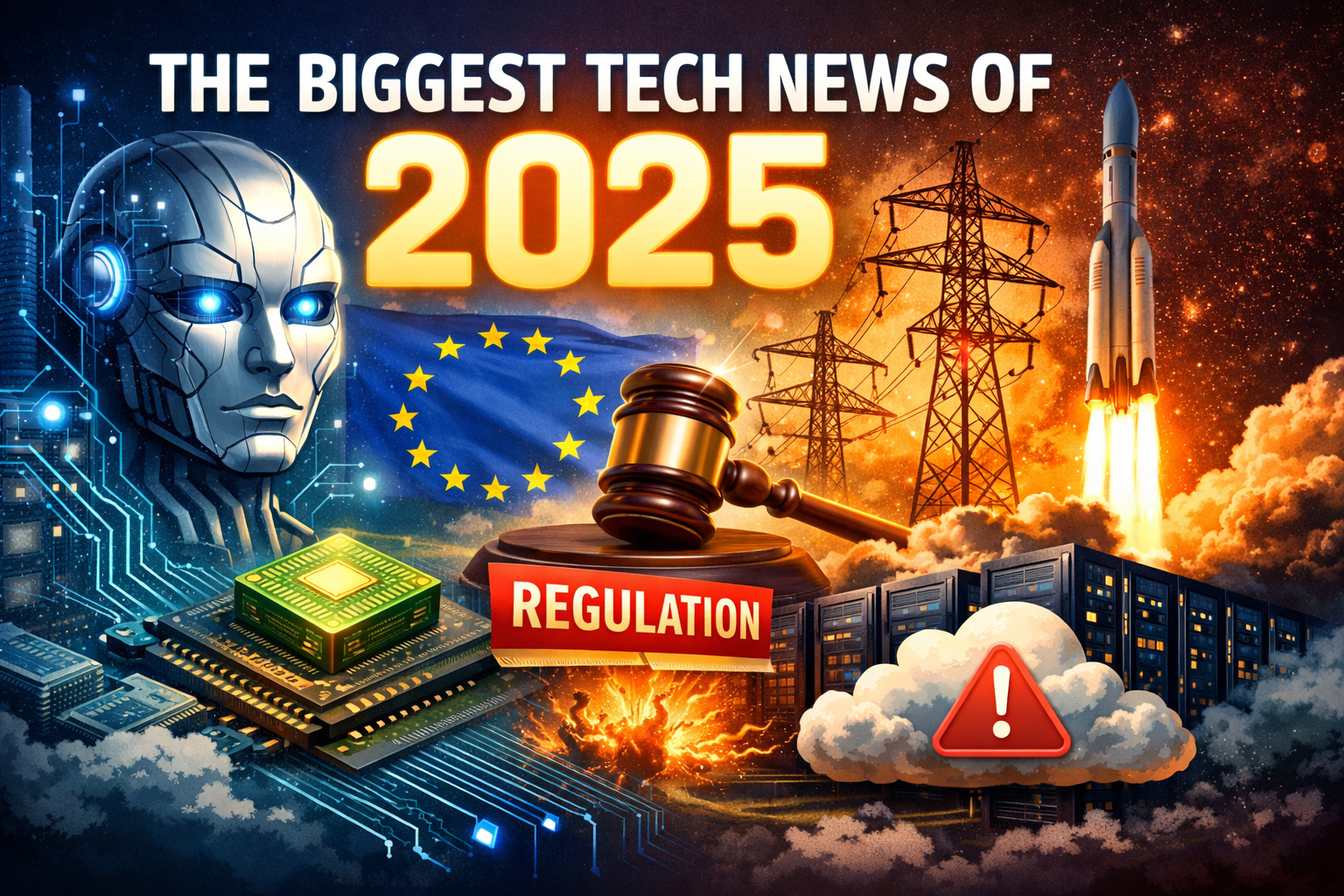
1) AI stopped being “a feature” and became the platform
In 2025, AI moved from “chatbots and demos” to default infrastructure inside products. Agentic workflows, tool-calling, and systems that could actually execute tasks started to define competitive advantage.
A clear signal was the release of GPT-5 and later GPT-5.2, which pushed longer-context reasoning and more reliable “do-the-work” behavior. At the same time, image and video generation accelerated rapidly, with big players openly racing toward next-generation multimodal systems.
What it meant for builders: AI integration stopped being about adding a chatbot. It became about redesigning entire user flows—search, support, onboarding, operations—around AI that actively performs work.
2) “Vibe coding” went mainstream and changed expectations
Describing software into existence—at least prototypes, internal tools, and MVPs—became normal in 2025. This massively increased speed, but also introduced fragility when teams skipped fundamentals like testing, architecture, and security.
The result was a split market: fast, cheap output on one side, and expensive, high-confidence engineering on the other.
What it meant for clients: some projects became cheaper overnight, while “boring engineering” (reliability, scalability, compliance) became more valuable than ever.
3) Regulation caught up to AI and Big Tech—especially in Europe
2025 wasn’t the year regulation finished; it was the year it started to apply in real life.
Europe enforced new AI rules, including bans on certain practices, mandatory AI literacy requirements, and obligations for general-purpose AI systems. Large platforms also faced increased scrutiny under digital competition and content rules.
What it meant for businesses: if you operate in or sell into the EU, “we’ll think about compliance later” stopped being a viable strategy.
4) Antitrust collided with AI distribution
A new regulatory focus emerged around who controls AI access. Messaging platforms, operating systems, search engines, and browsers became battlegrounds for default AI placement.
The debate shifted from “who has the best model” to “who controls distribution.”
What it meant: owning the interface became as important as owning the technology.
5) The biggest tech deal wasn’t social media—it was cybersecurity
One of the largest acquisitions of the year was in cloud security, signaling how critical security has become in an AI-heavy world.
What it meant: as AI increased attack surfaces and automation risks, security moved from a checkbox to a board-level priority.
6) Chips became strategy, and Intel became a geopolitical story again
Semiconductors remained central to everything: AI performance, national policy, and supply-chain resilience. Major investments and government involvement turned chip manufacturing into a strategic asset rather than just an industry.
What it meant: access to compute became a competitive advantage, not a given.
7) Energy became a first-class constraint for AI
By the end of 2025, it was obvious that the AI race is also an electricity race. Data centers demanded enormous amounts of power, pushing tech companies to secure long-term energy sources directly.
What it meant: AI growth is now limited not just by algorithms, but by grids, power generation, and infrastructure.
8) Cloud outages reminded everyone the internet runs on a few companies
Several major outages in 2025 affected large parts of the internet. This forced companies to revisit assumptions about uptime and resilience.
What it meant for product teams: redundancy, incident response, and graceful degradation became competitive features—not luxuries.
9) A massive PC upgrade cycle hit
The end of support for older operating systems triggered widespread hardware refreshes, security upgrades, and modernization efforts.
What it meant: increased IT spending, but also friction for smaller businesses and users with aging hardware.
10) Space quietly had one of its biggest years
Commercial spaceflight continued accelerating. Large rockets progressed through testing, private lunar missions advanced, and space-enabled infrastructure became more relevant to everyday tech.
What it meant: space is no longer a niche—it’s slowly integrating into mainstream technology planning.
The pattern of 2025
If 2024 was about AI shock, 2025 was about consequences.
AI ate software. Chips and energy became bottlenecks. Regulation arrived with real deadlines. And outages reminded everyone that the cloud is powerful—but not magical.
That’s why 2026 is shaping up to be about reliability, compliance, power constraints, and the real economics of deploying AI at scale.