
The Current AI “Winners” Have a Thin Moat (And 2026 Could Flip the Leaderboard)
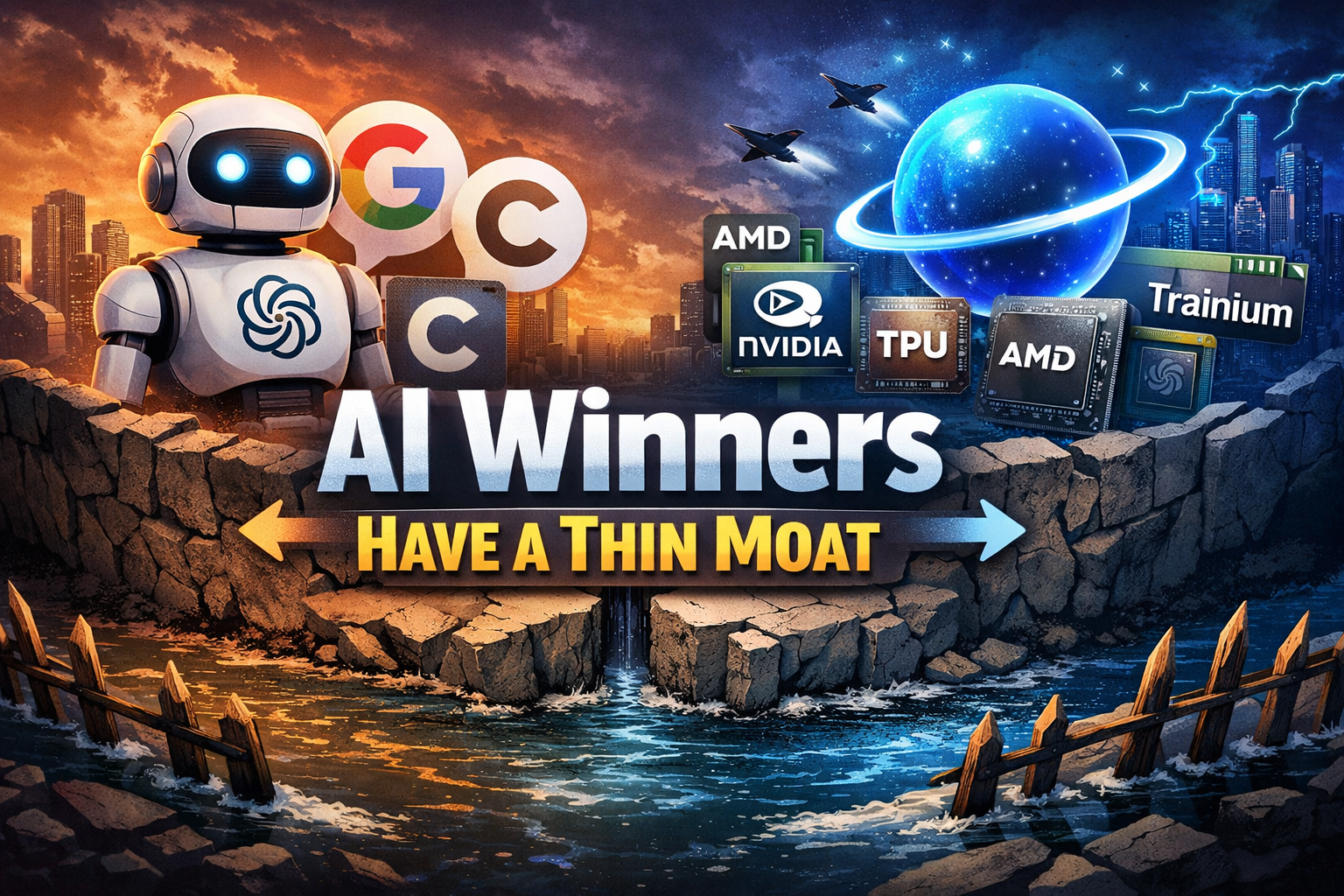
In 2024–2025, it felt like we got our “final answers” for who wins AI.
ChatGPT became the consumer default.
Claude emerged as the serious alternative, especially for coding.
Gemini positioned itself as the giant that would eventually catch up.
Cursor exploded as a breakout developer tool.
NVIDIA dominated the infrastructure layer.
But if you zoom out for a second, an uncomfortable truth appears.
Most AI winners right now have a thinner moat than they look like they do.
Not because they are bad products — but because the friction to switch is incredibly low, and the underlying capabilities are improving everywhere at once.
Why the moat is thin in AI (compared to classic software)
In traditional SaaS, moats form through things like:
Data locked inside the platform
Deep workflows and long training costs
Long-term contracts and procurement inertia
Ecosystems and integrations that are painful to rebuild
Network effects across teams and organizations
AI breaks many of these patterns.
For a large portion of users, “AI” simply means:
Open a chat
Paste a question
Copy the output
Move on
If a competitor is noticeably better or cheaper this month, there is no migration plan required. Users just open a different tab.
This does not mean AI companies have no moat — but it does mean brand leadership can disappear much faster than in previous software cycles.
The switching cost problem: the best product wins… until it doesn’t
Two forces define the current market.
Many users never truly “commit” to an AI tool
They do not store long-term data.
They do not configure complex workflows.
They do not onboard teams for months.
They simply use it.
When another model produces better answers, cleaner writing, stronger reasoning, or better code, switching is instant.
AI quality changes rapidly — and publicly
In classic software, a product can be “good” for years.
In AI, a product can be excellent in spring, average in summer, behind in autumn, and competitive again by winter.
This dynamic already played out in 2025, with visible shifts in attention and usage between major AI assistants.
What worked in 2024 or 2025 is not guaranteed to work in 2026.
Chat assistants: leadership is fragile
OpenAI built a massive consumer lead with ChatGPT. But consumer leadership is also the most fragile kind.
For an everyday user, switching costs are minimal:
A new login
Slightly different prompting
Possibly fewer or different convenience features
That is it.
At the same time, competitors have improved rapidly. Gemini made major gains in quality and distribution. Claude became a preferred option for many developers and technical users.
None of this suggests a single winner disappears. It shows that default status in AI is temporary, especially when competitors improve at similar speeds.
In 2026, the default assistant may be determined less by who launched first and more by who is embedded into daily work.
Distribution matters more than raw intelligence
Model quality matters, but distribution often matters more.
The assistant that wins is frequently the one that is:
Pre-installed
Built into email, documents, and calendars
Embedded inside the IDE
Approved by enterprise security teams
This is why platform companies are dangerous competitors. They can absorb model improvements and deploy them instantly across massive user bases.
The battle is not only about intelligence.
It is about where the AI lives by default.
Developer tools: fast winners, fragile positions
Cursor proved how quickly a developer tool can become the tool everyone talks about.
But developer tools also face intense pressure because developers already live inside ecosystems:
IDEs
Version control platforms
Cloud providers
Enterprise security environments
This allows incumbents to respond through bundling, deeper integration, and enterprise distribution.
GitHub Copilot continues expanding beyond autocomplete.
Microsoft is pushing Copilot across the entire development lifecycle.
Google is integrating Gemini deeply into developer workflows.
Anthropic’s Claude Code has become a serious daily tool for many engineers.
Cursor’s current moat is product quality, brand momentum, and timing. That is valuable — but it is not automatically durable if competitors reduce friction and bundle alternatives into existing workflows.
Hardware: even strong moats are being challenged
NVIDIA has one of the strongest moats in tech, built on software, ecosystem, and mindshare.
Yet even here, pressure is building:
AMD is becoming more competitive in specific workloads
Google is expanding TPU accessibility and compatibility
Amazon is pushing Trainium as a cost-efficient alternative
The key pattern repeats again.
When software friction decreases, hardware moats weaken.
Compatibility matters as much as raw performance.
Where real AI moats actually form
Sustainable advantages in AI tend to come from higher-level factors.
Workflow lock-in
Tools that become part of a daily loop — planning, execution, review — are harder to replace. Switching becomes a real project, not a casual decision.
Distribution control
AI embedded into operating systems, cloud platforms, enterprise suites, or IDEs can survive periods of weaker model performance.
Exclusive data with feedback loops
Not just more data, but data that competitors cannot access and that directly improves outcomes.
Enterprise trust and compliance
Security reviews, audit logs, data residency, admin controls, and predictable pricing create real friction. Consumer switching is easy. Enterprise switching is not.
Ecosystems and extensibility
When others build on top of your platform, value compounds beyond the base model.
What this likely means for 2026
Assistant leadership will remain fluid
Developer tools will consolidate around major ecosystems
AI infrastructure will increasingly be multi-vendor
Durable moats will move up the stack into workflow and distribution
The takeaway
If you are building in AI:
Do not assume today’s model advantage will last
Do not assume today’s growth is sticky
Do not confuse hype leadership with moat leadership
Build for daily workflows, strong distribution, deep integration, and measurable outcomes.
Because in AI, when switching costs are close to zero, the leaderboard is always temporary.