
Top 10 Biggest European Software Companies (Public + Private) by Value (January 2026)
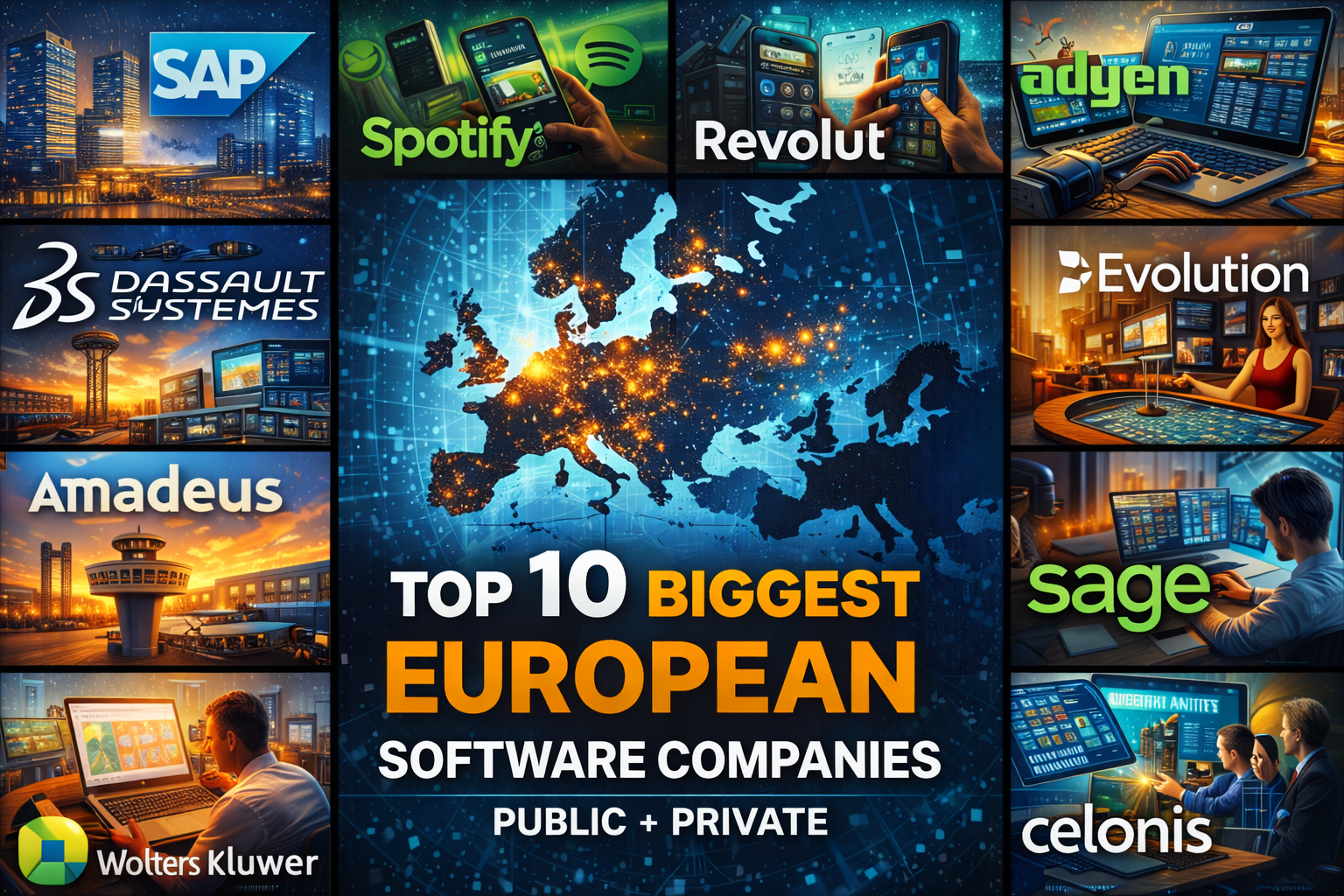
Europe doesn’t have many “social network” giants, but it does have massive software-first businesses — especially in enterprise software, fintech infrastructure, and industry / engineering tools.
This ranking combines:
Public companies (ranked by market capitalization)
Private companies (ranked by latest widely reported valuations)
All values are January 2026 snapshot-style estimates and can change over time.
1) SAP (Germany) — ~$276B (public)
SAP is Europe’s enterprise software backbone. Many of the world’s largest companies run their core operations on SAP, including finance, procurement, HR, and supply chain systems.
Why it’s so big
Extremely high switching costs; ERP migrations are risky and expensive
Long-term enterprise contracts and steady demand for digital transformation
2) Spotify (Sweden) — ~$118B (public)
Spotify is Europe’s most visible global consumer software platform, with hundreds of millions of users worldwide.
Why it’s so big
Strong daily usage habits and high engagement
Powerful personalization and discovery systems
Global distribution without hardware dependency
3) Revolut (United Kingdom) — ~$75B valuation (private)
Revolut is one of Europe’s most valuable private, software-first fintech companies, often described as a financial “super app.”
Why it’s so big
Fully digital platform with global scalability
Broad product suite across payments, banking, cards, and business accounts
Strong growth narrative and expanding user base
4) Adyen (Netherlands) — ~$52B (public)
Adyen is a major European payments infrastructure company serving large global merchants.
Why it’s so big
Unified platform for online, in-store, and mobile payments
Strong reputation for reliability, compliance, and reporting
Enterprise-focused business model with high transaction volumes
5) Dassault Systèmes (France) — ~$36B (public)
Dassault Systèmes is a leader in industrial and engineering software used to design complex products and systems.
Why it’s so big
Deep integration into engineering workflows
High switching costs and long product lifecycles
Strong presence in aerospace, automotive, and manufacturing
6) Amadeus IT Group (Spain) — ~$32B (public)
Amadeus provides the core software infrastructure behind much of the global travel industry.
Why it’s so big
Mission-critical backend systems for airlines and travel agencies
Deep integrations that make switching costly
Global footprint across travel and hospitality ecosystems
7) Wolters Kluwer (Netherlands) — ~$23B (public)
Wolters Kluwer delivers professional software and information tools for regulated industries.
Why it’s so big
Strong demand in legal, tax, accounting, compliance, and healthcare
High retention due to workflow dependence and trust requirements
Stable recurring revenue model
8) Evolution (Sweden) — ~$14B (public)
Evolution is a specialized software platform focused on live casino and gaming infrastructure for operators worldwide.
Why it’s so big
High-margin platform economics when scaled
Global B2B software distribution model
Strong operating leverage as volumes grow
9) Sage (United Kingdom) — ~$13B (public)
Sage is one of Europe’s strongest SMB software brands in accounting, payroll, and business management.
Why it’s so big
Accounting and payroll workflows are extremely sticky
Large installed base of long-term customers
Reliable recurring revenue from small and mid-sized businesses
10) Celonis (Germany) — ~$13B valuation (private)
Celonis is a private enterprise software company specializing in process mining and operational intelligence.
Why it’s so big
Software sits on top of mission-critical enterprise systems
Clear ROI for customers through efficiency and cost optimization
Strong positioning in large enterprise environments
Honorable mentions (just outside the top 10)
Nemetschek (Germany) — Architecture, engineering, and construction software
Checkout.com (United Kingdom) — Payments infrastructure platform
Klarna (Sweden) — Consumer payments and buy-now-pay-later platform
All remain major European software players by value.
What this list says about European software
Europe’s biggest software companies tend to focus on:
Mission-critical enterprise systems
Industrial and engineering workflows
Payments and financial infrastructure
Regulated professional software
Large-scale global platforms with strong fundamentals
Rather than chasing viral consumer trends, European software leadership is built on infrastructure, reliability, and deep integration.