
Upwork Went Ballistic With “Pay to Apply” Costs - And Small Freelancers Pay the Price
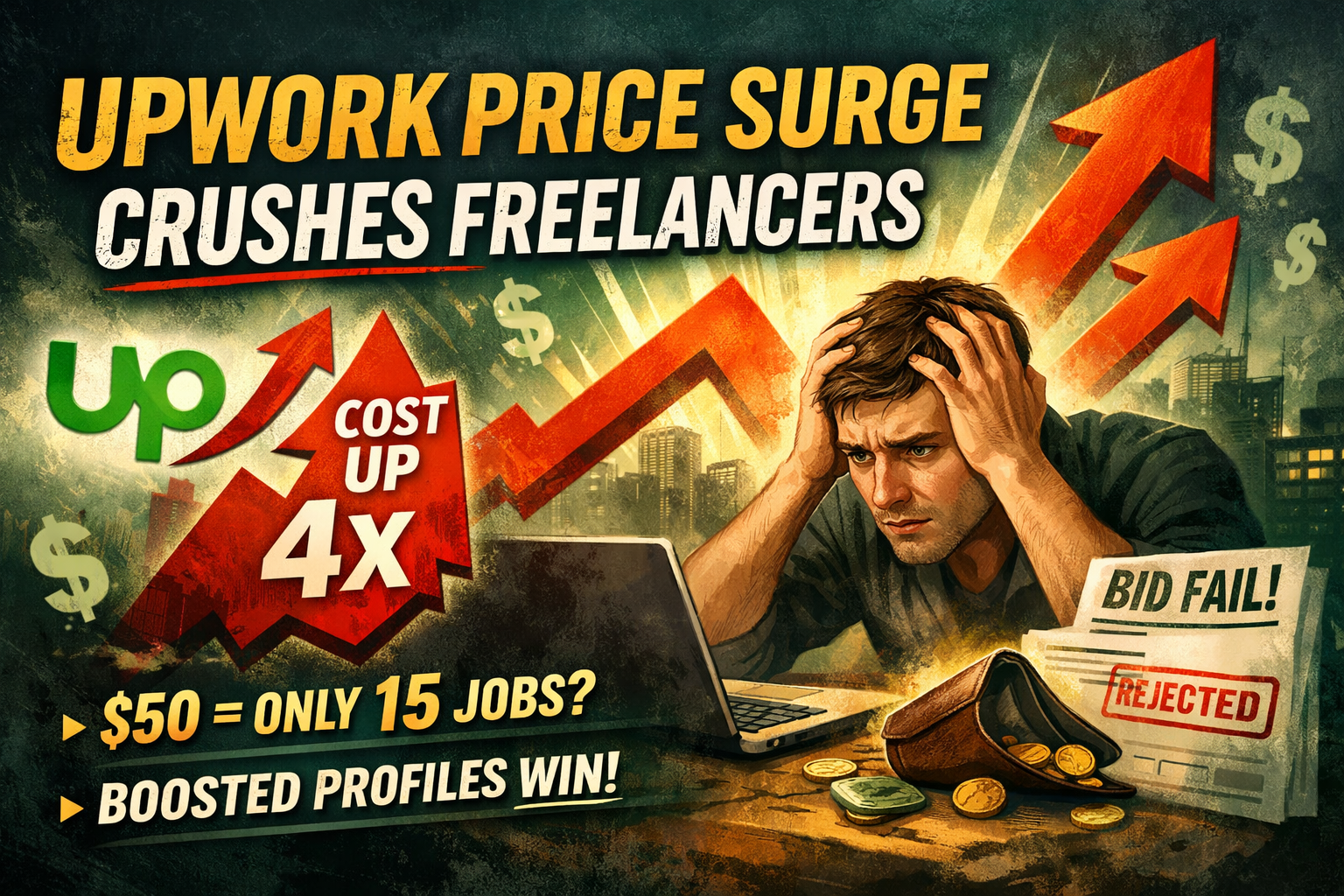
If you’ve been on Upwork long enough, you’ve felt it: applying to jobs used to be annoying, now it’s expensive.
The platform didn’t just “raise prices.” It changed the economics of getting work. The number of Connects required per application has climbed, and because Connects are paid, that translates directly into higher customer acquisition cost for freelancers.
For large agencies, this is a rounding error. For independent freelancers and small studios, it can become a serious problem—especially when a bad month hits and you need new work.
And that’s the scary part: on a marketplace, you can be one product update away from losing your ability to compete.
This article breaks down:
what changed (and why it feels like a 4x increase),
why it hits smaller freelancers harder than agencies,
why visibility inside Upwork is less “fair” than it used to be,
and what to do right now to reduce risk and build leverage.
The Real Cost of “Pay to Apply” in 2026 Freelancing
Upwork used to feel affordable to test the waters. You could apply to more opportunities, learn what works, refine your proposals, and build momentum.
Today, the same behavior gets expensive fast.
Many freelancers now experience something like this:
You spend around $50 on Connects
That may translate to roughly 15–20 job proposals
And if you’re applying to more competitive listings, that number can drop even lower
Even if your proposal quality is great, you’re still paying to earn the right to pitch. And pitching is not a guarantee of a reply.
So in a slow month, the platform can create a painful loop:
You have less revenue
You need more leads
Leads require Connects
Connects cost cash
You can’t spend aggressively
You lose visibility and volume
The month stays bad
That’s not just “expensive.” That’s structurally risky.
Why This Hurts Small Freelancers More Than It Hurts Agencies
A freelancer’s runway is smaller.
An agency with 10+ contractors can afford:
constant proposal volume,
multiple people applying,
buying Connects at scale,
and absorbing weeks with lower conversion.
A solo freelancer often cannot.
Even if you’re highly skilled, your ability to compete becomes tied to your ability to spend.
That’s the part many people miss: Upwork is increasingly a paid acquisition channel, and your “budget” matters more than your talent in the early funnel.
Upwork Wins Financially — Freelancers Lose Leverage
From Upwork’s perspective, higher Connects usage can lift platform revenue.
When Connects costs rise and more proposals are required to win work, Upwork can benefit in multiple ways:
more Connects purchased,
more “boosting” and paid visibility,
more competition kept inside the platform.
But the tradeoff is real:
the barrier to entry goes up,
small providers get squeezed,
and the platform becomes less forgiving for anyone who isn’t consistently booked.
If you’re an independent service provider, that’s a red flag.
Search Results on Upwork Don’t Feel as Fair as They Used To
There’s another layer to this problem: visibility.
When a client searches for freelancers on Upwork today, the “first page” is not purely a merit-based ranking in the way many people assume.
A common experience right now is:
A client sees 10 results on the first page
Around 3 of those are boosted (paid placement)
The other 7 appear organically
That means a meaningful portion of the most valuable real estate is effectively “rentable.”
And when you combine this with expensive Connects, you get a double-pay environment:
you pay to apply,
and you pay to appear.
If you’re a small freelancer, you’re competing not only against talent—but against budgets.
The “Bad Month” Problem: One Downturn Can Push You Out
This is the scenario that scares most serious freelancers:
You have a quiet month.
A few clients pause.
Projects end.
Pipeline dries up.
On an affordable platform, you respond by applying more aggressively.
On an expensive platform, you respond by applying less… because you can’t justify the spend.
That is how freelancers fall out of the game.
Not because they’re bad at their craft.
Because they got caught at the wrong time.
A system that punishes you for needing work is the opposite of stability.
Why This Might Be the Best Time to Build Your Own Website and Lead Engine
Upwork can still be valuable. It can still generate contracts.
But it should not be your entire business.
A platform can change:
pricing,
ranking,
rules,
visibility,
categories,
client quality,
or the algorithm that decides whether you get seen.
If your business depends entirely on that ecosystem, you’re exposed.
Building your own presence means:
you’re not one update away from losing your income,
you can generate leads without paying per pitch,
and your brand becomes an asset—not a profile page.
What “Owning Your Traffic” Actually Looks Like (Practical Version)
This doesn’t require fancy marketing or becoming an influencer.
A strong independent setup can be simple:
1) A focused website with one clear niche
Not “I do everything.”
Something like:
“Squarespace + custom code for service businesses”
“Shopify speed + CRO optimization”
“Angular front-end development for SaaS dashboards”
Clarity converts.
2) A portfolio that proves outcomes
Before/after.
Speed improvements.
Conversion improvements.
Revenue impact.
Screenshots and results.
Clients don’t buy skills. They buy confidence.
3) A discovery call funnel
A simple page:
what you do
what projects you accept
typical ranges
and a way to book or contact you
4) A small content engine
Not daily posting. Just consistent, searchable content:
“How much does a Squarespace website cost in 2026?”
“Shopify speed optimization checklist”
“When to choose Webflow vs Squarespace”
“What to ask before hiring a developer”
This builds long-term inbound leads.
Use Upwork, But Don’t Depend on Upwork
If Upwork is working for you, great—use it as one channel.
But treat it like a marketplace, not a foundation.
Because if the platform decides to increase costs again, change rankings, or tilt visibility further toward paid placements, the impact won’t be theoretical.
It will hit your cash flow.
And for small independent freelancers, cash flow is everything.
Final Thought
Upwork becoming more expensive doesn’t automatically mean it’s “bad.”
It means it’s evolving into a model where spend and visibility matter more.
If you’re a small service provider, the smartest move is not to argue with that reality.
The smartest move is to build a business that can survive it.
A personal website, a niche, and a reliable inbound lead flow can be the difference between:
surviving a slow month,
or being taken out by an update.