
Why AI Video Generation Is Much More Expensive Than Text (and Even Images) - With Veo 3.1 vs Sora 2 Pricing
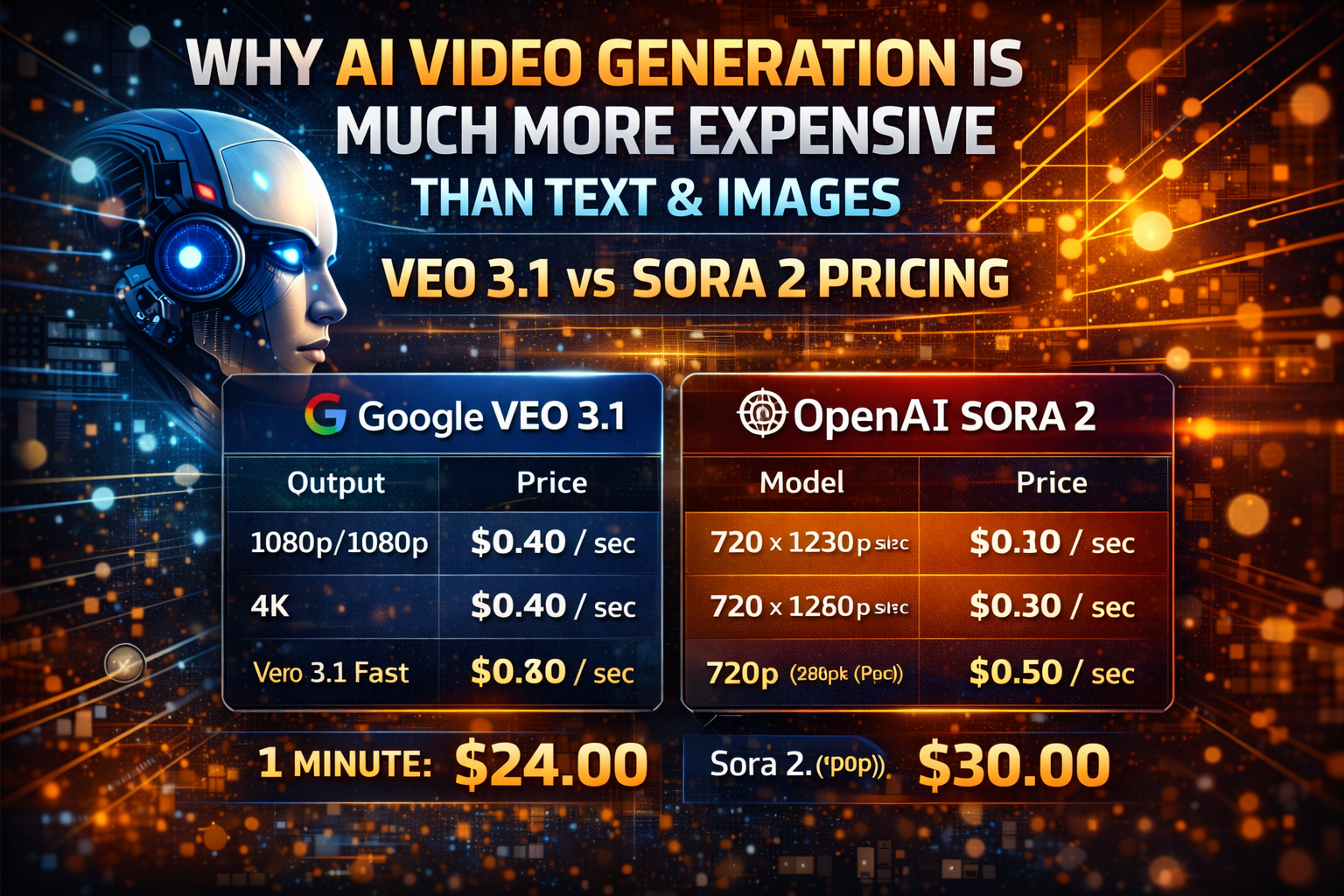
AI video feels “overpriced” until you compare what the model has to produce.
Text generation outputs a stream of tokens.
Image generation outputs one coherent frame.
Video generation must output many coherent frames in a row (plus motion, camera, lighting consistency, and often audio sync). That’s why pricing is almost always per second, not per prompt.
Below are the clearest public pricing anchors for 2026: Google Veo 3.1 and OpenAI Sora 2, split by API, regular users, and business.
1) API pricing (developers)
Google Veo 3.1 (Vertex AI / Google Cloud) — billed per second
| Veo 3.1 mode | Output | 720p / 1080p | 4K |
|---|---|---|---|
| Veo 3.1 | Video | $0.20 / sec | $0.40 / sec |
| Veo 3.1 | Video + Audio | $0.40 / sec | $0.60 / sec |
| Veo 3.1 Fast | Video | $0.10 / sec | $0.30 / sec |
| Veo 3.1 Fast | Video + Audio | $0.15 / sec | $0.35 / sec |
Notes:
“Video + Audio” means synchronized speech/sound effects and costs more than video-only.
“Fast” is cheaper and meant for iteration.
OpenAI Sora 2 (OpenAI API) — billed per second
| Model | Resolution tier | Price |
|---|---|---|
| sora-2 | 720×1280 portrait / 1280×720 landscape | $0.10 / sec |
| sora-2-pro | 720×1280 portrait / 1280×720 landscape | $0.30 / sec |
| sora-2-pro | 1024×1792 portrait / 1792×1024 landscape | $0.50 / sec |
Important:
API usage is separate billing from any ChatGPT subscription.
2) Regular users pricing (consumer subscriptions)
Consumer plans usually don’t price per second. They bundle usage into a subscription (often with limits, caps, or “fair use”).
OpenAI (Sora inside ChatGPT)
| Plan | Price | How Sora is priced for consumers |
|---|---|---|
| ChatGPT Plus | $20 / month | “Unlimited access to Sora” (subject to Terms / fair-use rules) |
| ChatGPT Pro | $200 / month | Also includes “unlimited access” (subject to Terms / fair-use rules) |
Practical meaning:
For creators, subscription access is simpler than per-second billing.
For automation, scaling, or integration, you typically move to the API.
Google (Veo inside Google AI plans / Gemini)
Google’s consumer approach is credits/points rather than per-second billing.
| Plan | Price | Monthly AI credits | Video access notes |
|---|---|---|---|
| Google AI Pro | $19.99 / month | 1,000 credits / month | Includes video generation (often “Veo 3.1 Fast” in Gemini) |
| Google AI Ultra | $249.99 / month | 25,000 credits / month | Highest limits, includes Veo 3.1 access and more |
Practical meaning:
Consumers pay a flat fee and spend credits across tools (Flow / Whisk / etc.).
Credits refresh monthly.
3) Business pricing (teams + production)
This is where “who pays what” becomes clear:
OpenAI business (seats)
ChatGPT Business is sold per seat:
| Plan | Price |
|---|---|
| ChatGPT Business (annual) | $25 / seat / month |
| ChatGPT Business (monthly) | $30 / seat / month |
Notes:
Seats cover the ChatGPT product for a team.
API usage remains separate and is billed independently.
Google business (production / integration)
For business use (apps, pipelines, product features), the clean “business price” is usually:
Vertex AI per-second pricing (the Veo 3.1 table above)
Why?
Businesses need governance, billing controls, scalability, and predictable cost-per-output.
4) Cost examples (so the “per second” reality clicks)
10 seconds and 60 seconds (1 minute)
| Option | 10 seconds | 60 seconds (1 minute) |
|---|---|---|
| Veo 3.1 1080p (video only) | $2.00 | $12.00 |
| Veo 3.1 1080p (video + audio) | $4.00 | $24.00 |
| Sora 2 (720p) | $1.00 | $6.00 |
| Sora 2 Pro (higher tier) | $5.00 | $30.00 |
That’s just generation cost. Real creator cost is often higher because you do multiple takes.
5) Why video is so much more expensive than text and images
A) Video is “many images” plus time consistency
A short clip can represent hundreds of frames. Even when models compress this internally, compute still scales with:
duration
resolution
motion complexity
temporal coherence requirements
B) Temporal coherence is a hard constraint (the “no flicker tax”)
With images, a small inconsistency is tolerable.
With video, a small inconsistency becomes visible immediately:
faces drift
logos warp
lighting jumps
objects “melt” between frames
Fixing that demands more compute, better sampling, and often multiple passes.
C) Resolution multiplies cost fast
1080p and 4K aren’t “a little more.” They’re a much larger pixel budget per frame, multiplied by time.
That’s why Veo has separate 4K pricing tiers.
D) Audio-synced video is more expensive because sync is extra work
“Video + audio” isn’t “generate audio on the side.”
If speech and sound effects must match timing and motion, the system needs tighter coordination. That shows up directly in pricing.
E) Serving and safety scanning also cost more
Even after generation, providers pay for:
encoding/transcoding
storage and CDN delivery
safety checks across frames and audio
Text is tiny. Video is heavy.
F) The hidden multiplier: iteration
Most users generate multiple versions to get one usable clip:
prompt tweaks
style changes
timing changes
camera changes
So “per second” becomes:
final seconds × cost/sec × number of takes
6) What to do if you’re building with AI video in 2026
Start with short clips (4–8 seconds)
Offer Draft vs Final modes (cheap preview, expensive render)
Use caching and reuse where possible
Add a cost meter in the UI (users trust transparency)
Budget using a takes factor (it’s the real cost driver)