
Why Microsoft Stock Dropped ~6–7% After Earnings (And What It Really Means in 2026)
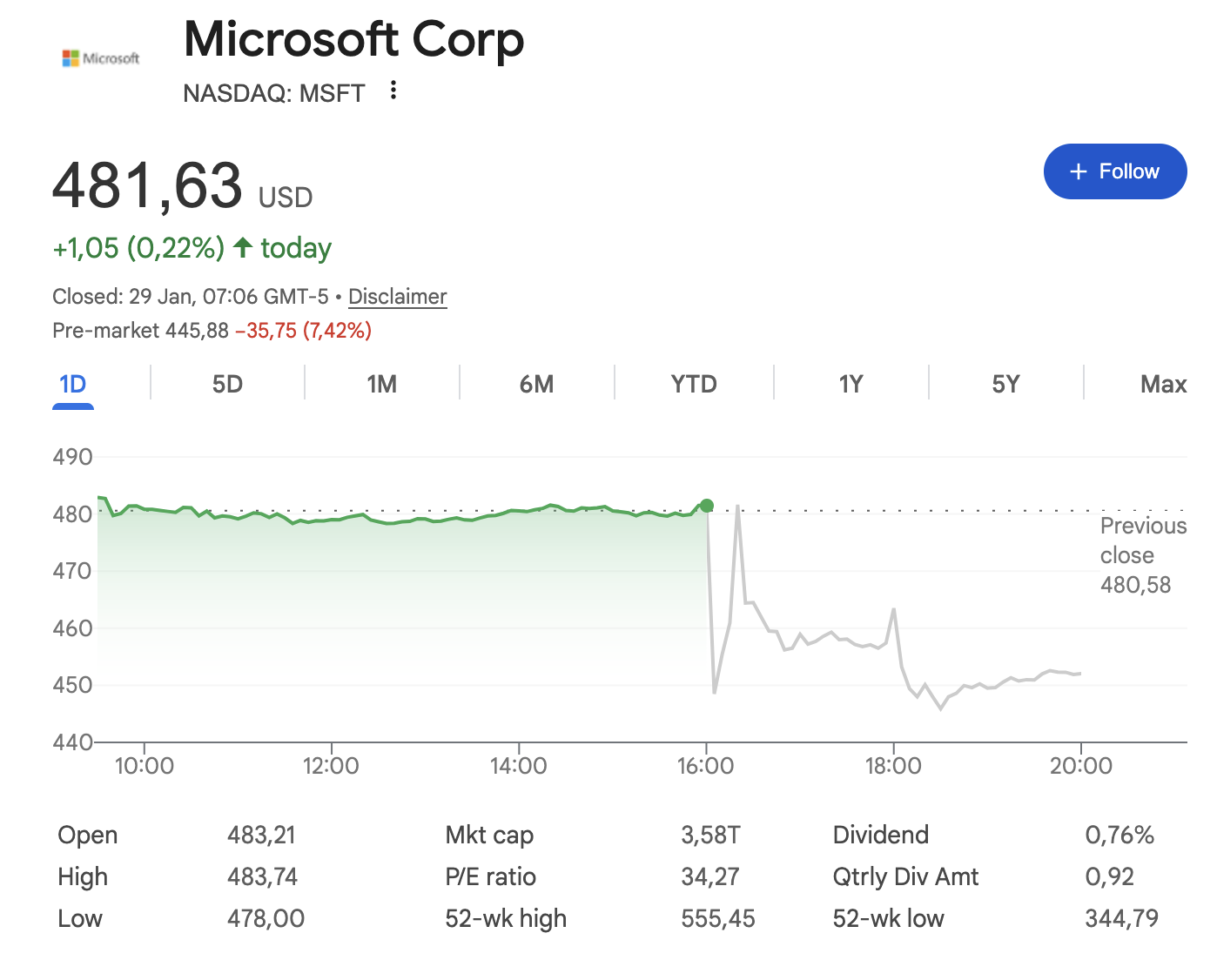
Microsoft reported a solid quarter — and the stock still fell about 6–7% right after the earnings announcement (the reaction showed up most clearly in after-hours trading on January 28, 2026, spilling into the next session for many brokers).
That confuses people the first time they see it:
“If results were good… why did the stock drop?”
Because markets don’t reward “good.” They reward “better than what was already priced in” — especially for a mega-cap that investors treat like a “safe AI + cloud compounder.”
Here’s what was going on — in plain English — and why it matters even if you’re not trading.
1) The quarter wasn’t the problem — the forward story was
When a company like Microsoft moves 6–7% in a day, it’s rarely because revenue or EPS were “bad.”
It’s usually one of these:
Guidance wasn’t exciting enough for how expensive the stock already was.
A key growth engine slowed, even slightly.
Costs jumped (or are expected to jump), raising margin/ROI questions.
The call’s tone hinted at “amazing future” but “messy near-term.”
This drop was that exact pattern.
2) Azure cloud growth “barely met” expectations (and that’s enough to spook investors)
Microsoft’s cloud business (especially Azure) is the engine investors watch most closely.
So even if Azure is still growing fast, a small deceleration or a “met, not beat” print can trigger a selloff when the market was hoping for a clean upside surprise.
That’s because Microsoft’s valuation assumes:
Azure keeps compounding strongly,
AI demand translates into durable cloud revenue,
and the growth curve stays smooth.
Any wobble in that narrative gets punished.
3) Record AI/data-center spending triggered margin anxiety
Microsoft has been spending aggressively on AI infrastructure:
data centers,
GPUs/accelerators,
networking,
and the entire stack required to serve AI workloads at scale.
Investors can love the strategy and still sell the stock because heavy CapEx usually means:
near-term margins get pressured
and it’s harder to model when the payoff shows up cleanly in profits
In other words, the market asked:
“How much do we have to spend to get this growth — and how long until it becomes high-margin?”
If the answer feels “more” and “longer” than expected, the stock drops.
4) “Earnings beat” doesn’t matter if expectations were already huge
Mega-caps often get into a “priced for perfection” zone.
So you can have:
strong revenue,
an EPS beat,
and optimistic long-term commentary…
…and still drop because the market was positioned for a bigger beat, stronger guidance, or cleaner Azure momentum.
This is why you’ll hear traders say:
“It was a good quarter, but not good enough.”
“Great company, expensive stock.”
“Sell the news.”
5) AI competition raised the bar for proof of payoff
The AI narrative is no longer “Microsoft has AI.” Everyone has AI.
The real question investors now ask is:
Is AI monetization showing up in a predictable, profitable way?
Or is it still mostly infrastructure spend + early adoption?
Any hint that the monetization curve is less immediate pushes investors to be cautious — especially when spending is accelerating.
What this means for founders, teams, and web/product builders
Even if you don’t care about stock charts, this 6–7% drop signals something important about the tech environment in 2026:
A) The AI era is an infrastructure era (and it’s expensive)
AI isn’t just “a feature.” It’s compute, pipelines, deployments, security, data governance, and cost control.
For builders, that translates into:
building leaner,
optimizing infra,
measuring ROI early,
and avoiding “AI bills” that quietly explode.
B) Cloud growth is still strong — but buyers are more selective
Enterprises are scrutinizing:
cloud spend,
utilization,
redundancy,
and vendor lock-in.
So “cloud-first” isn’t dead — it’s becoming “cloud-smart.”
C) If Microsoft is feeling margin pressure, smaller teams must be ruthless about efficiency
What Microsoft does at scale (CapEx, GPU allocation, massive infrastructure) shows where costs are going.
Founders and product teams should respond by:
doing cost-per-feature thinking,
using AI where it saves time and money,
and staying disciplined on architecture choices.
A simple mental model for the drop
Think of it like this:
Microsoft delivered a good quarter.
But investors wanted a cleaner “AI → Azure → profit” story.
Instead they got: “AI → huge spending → payoff later (maybe).”
That gap between expectation and clarity is what creates a sudden 6–7% move.
Bottom line
This wasn’t “Microsoft is failing.”
It was the market saying:
“Azure needs to keep accelerating.”
“Show me AI payoff faster.”
“Spending is rising — prove the margins come back.”
Microsoft can still be winning while the stock corrects — especially after a big run-up and sky-high expectations.
Sources I used to ground the facts (earnings reaction + drivers)
Reuters reporting on the ~6%+ after-hours drop, slower cloud growth, and record AI spending. (Reuters)
Additional coverage echoing Azure expectations vs reality and the capex/margin concern framing. (Yahoo Finance)
Microsoft’s official earnings page (for the earnings event reference). (Microsoft)