
Why We Saw Dramatic Technological Improvements in the Past 100 Years
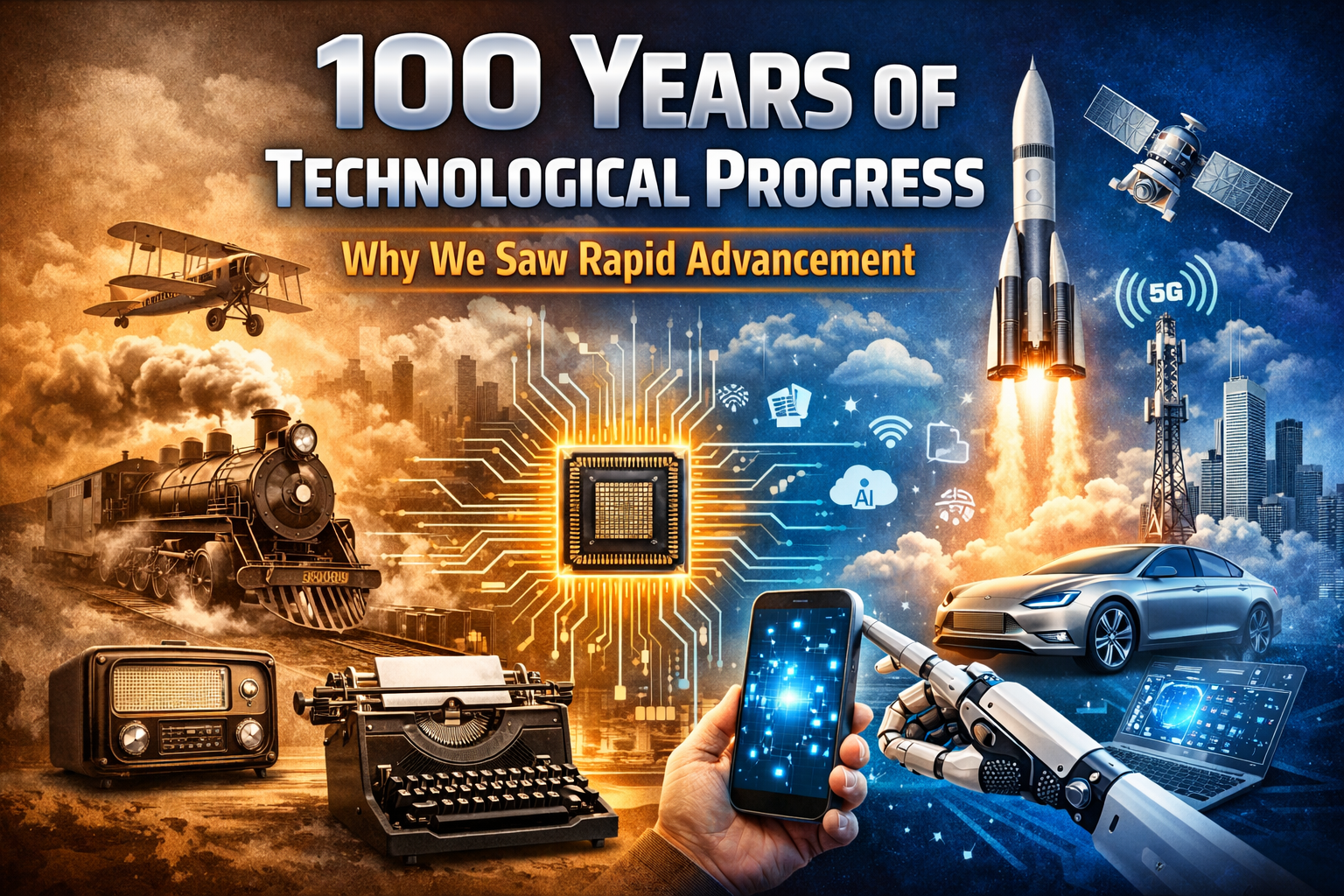
If you zoom out and compare daily life in 1926 vs 2026, it looks almost unreal: electrified cities, antibiotics, jets, satellites, computers, the internet, smartphones, cloud software, and now AI systems that can generate text, code, images, and plans.
That “overnight” feeling is misleading. The past century wasn’t magic - it was a set of reinforcing feedback loops that made progress compound.
Below is the practical explanation of why technology accelerated so hard, and why it often feels exponential.
1) Compounding knowledge is real (and it stacks forever)
The most important driver is simple:
New inventions are built on top of old inventions.
Once a discovery is written down, taught, standardized, and turned into tools, it becomes “free leverage” for the next generation.
That creates compounding effects:
Better tools → faster research
Faster research → more discoveries
More discoveries → better tools (repeat)
This is why progress can look slow for decades and then suddenly explode - the “invisible foundation” finally gets thick enough to support rapid building.
2) We learned how to mass-produce innovation, not just invent it
Earlier eras had brilliant inventors, but the last 100 years industrialized the whole process:
research labs
engineering teams
quality control
supply chains
standard parts
repeatable manufacturing
global distribution
The world didn’t just get smarter - it got better at turning ideas into reliable products at scale.
A prototype is one thing. A technology that can be manufactured billions of times is what changes civilization.
3) Semiconductors created an “exponential engine”
If there’s one reason the last 100 years feel so extreme, it’s this:
Computation became cheap, tiny, and everywhere.
Two key milestones:
The transistor (1947) replaced bulky, fragile vacuum tubes and enabled reliable switching at scale. (CHM)
The integrated circuit (late 1950s) put multiple components onto one chip, making it realistic to scale complexity massively. (Wikipedia)
Then came the compounding “rule of thumb” that organized an entire industry:
Moore’s Law: transistor counts on chips historically doubled on a predictable cadence, with big cost/performance benefits. (Newsroom)
Even when the classic pace slowed, the mindset remained: keep pushing cost down and capability up.
This is why computing became a universal multiplier:
your phone is a computer
your car is a computer
your TV is a computer
your thermostat is a computer
factories, logistics, and finance are computers
And the data behind it is not subtle - transistor counts grew by orders of magnitude over time. (Our World in Data)
4) Software is “infinitely replicable,” so it scales faster than physical tech
A physical invention often has constraints:
materials
shipping
manufacturing
maintenance
Software is different:
build once
copy forever
distribute globally in minutes
update continuously
That’s why the “software era” (roughly 1980s onward) feels like acceleration compared to earlier industries.
Once you had cheap computers, software became the fastest way to create new value.
5) Networks turned progress into a global group project
Before global networks, knowledge transfer was slow:
books
letters
conferences
local institutions
With the internet, knowledge became:
searchable
shareable
copyable
remixable
And bandwidth itself has followed a compounding trend over decades (often summarized by rules like Nielsen’s Law). (Nielsen Norman Group)
This matters because faster communication doesn’t just entertain people - it accelerates coordination:
open-source ecosystems
global engineering teams
instant documentation
online education at scale
rapid iteration via user feedback
6) Standardization unlocked interoperability (and interoperability unlocked scale)
A huge portion of “progress” is boring but critical:
voltage standards
shipping containers
TCP/IP and internet protocols
file formats
APIs
USB and wireless standards
programming languages and frameworks
Standards let different parts of the world build compatible pieces.
That means:
lower friction
bigger markets
more competition
faster iteration
Progress accelerates when you’re not reinventing the interface every time.
7) Competition (markets + geopolitics) poured fuel on the fire
The last century had intense competition on multiple levels:
companies competing for customers
nations competing for security and influence
scientific prestige and industrial leadership
That pressure created:
funding
urgency
talent pipelines
“move faster” cultures
Many foundational technologies were heavily accelerated by government-backed research and wartime urgency, then later became civilian platforms.
8) Education scaled up, and so did specialization
A modern smartphone, chip, or cloud platform is not “one invention.”
It’s thousands of specialties working together:
materials science
manufacturing engineering
RF design
OS development
UI/UX design
security engineering
distributed systems
battery chemistry
supply chain optimization
Over the last 100 years, more people gained access to education, and industries built training pathways. That increased the number of specialists who could push the frontier.
9) Technology improvements don’t just add - they multiply each other
The real acceleration comes from cross-multiplication:
Better chips → better software
Better software → better design tools
Better tools → better chips
Better networks → better collaboration
Better collaboration → faster R&D
Faster R&D → new industries
That’s why progress often arrives in waves:
electrification wave
automotive + aviation wave
electronics wave
computing wave
internet wave
mobile wave
cloud wave
AI wave
Each wave becomes the platform for the next.
10) Why it feels especially dramatic in the last 30–40 years
People often say “tech barely changed for centuries, then everything changed.” That’s partly because:
human life became deeply dependent on information systems
information systems improve faster than physical systems
software-based products update continuously
smartphones put “the frontier” into everyone’s pocket
So the last few decades weren’t necessarily the first time technology advanced rapidly - but they were the first time it became personal, constant, and visible.
A quick timeline of “compounding moments” (1926 → 2026)
Not exhaustive, but it shows the stacking effect:
Mass electrification + industrial manufacturing maturity (early 1900s)
Antibiotics and modern medicine scaling (mid 1900s)
Transistor era begins (1947) (CHM)
Integrated circuits enable modern computing scale (late 1950s) (Wikipedia)
Semiconductor scaling culture forms (Moore’s Law era) (Newsroom)
Personal computing spreads (1970s–1990s)
Internet + global networking becomes mainstream (1990s–2000s)
Smartphones + app economies (late 2000s–2010s)
Cloud + SaaS + global developer platforms (2010s)
AI models + automation layers built on top of cloud + data + chips (2020s)
Each step makes the next step cheaper and faster.
The practical takeaway: progress accelerates when you build on platforms
If you’re building a business or product in 2026, the playbook is the same as the last 100 years:
choose platforms with compounding (cloud, APIs, AI tooling, distribution)
standardize what you can
automate what repeats
ship, measure, iterate
build systems that make the next version easier than the last
That’s how the world got from radio to smartphones in a century - and it’s how modern companies move faster than ever today.