
Finding the Right Squarespace Developer or Designer Isn’t as Easy as You Might Think
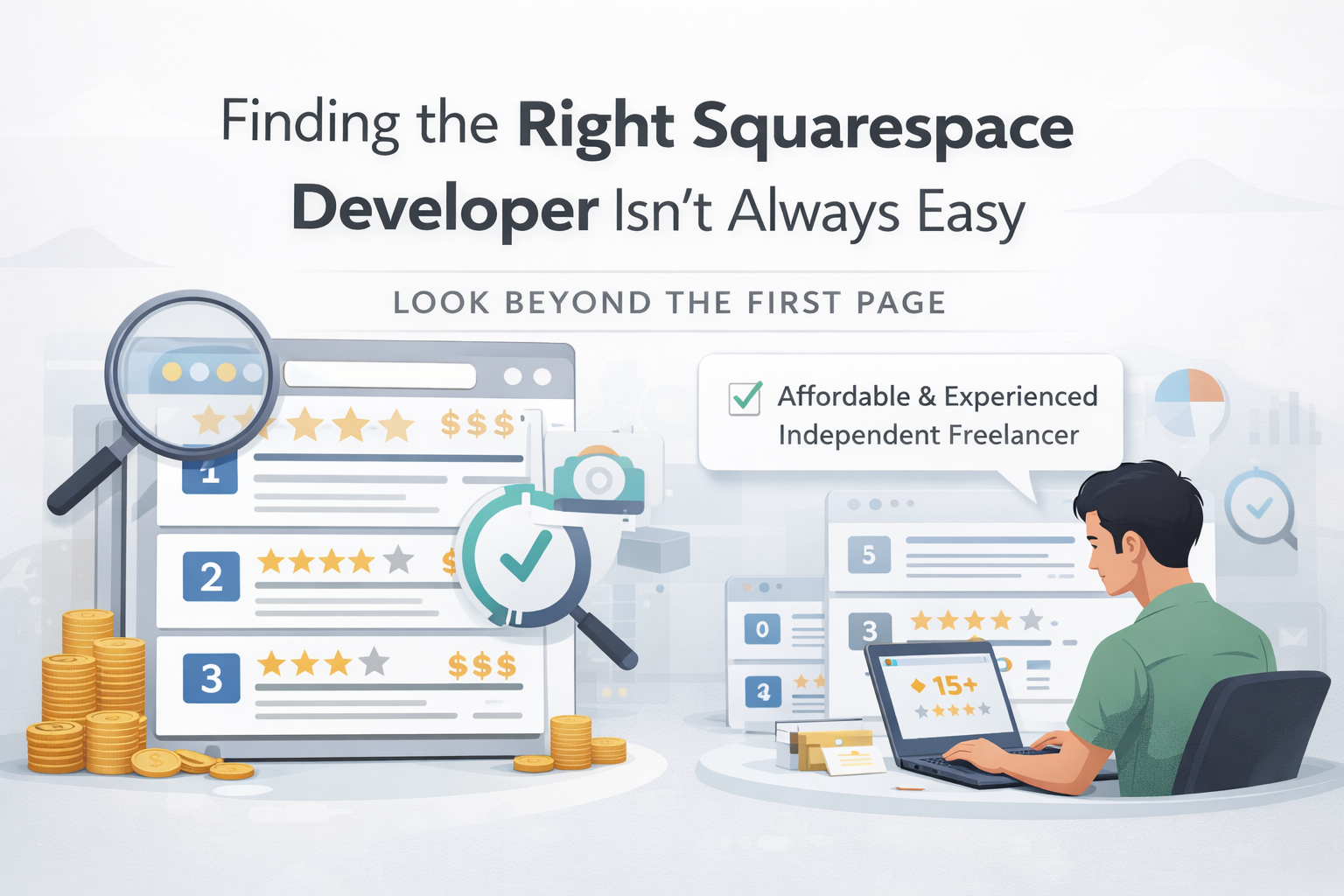
If you’ve ever tried hiring a Squarespace expert, you’ve probably had this experience:
You search “Squarespace designer” or “Squarespace developer,” click the first few results… and immediately land on big agencies with big teams and big prices.
That doesn’t mean they’re wrong. It just means the search results are biased toward companies that can afford to dominate them.
And that creates a real problem:
A smaller agency—or an individual Squarespace expert—might actually be the perfect fit for your project, at a better price-to-quality ratio… but you might never see them.
Let’s break down why this happens, and what you can do to find great Squarespace talent without overpaying.
Why the “first page” is often not the best page
1) Large agencies can afford visibility
The top spots in Google results usually go to companies that invest heavily in:
SEO over many years
large content teams
backlinks and PR
paid ads and retargeting
strong domain authority
They’re not “better” by default. They’re just more visible.
And visibility often comes with higher overhead:
account managers
sales calls
internal project handoffs
bigger margins to support the business structure
That overhead can be fine if you’re a bigger company. But if you’re a small business, it can mean paying more than you need.
2) Great smaller experts struggle to get noticed
A newer agency or a solo Squarespace specialist can deliver incredible work—sometimes better than a large agency—because:
you work directly with the person doing the work
fewer handoffs, fewer miscommunications
faster decisions
more flexibility
often stronger attention to detail (because reputation matters a lot)
But they don’t always rank high, because ranking high is its own game.
Freelance platforms don’t fix this anymore (they often make it worse)
A lot of business owners think:
“Okay, I’ll just go to Upwork / Fiverr and pick a Squarespace expert there.”
That used to be a great shortcut.
But today, there’s a big hidden issue: platform economics.
Upwork is more expensive for freelancers than it used to be
On Upwork, freelancers often pay to:
apply for jobs (Connects)
apply competitively (boosting proposals)
appear higher in search (paid visibility options)
Over time, this has created a “pay to be seen” environment.
So the freelancers you see first aren’t always the best fit.
They may just be the ones paying the most to show up first.
That doesn’t mean Upwork is bad—it just means you need to search smarter.
The simple strategy most people skip: look past page one
Here’s the practical advice that works:
1) Don’t stop at the first page of Google results
The first page is often:
large agencies
premium pricing
very polished marketing
less flexibility
If you want better value, go to:
page 2
page 3
sometimes even page 4
That’s where you start finding:
small agencies
independent developers/designers
specialists with lower overhead
people who are hungry to earn trust and deliver
2) Start conversations (don’t just compare websites)
A website portfolio can look great… and still not tell you:
how they communicate
how long delivery takes
how they handle feedback
what happens when something breaks
whether they actually understand your business goals
So your goal should be to initiate a few short conversations and quickly compare:
Experience (years on Squarespace, types of clients)
Fit (have they built something similar to your project?)
Process (discovery, design, build, QA, launch)
Timeline (realistic delivery time)
Price (fixed vs hourly, what’s included)
Support (post-launch support / training)
A 10-minute call can reveal more than an hour of browsing portfolios.
How to get value without risking quality
Here’s a good “value-first” approach:
Shortlist 5–7 candidates
Don’t aim for 1. Aim for options.
2 from the first page (premium agencies)
3–5 from page 2–3 (smaller agencies, solo experts)
Ask the same 5 questions to everyone
This makes comparison fair:
What similar Squarespace projects have you done?
What’s your typical timeline for a site like mine?
What do you need from me to start?
What’s included in your price (and what’s not)?
What happens after launch (support, edits, training)?
You’ll quickly spot who is:
experienced and clear
vague and salesy
rushed or overloaded
a great communicator (often the best sign)
Bonus: where else to look (besides Google and Upwork)
If you want options outside the “pay to be seen” ecosystem:
search on LinkedIn (filter by “Squarespace” + your country/timezone)
check Squarespace-related Facebook groups (lots of specialists)
look at smaller agencies on Instagram/Behance/Dribbble (then verify reviews)
ask for referrals in local business groups
The key is the same: start conversations.
The bottom line
Finding a great Squarespace developer/designer is hard today because:
big agencies dominate page one
freelance platforms increasingly reward paid visibility
quality doesn’t always correlate with ranking
But you can beat the system by doing one simple thing:
Look past the first page, shortlist a few smaller experts, and start conversations.
That’s often how you find the best “price-to-quality” fit.