
Is a Squarespace Website a Good Fit for Your Business? Start With Your Goals
Is a Squarespace Website a Good Fit for Your Business? Start With Your Goals
Squarespace can be an excellent platform—or the wrong platform—depending on what you’re trying to achieve.
Most “Squarespace vs X” debates miss the point. The real question is:
What are your business goals for the website?
Because a website isn’t just design. It’s sales, credibility, lead generation, speed, SEO, and long-term maintenance.
Below is a practical decision framework you can use in 10 minutes to figure out whether Squarespace is the right fit for your business.
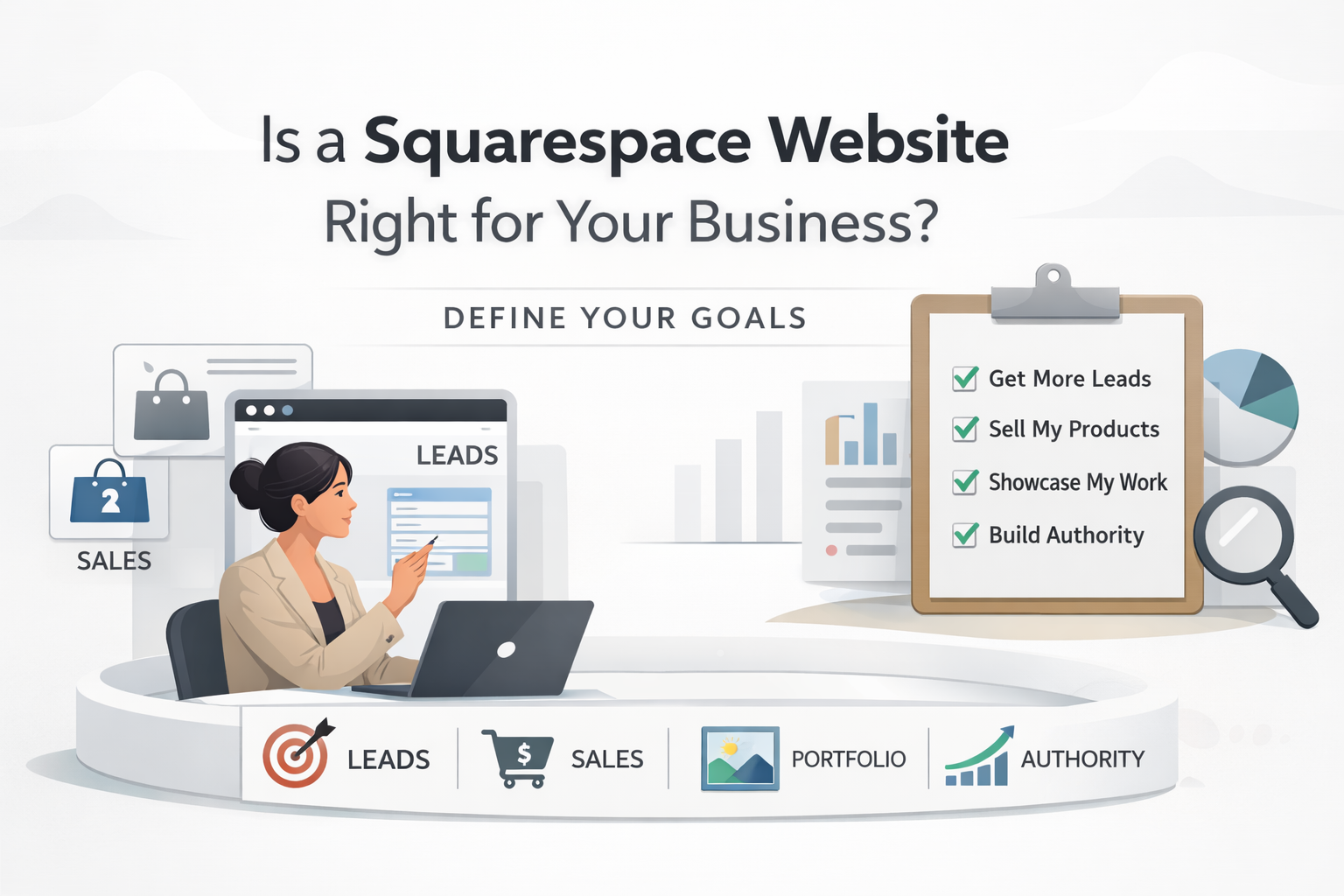
Step 1: Define your #1 goal (don’t skip this)
Pick the main job your website must do:
Generate leads (book calls, request quotes, contact forms)
Sell products (physical or digital)
Build authority (brand, credibility, content, SEO)
Showcase work (portfolio, case studies, photography)
Support operations (members area, gated content, scheduling)
Move fast (launch quickly, test an idea, validate a market)
Squarespace is strongest when your goal is clarity, speed, and professional presentation—without needing a complex technical stack.
When Squarespace is a great fit
1) You want a premium-looking site without a complex build
Squarespace templates and layout tools make it easy to build a polished site that feels “high-end” quickly—especially for service businesses and personal brands.
Good fit for:
consultants, agencies, coaches
local service businesses
creators, speakers, authors
portfolios (designers, photographers, architects)
2) You want to manage content yourself (without breaking things)
Squarespace is designed for non-technical updates: text edits, images, pages, blog posts, basic SEO fields, layout adjustments.
If you don’t want to rely on a developer for every small change, that’s a big win.
3) Your website is mostly about storytelling and conversion
Squarespace shines when your site structure is something like:
Homepage → Services → About → Case Studies → Contact
That’s the classic “brand + trust + CTA” funnel, and Squarespace supports it really well.
4) You’re launching fast, testing, or rebuilding
If you need to get something live quickly and iterate, Squarespace is usually faster than custom builds or heavier platforms.
When Squarespace might NOT be the best fit
1) You need advanced ecommerce features (beyond standard needs)
Squarespace Commerce is solid, but if your store needs things like:
very advanced product variants
complex shipping rules
big catalogs with sophisticated filtering
deep integrations (ERP, warehouse, advanced subscriptions)
…then Shopify is usually a better fit.
Squarespace works great for simple-to-medium ecommerce, especially digital products and smaller catalogs.
2) You need a custom web app or complex user accounts
If your product requires:
custom dashboards
complex permissions and roles
real-time data
advanced backend logic
Squarespace isn’t built for that. You’ll want a web app stack or a platform built around accounts and data.
3) Your SEO strategy relies on large-scale content operations
Squarespace can rank well. But if you’re building a large content machine with heavy technical SEO needs (programmatic pages, advanced schema setups, custom routing), you may outgrow it.
For most small businesses, Squarespace SEO is more than enough. For aggressive SEO at scale, you might want something else.
The “Goals Checklist”: decide in 2 minutes
Squarespace is likely a good fit if most of these are true:
You need a professional site fast
Your site’s main job is lead generation, credibility, or content
You want simple editing without technical maintenance
You don’t need complex backend logic
Your ecommerce needs are simple to moderate
You want a platform that’s stable and managed
Squarespace might not be the best fit if most of these are true:
You need advanced ecommerce operations
You need a custom app-like experience
You require deep integrations and automation across tools
You expect heavy technical SEO customization at scale
A smart middle path: Squarespace + custom code (best of both worlds)
A lot of businesses are in this category:
They want the stability and simplicity of Squarespace, but also want something that feels more unique than a standard template.
That’s where custom code (HTML/CSS/JavaScript) comes in:
custom sections and layouts
better conversion-focused landing pages
advanced UI details that make the site feel premium
performance improvements (when done properly)
custom forms / tracking / integrations
This is often the sweet spot: Squarespace foundation + tailored execution.
What I recommend to most business owners
If your business is service-based and you want:
a clean, credible web presence
strong messaging and conversion
a site you can maintain yourself
and a platform that won’t become a tech headache
Squarespace is usually a strong choice.
The real differentiator isn’t “Squarespace vs WordPress vs Webflow.”
It’s:
site structure
clarity of messaging
page layout strategy
trust building (proof, case studies, testimonials)
and conversion details (CTAs, forms, speed, mobile UX)
Quick examples: “Is it a fit for me?”
Yes, Squarespace is usually a fit if you are:
a coach/consultant who needs leads
a local business needing credibility + calls
a creator or personal brand
a service business with a portfolio or case studies
a small ecommerce business with a focused catalog
Consider alternatives if you are:
a large ecommerce operation with complex needs (Shopify)
a SaaS or web app (custom stack)
a marketplace or multi-user system (custom stack)
a content giant doing heavy technical SEO at scale