
Elon Musk at Davos 2026: The 7 Big Topics He Kept Coming Back To (Robots, AI, Energy, Self-Driving, and “Life Insurance” for Civilization)
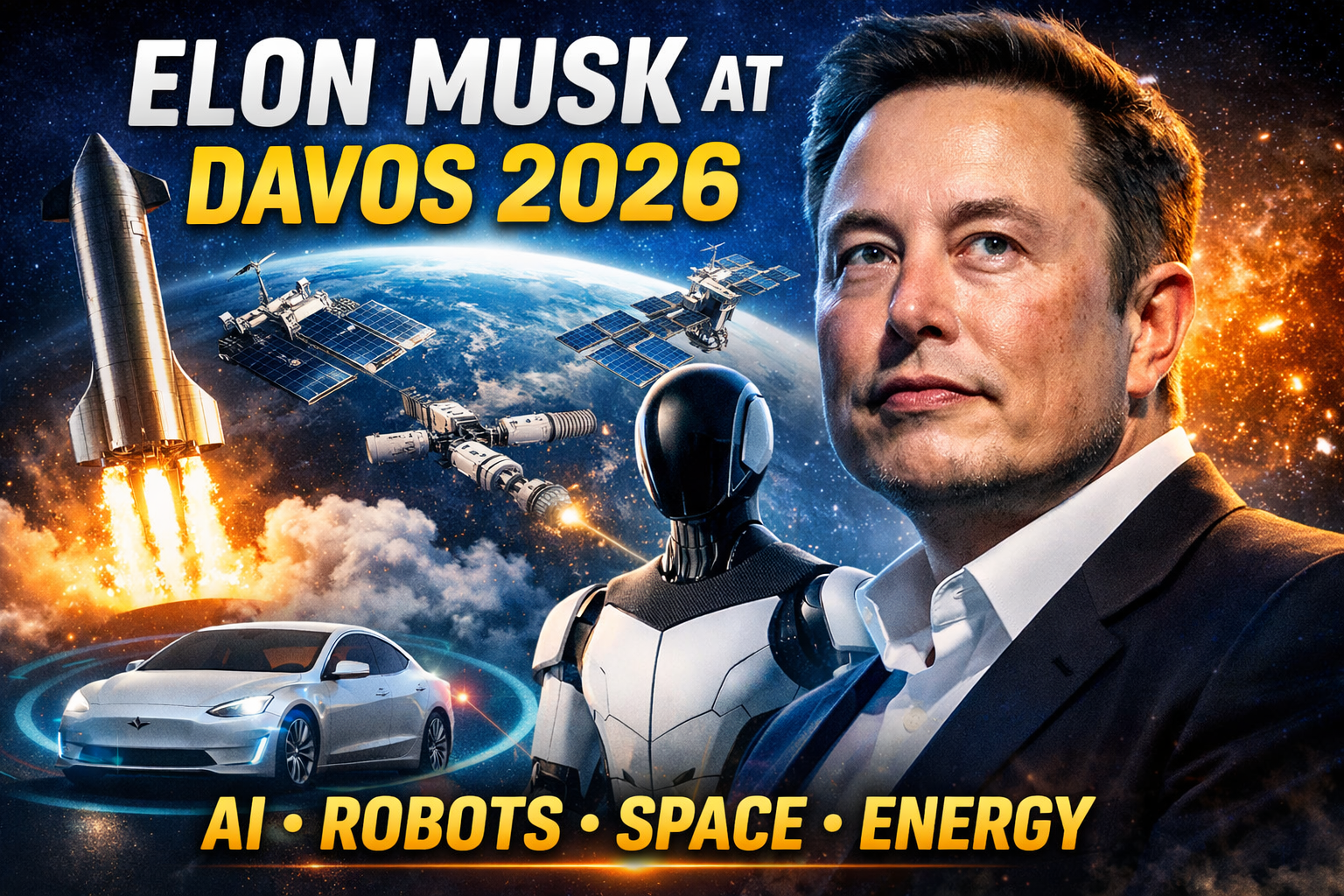
At the World Economic Forum Annual Meeting in Davos (January 22, 2026), Elon Musk joined BlackRock CEO Larry Fink for a wide-ranging on-stage conversation that touched nearly every Musk “stack” at once: Tesla + autonomy + humanoid robots + AI + energy + SpaceX + long-term civilization bets.
Below is a clean breakdown of the main topics he discussed — and what each implies for tech, business, and the next wave of products.
1) “Make life multiplanetary” (the core why behind SpaceX)
Musk opened with a philosophical framing: life and consciousness may be rare, so civilization should reduce existential risk by becoming multiplanetary — essentially “civilization insurance.”
This wasn’t just sci-fi branding. It set up the rest of his logic: if the future matters a lot, then scaling energy, AI, and transportation becomes a civilization project, not just a business plan.
2) Starship and full reusability (the cost curve that changes everything)
One of the most concrete SpaceX points: Musk emphasized full reusability for Starship, arguing that it can reduce the cost of access to space dramatically (he used a “single-use aircraft” analogy).
Why it matters:
Cheaper launches expand what’s economically possible in orbit (communications, manufacturing, energy, and—yes—compute).
3) Humanoid robots and “abundance for all”
Musk repeated a theme he’s pushed for years: humanoid robotics will advance quickly, and he painted a future where “everyone will have a robot,” leading to broad material abundance.
He also discussed Tesla’s Optimus timeline, with multiple reports citing Musk saying robots could be sold to the public around 2027 (some coverage frames it as “late 2027”).
Practical takeaway: If humanoid robots get even halfway to “reliable and affordable,” we’re not just talking about manufacturing — we’re talking about services, logistics, elder care, hospitality, and entirely new consumer categories.
4) Energy is the bottleneck for AI (not ideas)
A big thread in the Davos discussion: AI progress is increasingly constrained by power generation and delivery. The WEF live blog highlights Musk’s focus on energy scale, renewables, and the reality that compute growth can outpace the ability to power it.
This point matters because it’s a rare place where “AI hype” hits physics:
Chips are one curve.
Electricity, grids, and cooling are another.
5) Solar — on Earth, and in space (yes, really)
Musk argued the solution is ultimately “about the sun,” including the idea of solar-powered satellites because solar in space can be far more effective than on Earth (no atmosphere, constant exposure).
Whether or not you buy the near-term feasibility, the direction is consistent:
Scale energy → scale compute → scale robotics/autonomy → scale output.
6) Self-driving: “a solved problem” (plus the real-world constraint: regulation)
Musk called self-driving effectively “solved,” and discussion quickly moved from capability to approval and rollout.
Reuters reported Musk saying Tesla expects driver-supervised Full Self-Driving approval in Europe and China as early as next month, with Europe potentially beginning via an initial approval path (reported as tied to the Netherlands).
This is the important subtext:
The tech timeline is one story.
The regulatory timeline is the story that determines commercialization speed.
7) AI timelines: “smarter than all of humanity collectively” by 2030
Musk made bold predictions about AI capability by 2030, including that it could be “smarter than all of humanity collectively,” and he linked that to the idea of space-based, solar-powered compute (cooling + energy economics).
Even if you discount the exact dates, the strategic point is clear:
He’s positioning AI not as a feature, but as the engine behind robotics, autonomy, and industrial-scale output.
The “Musk pattern” at Davos: one integrated roadmap
If you strip away the headlines, the Davos conversation showed a single integrated thesis:
AI becomes the planning/execution layer
Robotics becomes the physical labor layer
Autonomy becomes the mobility layer
Energy becomes the scaling constraint
Space becomes the long-term scaling unlock
That’s why Fink’s opening question (“what do these have in common?”) matters — Musk answered it as a unified engineering mission rather than separate companies.
What this means for builders and businesses (the non-sci-fi version)
Even if you ignore the Mars parts, Davos 2026 still points to near-term realities:
AI + automation will keep shifting value from “manual workflow” to “systems that plan and summarize.”
Regulation will determine the pace of autonomy in each region (expect uneven rollouts).
Energy constraints will increasingly shape where compute is built and what it costs.
Robotics will start as enterprise pilots long before it becomes consumer-normal.
If you’re building products, your edge is less “using AI” and more:
turning AI into reliable workflows
making systems observable and auditable
designing experiences that reduce friction for real users (not demos)
The twist - Musk showed up at Davos after years of criticizing the WEF
Elon Musk showing up at Davos 2026 was a surprise for one simple reason: for the past few years, he wasn’t just “not attending” — he was publicly mocking and criticizing the World Economic Forum and the Davos crowd.
Back in January 2023, Musk used social media to question why Davos/WEF has so much influence, portraying it as a kind of elite, top-down forum. Multiple outlets referenced the same theme from that period: Musk argued the WEF was starting to look like an unelected global authority, and he repeatedly framed Davos as an out-of-touch gathering.
That’s what made his Davos debut in 2026 notable: it wasn’t just another billionaire doing a panel — it was a billionaire who had spent years criticizing the institution, now walking onto the WEF stage for a headline conversation with BlackRock CEO Larry Fink.