
The Topics Tech Leaders Discussed at Davos 2026 (AI, Chips, Energy, Jobs, Security, and the New Geopolitics)
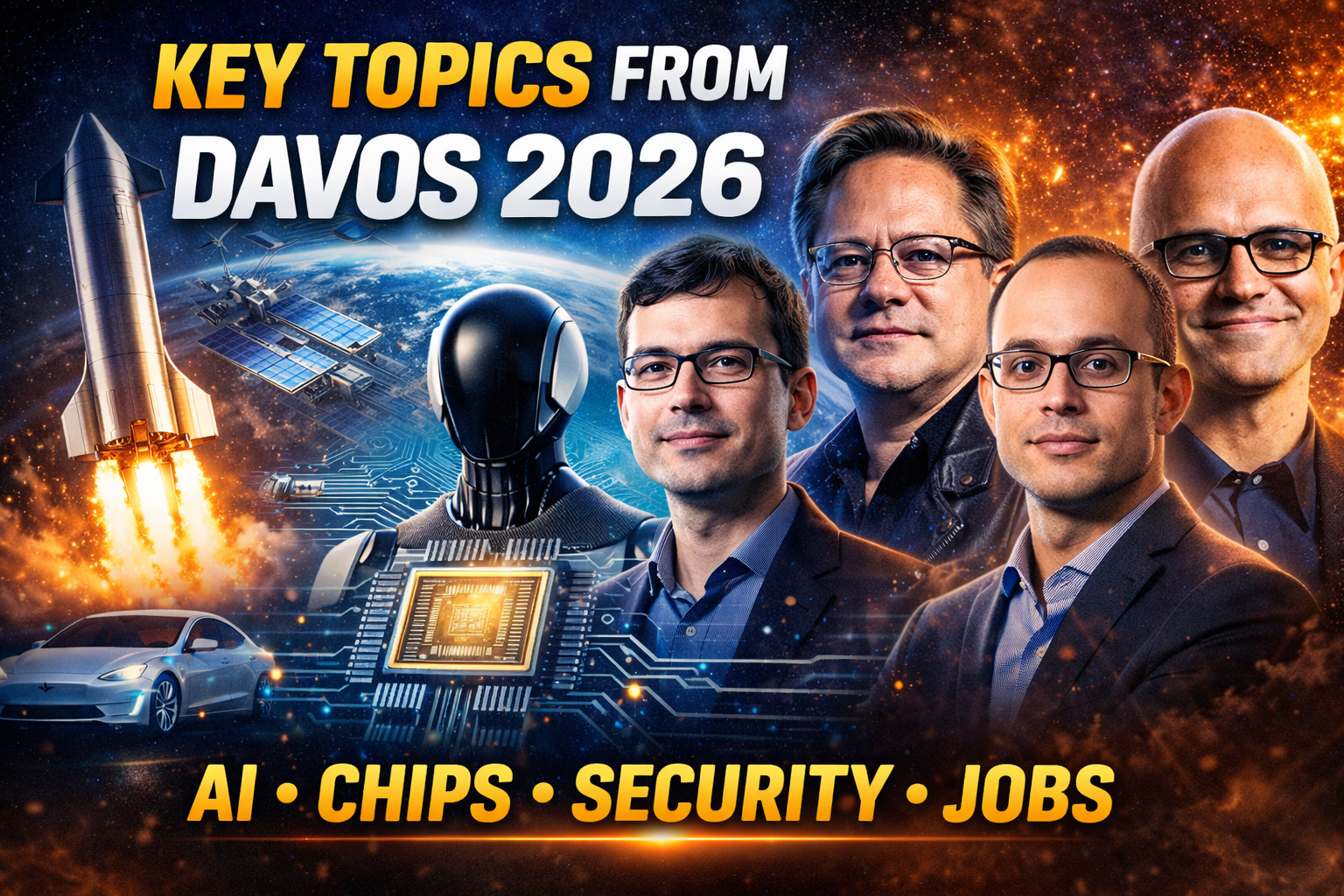
The World Economic Forum Annual Meeting 2026 ran January 19–23 in Davos-Klosters, under the theme “A Spirit of Dialogue.”
And if you zoom out from the headlines, the tech conversations were surprisingly consistent: most leaders weren’t debating whether AI is real anymore — they were debating the constraints (energy, chips, regulation, trust) and the second-order effects (jobs, inequality, geopolitical leverage).
Here are the big topics tech leaders kept returning to.
1) AI moved from “product” to “infrastructure”
One of the clearest meta-themes: AI is now framed like a foundational infrastructure buildout, not a single innovation wave.
At Davos, NVIDIA CEO Jensen Huang described AI as a multi-layer stack (energy → computing/chips → data centers → models → applications), arguing that every layer has to be built and operated — and that this is why AI creates real-world demand far beyond software.
2) Energy and power supply became the bottleneck narrative
Multiple tech leaders emphasized that scaling AI is increasingly constrained by electricity and infrastructure, not ideas.
This “energy-AI nexus” was already positioned as central heading into Davos 2026, and the Davos conversations reinforced it: compute growth is running into physical limits like power availability and siting.
3) AI chips as geopolitical leverage (the “new strategic resource”)
A recurring thread was that AI hardware and supply chains are becoming geopolitical tools.
Bloomberg reported Anthropic CEO Dario Amodei drawing an analogy between AI chips and strategic weapons, while DeepMind CEO Demis Hassabis warned about how close competitors are — reframing frontier AI as a national capability race, not just a market race.
4) The “Day After AGI” question: timelines, missing ingredients, and responsible deployment
One of the most talked-about AI sessions featured Demis Hassabis (Google DeepMind) and Dario Amodei (Anthropic), moderated by Zanny Minton Beddoes (The Economist), focused on what matters “on the road to AGI” and what comes after.
In parallel coverage, Reuters noted Hassabis saying the pathway to human-level AI is becoming clearer but still has “missing ingredients,” while also contrasting different AGI timelines being floated across frontier labs.
5) “Prove value” or risk a bubble: adoption beyond Big Tech
Another repeated idea: the AI boom needs broad, real adoption, not just impressive demos.
Coverage of Microsoft CEO Satya Nadella at Davos emphasized that the real question is whether AI gets used to deliver measurable outcomes across industries and countries — and that access to capital/infrastructure will shape who benefits.
6) AI’s labor impact shifted from vague to operational
The tone on jobs was less “future-of-work philosophy,” more “how do organizations actually change?”
Leaders discussed workflow redesign, skill shifts, and the idea that the biggest barrier inside large companies may be organizational inertia — not model capability.
7) AI agents and privacy: “perilous” by default if they need your data
As AI agents become more autonomous, privacy and security leaders pushed back hard on the default architecture.
Signal President Meredith Whittaker warned that deeper integration of AI agents can be “perilous” for encrypted/private services because they often require broad access across apps and data stores.
8) Cybersecurity escalated with AI acceleration and fragmentation
Cyber was treated as a top-tier risk layer underneath everything else.
WEF’s Global Cybersecurity Outlook 2026 highlighted how accelerating AI adoption plus geopolitical fragmentation is reshaping the threat landscape — and Davos programming (including WEF discussions/podcasts around the report) reinforced that security is now a core strategy issue, not an IT issue.
9) “Sovereign AI” and infrastructure constraints (land, water, energy)
Another theme: countries want AI capacity domestically, but practical constraints show up fast.
Coverage around Davos 2026 emphasized sovereign AI investment and the physical constraints of scaling infrastructure (including energy/water/land), plus regulatory friction.
10) The Davos 2026 tech vibe in one sentence
If Davos 2024/2025 was “AI is happening,” Davos 2026 felt like “AI is happening — now show me power, chips, security, regulation, and distribution.”
Even the public-facing summaries of Davos 2026 tech conversations leaned into that shift from hype to “useful + safe + scalable.”