
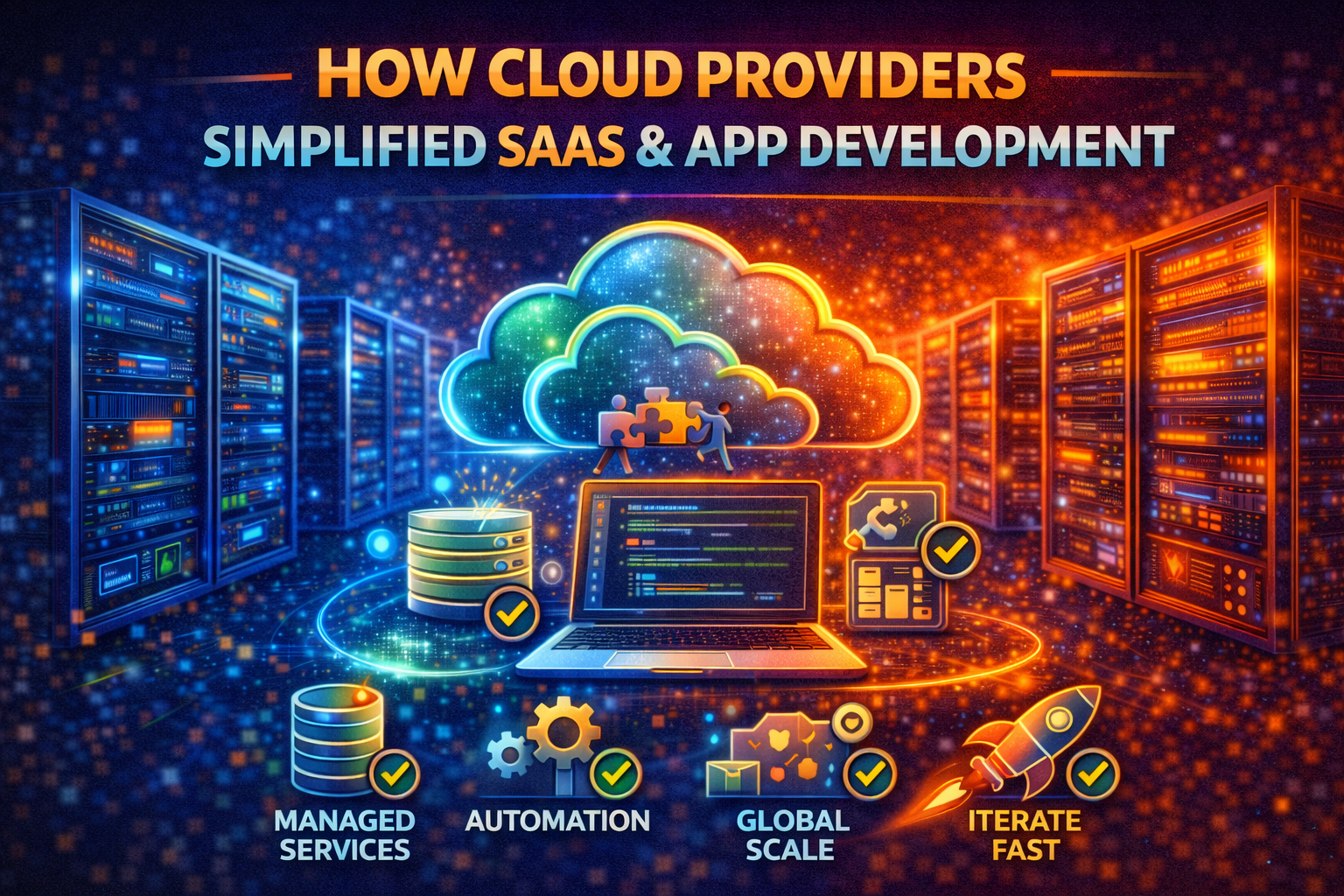
How Cloud Providers Simplified SaaS and App Development - And Made Software Possible for Startups
Twenty years ago, building software wasn’t just about writing code.
It was about everything around the code:
buying servers
renting rack space
negotiating contracts with data centers
planning capacity months in advance
setting up networking, firewalls, load balancers
managing backups, failover, and hardware failures
hiring ops teams just to keep things running
For many startups, that reality wasn’t “hard.” It was impossible.
Cloud providers changed that.
They turned infrastructure into a product — and that single shift made SaaS and app development dramatically easier for small teams.
Before cloud: startups needed “Ops” before they had users
In the old world, you had two painful options:
1) Buy your own servers (CapEx)
high upfront cost
hardware planning guesswork
long setup time
risk of buying too little or too much
2) Rent dedicated servers / colo (still complex)
recurring costs
manual provisioning
scaling takes days or weeks
lots of sysadmin work
Either way, you needed real infrastructure knowledge early:
Linux administration
security hardening
networking
monitoring
backups
disaster recovery
You had to act like a big company before you were a company.
Cloud made infrastructure “elastic”
The first big unlock was elasticity:
deploy today
scale tomorrow
pay for what you actually use
Instead of “buy for peak,” startups could:
start small
iterate
scale as demand grows
That made the risk profile completely different.
A small team could launch with low costs and upgrade only when the product proved it deserved to scale.
The biggest change: managed services replaced entire engineering roles
The most important cloud benefit isn’t just renting servers.
It’s the managed services layer.
Cloud providers took core infrastructure problems and turned them into “APIs you call.”
Here’s what that replaced:
Managed databases replaced DB administration
Instead of:
installing PostgreSQL/MySQL
tuning performance
setting up replication
running backups
patching versions
You click a button, get a database, and focus on product.
Object storage replaced file servers
Instead of:
building file upload servers
handling scaling, durability, backups
You store files in a bucket with near-infinite scale.
Managed auth replaced custom security systems
Instead of:
password storage logic
2FA implementation
account recovery flows
session security
You can use managed identity systems and reduce risk dramatically.
Serverless replaced “always-on backend servers”
Instead of paying for idle servers, you pay per request.
For many SaaS apps, serverless became the default because it fits startup reality:
unpredictable traffic
small teams
need to ship fast
minimal ops
The developer experience improved massively
Cloud didn’t just provide servers.
It standardized modern app development workflows:
Infrastructure as Code
Teams can version-control infrastructure like code:
environments are repeatable
deploys are predictable
fewer “it works on my server” surprises
CI/CD became normal
It used to be rare to have a professional deployment pipeline.
Now even tiny startups can:
run tests on every commit
build automatically
deploy reliably in minutes
Global distribution became accessible
CDNs, edge caching, and global load balancing used to be expensive and complex.
Now they’re standard.
A startup can launch globally on day one.
Cloud lowered the cost of experimentation
This is underrated.
When infrastructure is cheap and flexible, startups can experiment more:
build MVPs quickly
launch features early
test ideas without massive upfront cost
shut down failed projects without losing hardware investments
Cloud didn’t just reduce costs.
It increased speed.
And speed is the real advantage for startups.
The cloud also created entire new categories of software
Some products only exist because cloud exists:
real-time collaboration tools
AI-powered apps (GPU inference, managed AI APIs)
global video delivery services
large-scale analytics dashboards
multi-region SaaS products for enterprise customers
Cloud providers made advanced capabilities accessible by packaging them as services.
The trade-off: you now rent everything (and dependence grows)
Cloud isn’t pure upside.
It introduced new realities:
Vendor lock-in
Once you build deeply into a cloud’s services, migration becomes painful.
Costs can scale unpredictably
Some startups discover too late that:
databases scale cost
egress bandwidth costs
logs and metrics costs
AI inference costs
A product can become “successful” and suddenly very expensive.
Complexity didn’t disappear — it shifted
Instead of managing servers, teams now manage:
cloud architecture decisions
security policies
IAM roles
cost monitoring
region strategy
quotas and scaling rules
Cloud makes things easier — but you still need strong engineering thinking.
Why cloud made SaaS possible for small businesses
For startups and small teams, cloud did something huge:
It reduced the minimum requirements to build real software.
You no longer need:
a data center contract
a hardware budget
a full ops team
You need:
a laptop
a product idea
the ability to ship
That is the reason the SaaS explosion happened.
Bottom line
Cloud providers simplified SaaS and app development by turning the hardest infrastructure tasks into managed services.
That changed the startup game:
lower upfront costs
faster iteration
scalable architectures by default
professional deployment pipelines for everyone
In 2026, the cloud is still the biggest reason a small team can compete with large companies.
Because the infrastructure advantage of the enterprise is no longer exclusive.
It’s now rented by the hour.