
What Are Hyperscalers?
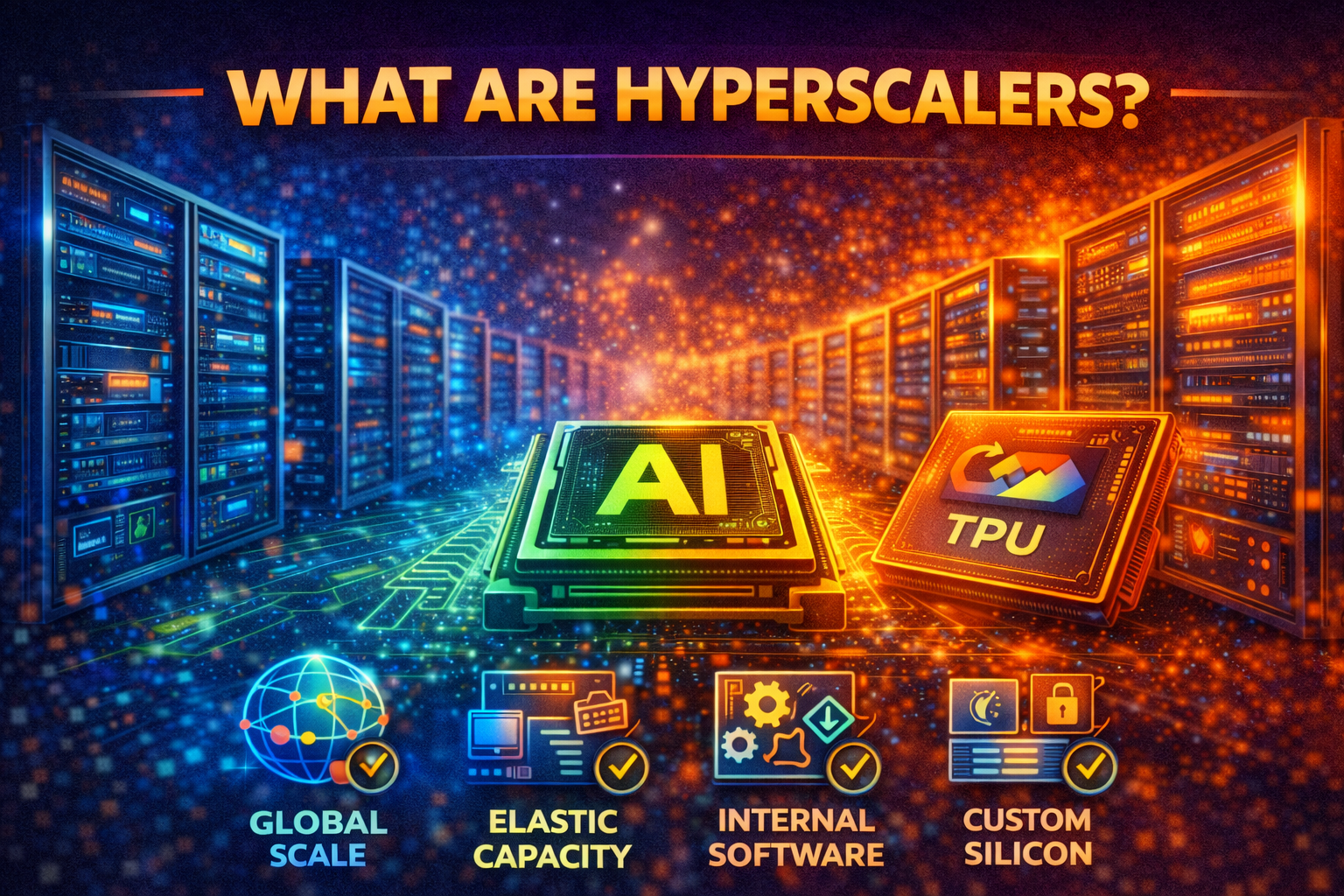
You’ll hear the term “hyperscaler” constantly in tech news — especially around AI, GPUs, cloud pricing, and data centers.
A hyperscaler is a company that can scale computing infrastructure to massive levels, quickly and efficiently, across many data centers worldwide.
In plain words:
Hyperscalers build and operate the biggest cloud-scale “computer factories” on Earth.
They don’t just run a few servers. They run millions of servers, with global networks, custom hardware, and internal software platforms that let them add capacity fast.
The simple definition
A hyperscaler is typically defined by these traits:
Massive scale (global data centers, huge server fleets)
Elastic capacity (able to add and allocate compute on demand)
Standardized infrastructure (repeatable designs, automation everywhere)
High efficiency (cost per unit of compute keeps dropping at scale)
Software-defined operations (automation, orchestration, internal platforms)
Who are the hyperscalers?
There are two main “types”:
1) Cloud hyperscalers (sell cloud services)
These are the “big three” most people mean:
Amazon Web Services (AWS)
Microsoft Azure
Google Cloud
They sell compute, storage, networking, databases, and AI services to other companies.
2) Platform hyperscalers (build massive compute for their own products)
These may not sell “cloud” the same way, but they operate hyperscale infrastructure:
Meta (Facebook, Instagram, WhatsApp)
Apple (services at global scale)
ByteDance (TikTok)
Sometimes: Tesla/xAI, OpenAI partners, depending on how they build infrastructure
They still build huge data centers because their products require enormous compute.
What makes a hyperscaler different from a normal “big company with servers”?
A normal enterprise might have:
1–10 data centers
thousands of servers
manual processes mixed with automation
A hyperscaler has:
dozens or hundreds of data centers
millions of servers
custom hardware supply chains
high-speed global networks
extreme automation (provisioning, monitoring, failover)
The key difference is not “they have more servers.”
It’s that they have a repeatable system to build, deploy, and operate infrastructure at insane scale.
Why hyperscalers matter (especially in 2026)
Hyperscalers sit in the middle of almost every major trend:
1) They control the modern internet’s “default infrastructure”
A huge percentage of websites, apps, and APIs run on AWS, Azure, or Google Cloud — directly or indirectly.
2) They set the real price of compute
If you’re a SaaS company, your biggest costs often include:
compute instances
storage
networking
managed databases
AI inference and training
Hyperscalers shape pricing, availability, and the “default” architecture patterns.
3) They drive the AI arms race
The demand for GPUs, power, and data-center capacity is heavily influenced by hyperscaler investment decisions.
4) They are now chip companies too
This is the big shift you mentioned.
Hyperscalers increasingly design their own AI chips because:
GPUs can be scarce
AI workloads are expensive
custom silicon can reduce costs at scale
it reduces dependence on one vendor
So now it’s not just:
“Cloud providers rent servers.”
It’s:
“Cloud providers build the chips, data centers, and networks that power AI.”
Why hyperscalers build their own chips (TPUs, Trainium, Maia)
This is the logic:
Cost control at scale
When you spend billions per year on AI compute, even small efficiency gains are worth it.
Supply chain control
If GPU supply is constrained, your roadmap becomes dependent on another company’s manufacturing pipeline.
Workload specialization
Hyperscalers know exactly what they run:
inference for search, feeds, recommendations
internal copilots and productivity assistants
ad ranking and real-time personalization
Custom chips can be optimized for those workloads.
Strategic leverage
Even if they still buy a lot of NVIDIA GPUs, having a serious alternative improves negotiating power.
Hyperscalers vs “cloud providers” (common confusion)
All hyperscalers are cloud-scale.
But not all cloud providers are hyperscalers.
A regional cloud provider can offer cloud services.
A hyperscaler operates at a global, massive, automated scale that changes unit economics.
Think of hyperscalers as:
cloud providers with industrial-scale manufacturing and operations.
What hyperscalers mean for SaaS founders and web developers
For SaaS founders
You are building on top of hyperscaler pricing and policy.
AI features are strongly tied to their GPU availability and AI service costs.
If you sell “unlimited AI,” you’re effectively reselling hyperscaler compute with unpredictable usage risk.
For web developers and agencies
Your clients’ sites often rely on hyperscaler infrastructure (directly or via platforms).
Performance, latency, compliance, and uptime are influenced by hyperscaler regions and services.
More AI features in apps means more dependence on hyperscaler AI pipelines.
Bottom line
Hyperscalers are companies that operate the world’s largest, fastest-scaling computing infrastructure.
They matter because they:
set the baseline economics of the cloud
drive AI infrastructure expansion
increasingly design their own chips
shape what software businesses can build profitably
In 2026, hyperscalers aren’t just “cloud vendors.”
They’re becoming the core industrial layer behind the AI economy.