
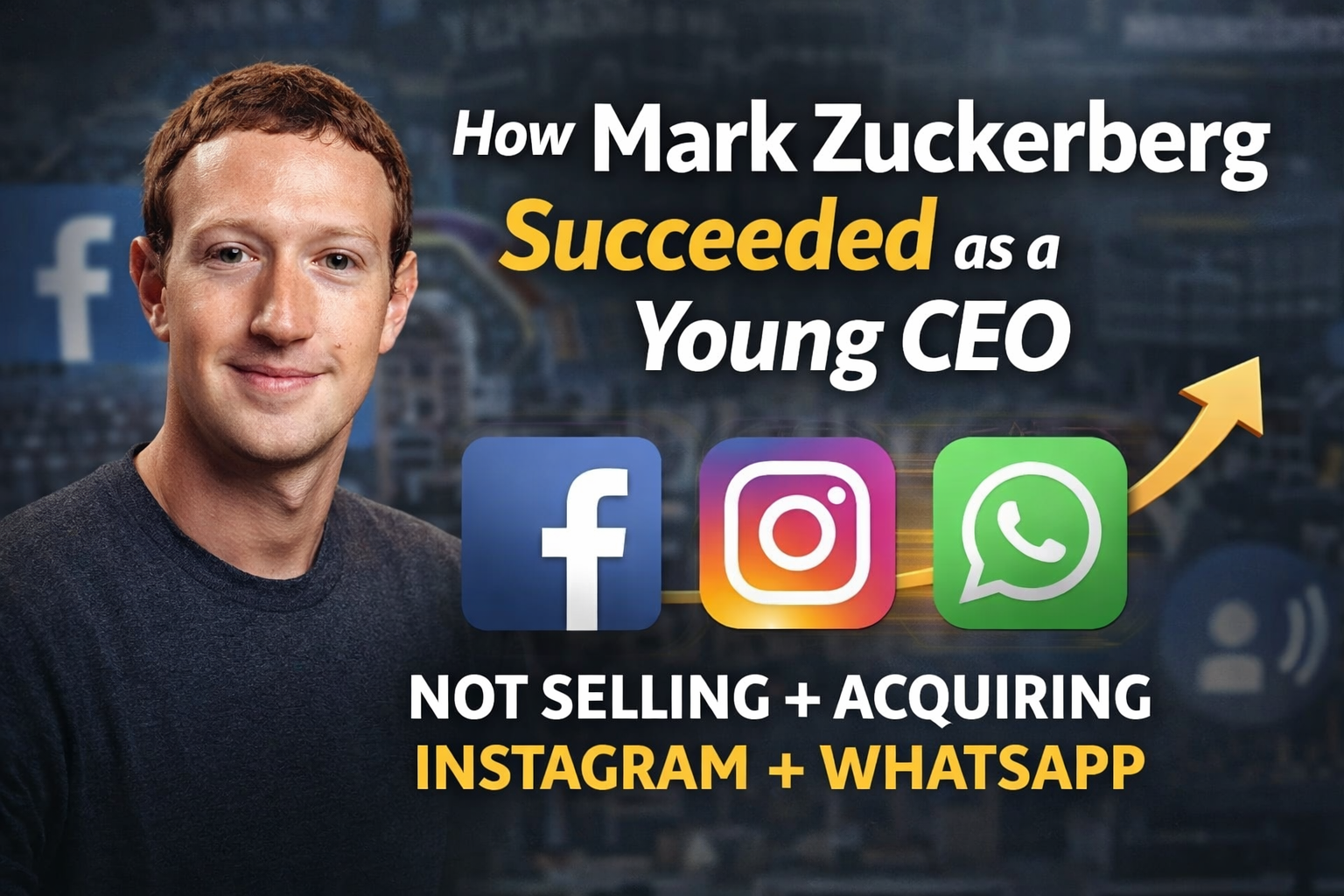
How Mark Zuckerberg Won With Facebook as a Young Founder - And Why Not Selling (Plus Instagram + WhatsApp) Made Meta Massive
Most “young founder” stories end the same way:
grow fast
get a big offer
sell
disappear
Mark Zuckerberg’s story is different because he didn’t sell when the outcomes were still uncertain — and because Facebook later made two of the most important platform acquisitions in tech history: Instagram (2012) and WhatsApp (2014).
This isn’t a “hero worship” story. Facebook/Meta has had plenty of controversies. But if you’re studying strategy, founder control, and long-term compounding, the playbook is worth understanding.
1) The early advantage: network effects compound brutally
Facebook wasn’t “just a website.”
It was a network.
And networks behave differently than normal products:
each new user increases value for existing users
growth makes the product stronger, not just bigger
competitors can copy features, but they can’t copy the network
That compounding effect is why social platforms can look “replaceable” in year 1 and feel “unbeatable” by year 5.
2) The risky decision most founders wouldn’t make: not selling early
In the mid-2000s, Facebook received acquisition interest (including a well-known offer reported around $1B from Yahoo). Zuckerberg didn’t take it.
This matters because it shows a specific founder trait:
He was optimizing for building a category-defining platform, not for a payout.
That’s easy to praise in hindsight — but at the time it was a real risk. Facebook still had major product, scale, and monetization uncertainty.
The structural reason he could hold the line
Facebook’s governance and share structure gave Zuckerberg outsized voting control relative to economic ownership, making it easier to pursue long-term decisions without being forced into short-term outcomes.
3) Product decisions that turned “a college site” into infrastructure
One reason Facebook survived early chaos is that it kept evolving from:
profiles → feed → sharing layer → identity layer → ad platform
Wired’s reporting on Zuckerberg’s early planning highlights how deliberately Facebook moved from a campus network into a system for mass-scale sharing and distribution.
Love or hate what social media became, the core strategy was consistent:
increase time spent
increase connections
make sharing frictionless
then monetize attention
4) The mobile pivot — and why Instagram was a master move
Facebook’s biggest existential threat around 2011–2012 was simple:
People were moving from desktop to mobile.
Instagram was already winning mobile photo-sharing and growth. Facebook announced it would acquire Instagram in April 2012 for approximately $1B (cash + stock), and the deal closed later in 2012.
Why this acquisition mattered:
Instagram owned a behavior Facebook needed (mobile-first posting)
it captured a younger, trend-driven audience
it became a second growth engine inside the same empire
Years later, in antitrust trial testimony, Zuckerberg acknowledged Instagram’s product strength as a major reason to buy it (instead of trying to out-build it).
5) WhatsApp: owning messaging globally (and the “Meta bundle” is born)
Facebook announced the WhatsApp acquisition in February 2014 with deal terms described as roughly $16B (cash + stock) plus $3B in RSUs.
As the deal progressed, it was widely reported as a $19B acquisition; the European Commission decision also references $19B.
Why WhatsApp mattered strategically:
it gave Facebook a dominant messaging channel outside the U.S.
it strengthened Meta’s presence in countries where WhatsApp is “the internet”
it added a parallel communication network alongside Facebook + Instagram
Put simply:
Facebook owned social graphs. WhatsApp owned private communication at massive scale.
6) From “Facebook” to “Meta”: the holding company logic
In October 2021, Facebook rebranded the parent company as Meta, positioning the company as a broader umbrella for Facebook, Instagram, WhatsApp, and its AR/VR ambitions.
You can argue about the metaverse pivot, but the corporate structure point is real:
Facebook wasn’t one product anymore — it was a portfolio of platforms.
7) “But couldn’t regulators unwind this?” The real-world stress test
For years, the Instagram and WhatsApp acquisitions were cited as examples of “buying future competitors.”
The FTC sued Meta in December 2020, seeking to unwind the deals; after a long legal fight, a U.S. judge ruled against the FTC’s attempt to force divestitures in November 2025.
Regardless of where you stand on regulation, this shows the modern reality:
big platform acquisitions can become strategic “forever assets”
but they can also create decade-long legal and political risk
What founders should actually learn from this story
1) “Don’t sell” only works if you’re building something that compounds
Not selling isn’t bravery by itself.
It only makes sense when the product has compounding advantages:
network effects
distribution
strong retention loops
a growing ecosystem
2) Founder control changes the entire game
If you can’t control the company, you often can’t play the long game.
Meta is a case study in how governance structure enables long-term bets.
3) The best acquisitions aren’t random — they defend a platform shift
Instagram = mobile-first social content
WhatsApp = global messaging + private communication
Both were positioned around where user behavior was going, not where it had been.
4) Your “Meta moment” is building a portfolio, not a single feature
Most founders think in terms of features.
Big outcomes often come from building (or acquiring) multiple engines under one strategy.
Closing thought
Zuckerberg succeeded early because Facebook wasn’t treated like a project — it was treated like infrastructure.
And Meta got bigger because it didn’t rely on one product:
Facebook for the original social graph
Instagram for mobile-first content
WhatsApp for messaging at global scale
Meta as the umbrella that ties it all together