
How the Transformer Breakthrough Works (Explained Simply)
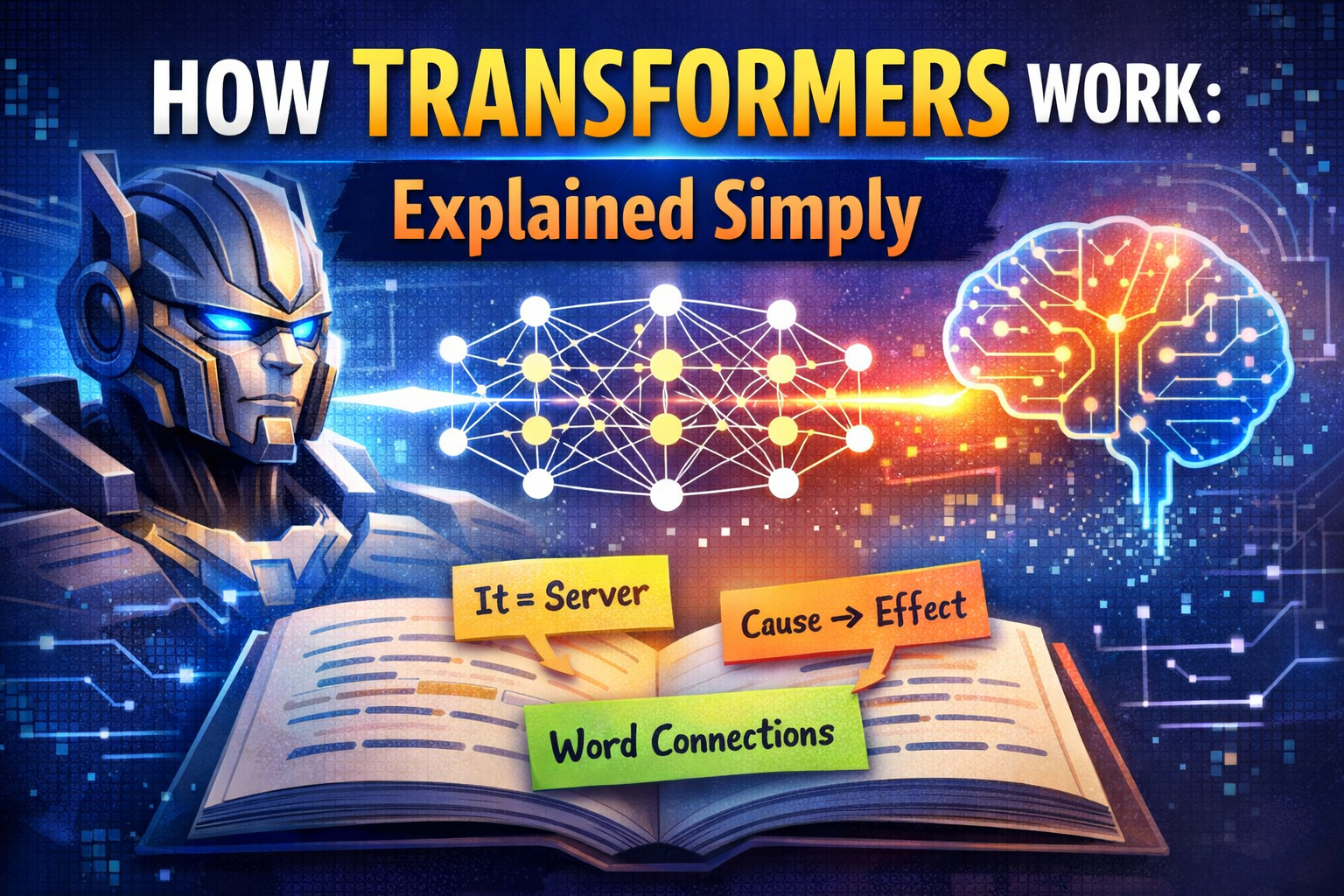
If you’ve heard “Transformers” and your brain jumps to robots — same.
In AI, a Transformer is the breakthrough architecture that made modern language models possible.
Before Transformers, AI was like reading a sentence one word at a time, in order, with a weak memory.
Transformers made AI able to look at all words at once, decide what matters most, and build meaning fast — and that’s why they scale so well.
This article explains the core idea in plain English.
The big problem Transformers solved
Human language (and code) has long-distance dependencies:
“The server crashed because it ran out of memory.” → it = server
“If the user is not logged in, redirect to /login.” → the
ifcontrols the redirect much later“The CEO of the company that acquired the startup…” → the subject of the sentence is far away
Older AI approaches struggled because they processed text step-by-step and had trouble keeping the important earlier details “active.”
Transformers solved this with attention.
The core idea: attention = “what should I pay attention to right now?”
When you read a sentence, your brain doesn’t treat every word equally.
You automatically do something like:
“This word probably refers to that word.”
“This phrase depends on that earlier phrase.”
“That detail is important for the meaning.”
A Transformer does the same thing — but mathematically.
A simple analogy
Imagine each word has a spotlight it can move around:
When the model processes the word “it”, it shines the spotlight backward to figure out what “it” refers to.
When it sees “because”, it looks for causes.
When it sees code like
return, it looks for the matching function context.
That spotlight mechanism is attention.
And the big difference is: it can do this for every word at the same time.
Why that was a breakthrough
Transformers are powerful because they can:
1) Process text in parallel
Older models (like classic RNNs/LSTMs) read:
word1 → word2 → word3 → …
Transformers can read:
word1, word2, word3… all at once
That makes training much faster on GPUs, and speed is what enables scaling.
2) Keep relevant context “alive”
Instead of trying to compress everything into a tiny memory state, attention lets the model directly link:
pronouns to nouns
causes to effects
variables to definitions
questions to relevant parts of the prompt
3) Scale with more data and compute
Transformers are “compute-friendly.”
Give them more data + bigger models + more GPUs → they keep improving.
That’s basically why we now have modern LLMs, code assistants, image models, and more.
How attention works (without heavy math)
At a high level:
Each word is turned into a vector (a list of numbers) → called an embedding
The model asks: for the current word, which other words matter most?
It assigns a score (weight) to every other word
It mixes the information using those weights
So it’s like building a “meaning summary” for each word by pulling useful information from other words.
Multi-head attention: paying attention in multiple ways
One attention “spotlight” is good.
But language has multiple relationships happening at once:
grammar structure
meaning
coreference (“it” → “server”)
topic focus
sentiment
in code: indentation, scope, function calls, variable types
So Transformers use multi-head attention:
multiple spotlights, each learning a different pattern.
One head might learn grammar.
Another might learn “what does this pronoun refer to?”
Another might learn code structure.
Then the model combines them.
But attention alone isn’t enough: it also needs sequence order
If the model looks at all words at once, it needs to know the difference between:
“dog bites man”
“man bites dog”
Same words. Different order. Different meaning.
Transformers solve this with positional information (often called positional encoding).
In simple terms:
each word gets “where am I in the sentence?” added into its representation
So the model knows both:
what the word is
where it is
The Transformer block (the repeating “engine”)
A Transformer isn’t one big magic step.
It’s a stack of repeated layers (blocks).
Each block does roughly:
Attention: gather context from other tokens
Feed-forward network: process that information and transform it
Residual connections: keep the original signal so learning stays stable
Normalization: keep numbers well-behaved so training doesn’t explode
Stack many blocks → deeper understanding.
Encoder vs decoder: two main Transformer modes
Depending on the job:
Encoder-style (understanding)
Used for:
classification
search
embeddings
“what does this mean?”
It reads the whole input and creates a rich representation.
Decoder-style (generation)
Used for:
text generation
code generation
chat
It predicts the next token repeatedly:
given everything so far, what comes next?
Most chat models are decoder-based.
Why Transformers also helped beyond text
Once you have “tokens + attention,” you can tokenize other things too:
images → patches (Vision Transformers)
audio → frames
video → chunks
actions → sequences
That’s why Transformers show up everywhere in modern AI.
The simplest summary
If you remember one thing:
Transformers are a way for AI to understand a sequence by letting every part “look at” every other part (attention), efficiently and at scale.
That’s the breakthrough.
What this means for builders (web + product)
If you’re a developer or business building products, Transformers are why:
AI assistants can handle long prompts and follow instructions better
code tools can relate functions/variables across files
chatbots can be made domain-specific with RAG and embeddings
“AI features” (summaries, classification, extraction) are practical now
In other words: Transformers turned AI from “cute demo” into “shippable product.”