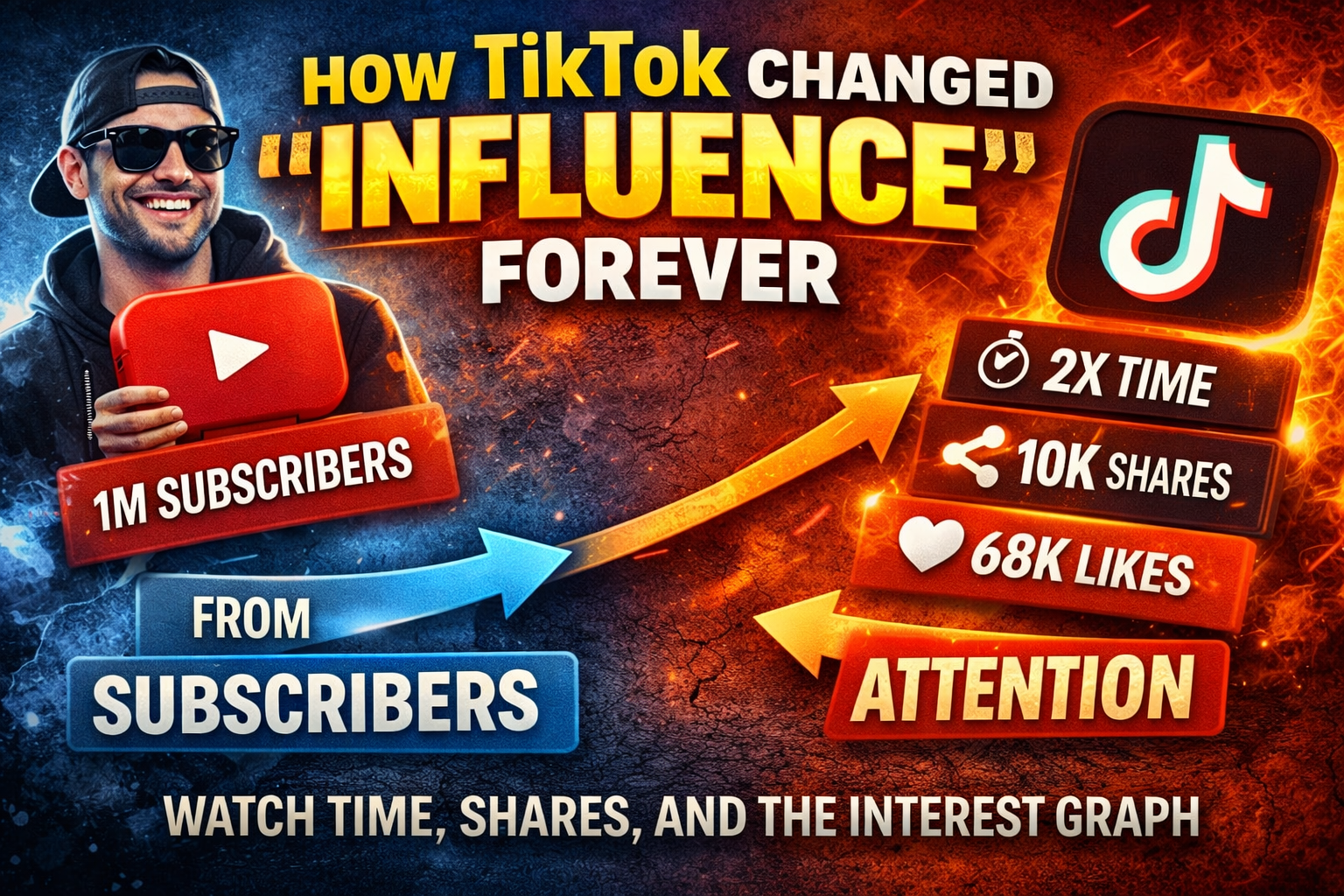
How TikTok Changed “Influence” Forever: From Subscribers to Attention (Watch Time, Shares, and the Interest Graph)
For most of social media’s early life, influence was basically a follower graph game:
you built an audience (friends / followers / subscribers)
you posted
the platform showed your post to a meaningful chunk of those followers
growth happened mostly through shares, tags, and slow network effects
TikTok flipped that.
Today, on most major platforms, influence is increasingly an attention game:
what gets watched (and rewatched)
what gets shared
what holds retention
what leads to more viewing
And yes - TikTok is a big reason the rest of the industry moved in that direction.
The big shift: “Social graph” → “Interest graph”
A useful mental model is:
Social graph (older model)
Your feed is primarily shaped by who you follow and your direct network.
Interest graph (TikTok model)
Your feed is shaped by what you seem interested in, inferred from behavior (watch time, interactions, rewatches, etc.) - even from people you don’t follow.
TikTok describes its recommender systems as personalization based on preferences expressed through interactions like following, liking, and other behavior.
Academic and industry analysis often frames TikTok as accelerating this “interest graph” approach - clustering users around shared interests rather than explicit connections - and pushing other platforms to mimic it.
What TikTok made normal: distribution without subscribers
The For You feed popularized a brutal but powerful idea:
You don’t need followers to reach people. You need performance signals.
TikTok can take a brand new account and test a video with a small audience, then expand if the signals are strong. While TikTok doesn’t publish exact mechanics, its public explanations consistently emphasize recommendations driven by user interactions and preferences.
That model changed creator psychology:
Old world: “I need followers first.”
New world: “I need one video to hit, then the followers come after.”
“What is viewed more is recommended more” - accurate, but simplified
This statement feels true because people often see a video “take off” after it starts doing well.
But the more accurate version is:
Platforms recommend what they predict will satisfy the next viewer, based on many signals - and performance signals (especially watch behavior) heavily influence that prediction.
YouTube: this shift started earlier than most people think
YouTube publicly explained years ago that it was focusing recommendations on watch time and successive viewing, not just clicks or raw views.
More recent explanations describe recommendations as helping viewers find content that matches their interests, using signals such as watch history and satisfaction measures.
So it’s not “most views wins.” It’s closer to:
“Best predicted watch + satisfaction for a specific audience segment wins.”
TikTok: “watch behavior” is the core language
TikTok frames recommendations around preferences expressed via interactions. In practice, watch behavior (what you finish, rewatch, or skip quickly) is a core signal, even if exact weights aren’t publicly listed.
Instagram: ranking is now multi-surface and increasingly discovery-driven
Instagram explains ranking as different systems for different surfaces (Feed, Explore, Reels, etc.). Discovery-focused surfaces naturally lean more toward “interest-driven” ranking than “follower-driven” ranking.
What actually changed about “influence”
1) Followers became less of a gatekeeper
You can now reach millions without a huge follower base if a piece of content performs strongly in early tests.
Followers still matter - but they are less of a hard prerequisite for distribution.
2) Influence moved from “identity” to “performance”
Old: “This person is influential because they have 2M followers.”
New: “This person is influential because their content repeatedly wins attention.”
3) Shares and watch time became the universal currency
Across platforms, the strongest signals tend to be variations of:
retention / completion
rewatches
shares (especially sends or private shares)
saves (often a strong “value” signal)
Even without knowing exact formulas, platform behavior clearly points to watch and satisfaction signals as core inputs.
What stayed true: subscribers still matter (just less than before)
It’s not accurate to say “subscribers don’t matter anymore.”
They still matter because they:
give you a reliable early view base
create habitual returning viewers
drive predictable engagement
support monetization and brand deals
Some surfaces are still explicitly follower-based. The big shift is that the largest growth surfaces are now discovery-first.
Why platforms copied TikTok
Because TikTok’s model is extremely good at one thing:
keeping people watching.
An interest-driven feed that constantly tests fresh content creates a novelty loop. That drives longer sessions, which drives retention and ad revenue.
Industry analysis consistently points to TikTok’s interest-clustering model as highly effective for engagement, which explains why other platforms copied it.
You can see this directly in product changes:
YouTube Shorts
Instagram Reels
algorithmic discovery surfaces becoming primary
What seems accurate vs what’s exaggerated
Accurate
Discovery is increasingly interest-based, not follower-based.
Watch behavior matters massively for recommendation systems.
Shares and retention correlate strongly with distribution because they signal value and satisfaction.
Exaggerated or misleading
“It’s literally just views.”
Views are usually an outcome. Retention, satisfaction, and predicted interest are the drivers.“Followers don’t matter.”
They matter for stability and velocity - just not as a strict gatekeeper anymore.
A 2026 trend: platforms are admitting the algorithm shapes everything
Platforms are now openly acknowledging how much algorithms shape feeds and are beginning to add user-facing controls to adjust interests.
That signals where we are today:
feeds are heavily algorithmic
users want more transparency and control
platforms want to keep interest-based ranking without full backlash
Practical takeaway for creators and brands
If you’re growing on social media in 2026, the right mental model is:
You are competing in an attention marketplace, not a follower marketplace.
So you optimize for:
clarity (what is this content about, instantly?)
retention (strong hooks and pacing)
rewatch value (dense, focused delivery)
share triggers (useful, relatable, or conversation-starting)
consistency (teaching the algorithm your niche)
Followers become the result of repeated attention wins, not the prerequisite.