
Why Social Media Algorithms Reward Big Creators (and Why Starting From Zero Feels Brutal)
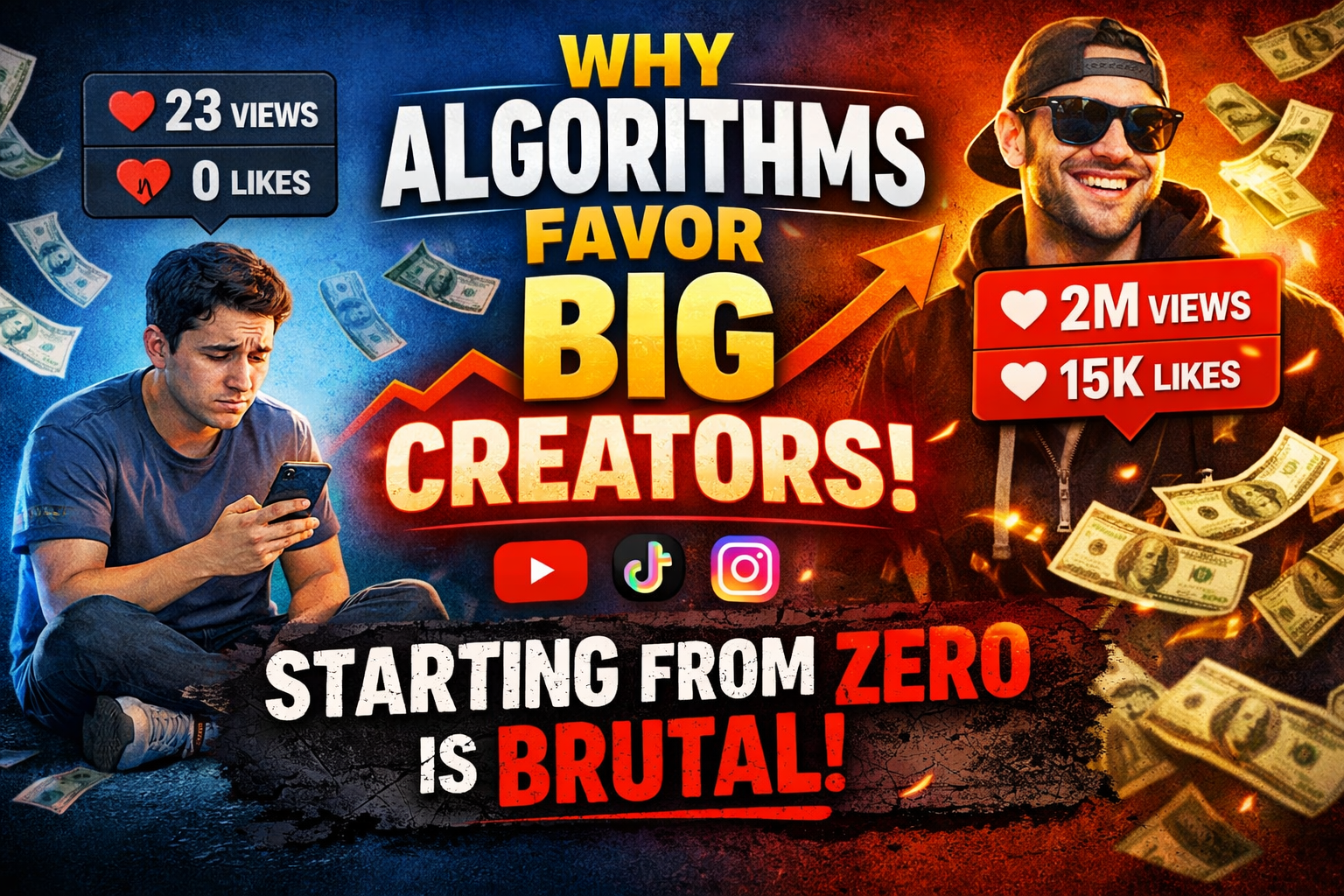
If you’ve ever posted a solid video and watched it die at 200 views while a big creator posts something average and gets 2 million, you’re not imagining it.
Most social platforms are recommendation engines first and “social networks” second. Their core job is simple:
keep people watching
keep people coming back
keep ads (and users) happy
YouTube openly frames its recommendation system around helping viewers find videos they want to watch and get value from (and improving long-term satisfaction).
Instagram explains ranking as a set of systems that decide what to show people on different surfaces (Feed, Reels, Explore, etc.).
TikTok describes recommendation as ranking content using signals like interactions, content info, and user info across its systems.
That design creates a predictable outcome: the “rich get richer” dynamic—more attention leads to more attention, which concentrates views and income among a small percentage of creators.
1) What algorithms actually optimize for (it’s not “fairness”)
Algorithms don’t wake up and say “push the biggest creators.”
They rank content based on predicted outcomes like:
watch time / retention (do people keep watching?)
engagement quality (shares, saves, comments, follows)
viewer satisfaction signals (did people stick around, watch more, or bounce?)
session outcomes (did this keep the user on the platform longer?)
safety + policy risk (avoid content likely to get reported or cause problems)
YouTube’s own docs and explanations emphasize matching viewers to videos they’re likely to enjoy so they return regularly—this is a “keep the viewer happy long-term” machine.
2) Why big creators win more often (even when the content isn’t “better”)
A) They generate better data, faster
A big creator can post and get thousands of early impressions in minutes. That instantly gives the algorithm clean signal:
who likes it
who watches it fully
who shares it
who follows afterward
A new creator might get too few impressions for the system to be confident. So the platform plays it safe and stops testing.
B) They have higher “baseline performance”
Even if the content is average, big creators often get:
higher early click / view rate (people recognize them)
higher retention (audience already likes their style)
more comments (community habit)
more shares (social proof)
That early spike is exactly what a recommender needs to justify expanding distribution.
C) Social proof is a ranking accelerant
People react differently when they see:
“102 views” vs “102,000 views”
a creator with no comments vs a creator with active discussion
a channel with no history vs one they’ve seen before
That changes behavior, and behavior changes ranking.
D) Platforms prefer predictable outcomes
Recommendation systems are inherently risk-managed. When two videos look similar in predicted performance, the system tends to favor the one with:
proven track record
clearer audience match
lower chance of being low-quality or spammy
This is one reason “cold start” feels so punishing.
3) The cold-start problem: why starting out is genuinely hard
When you’re new, the algorithm has limited answers to:
Who is this for?
Will people watch it all the way through?
Will it cause a good session (more viewing) or a bad session (bounce)?
TikTok itself describes recommendations as ranking content based on multiple factors and adjusting as it learns what users are interested in.
So if you’re new, your content is often shown to a small test group first. If early signals aren’t strong enough, the distribution stops. If signals are strong, the system expands.
That means your first job isn’t “go viral.”
Your first job is: produce a video that beats the platform’s average expectations for that viewer group.
4) The “rich get richer” effect is real (and measurable)
This isn’t just a vibe. Research analyzing creator earnings patterns across major platforms finds strong concentration dynamics consistent with a rich-get-richer model (often resembling power-law distributions).
In plain English:
a small % of creators capture a huge % of attention
attention compounds (momentum is real)
once someone is “in the loop,” the system keeps finding reasons to show them
5) “Do platforms only push big creators?” Not exactly.
Platforms do try to surface new creators—because novelty keeps users engaged and prevents feeds from feeling stale.
Instagram has explicitly said it has worked on ranking recommendations to help creators find new audiences and improve originality-based distribution.
TikTok has also talked about diversifying the For You feed and giving users more control over what appears.
But here’s the catch:
They can want “creator discovery” and still end up rewarding big creators most of the time, because the whole system is optimized around predictable viewer satisfaction.
6) So how hard is it for a new creator, really?
It’s hard in a specific way:
You are competing against creators who have momentum
the algorithm is cautious with unknown accounts
early performance matters more than you think
consistency matters because each post is another “test”
The realistic mindset is:
You don’t need one breakout video. You need a repeatable format that wins small tests over and over.
That’s what eventually creates momentum.
7) What actually works for new creators (without coping or “just post more”)
A) Pick a narrow “audience promise”
Instead of “web dev,” go:
“Shopify speed fixes”
“Angular performance patterns”
“front-end freelancing / Upwork systems”
The narrower the promise, the easier it is for the algorithm to learn “who this is for.”
B) Optimize the first 3 seconds (short-form) or first 30 seconds (long-form)
Your hook isn’t a trick. It’s context:
what this is
why it matters
why this video is different
C) Build series, not one-offs
Series creates returning viewers, and returning viewers are strong signals.
Examples:
“1-minute Shopify fixes #1–#30”
“Daily Angular tips #1–#60”
“Upwork profile teardown #1–#20”
D) Win on retention, not just clicks
A click with a quick swipe is a negative signal.
A click with full watch (or rewatch) is a distribution trigger.
E) Create a “small external push” loop
The first 50–200 viewers can matter a lot.
Use:
Reddit (in the right sub, with value-first posts)
X threads that summarize the video
a newsletter blast
a community post linking to the clip
Not to “force” virality—just to generate enough signal for the platform to learn.
F) Don’t fight every platform at once
Pick one primary surface:
YouTube (long-form + Shorts)
TikTok (short-form)
Instagram (Reels + carousels)
Then cross-post once you have a format that works.
8) The honest takeaway
Social media isn’t a level playing field because recommendation engines are not designed for fairness. They’re designed for viewer satisfaction + retention + predictability.
That naturally rewards big creators because big creators provide:
faster data
stronger early signals
lower uncertainty
proven audience match
But new creators can still break through—by making it easy for the algorithm to answer one question:
“Who will love this, and will they watch it all the way through?”