
NVIDIA just launched Alpamayo, a “reasoning” autonomous driving AI model - and it changes the Tesla vs Waymo narrative
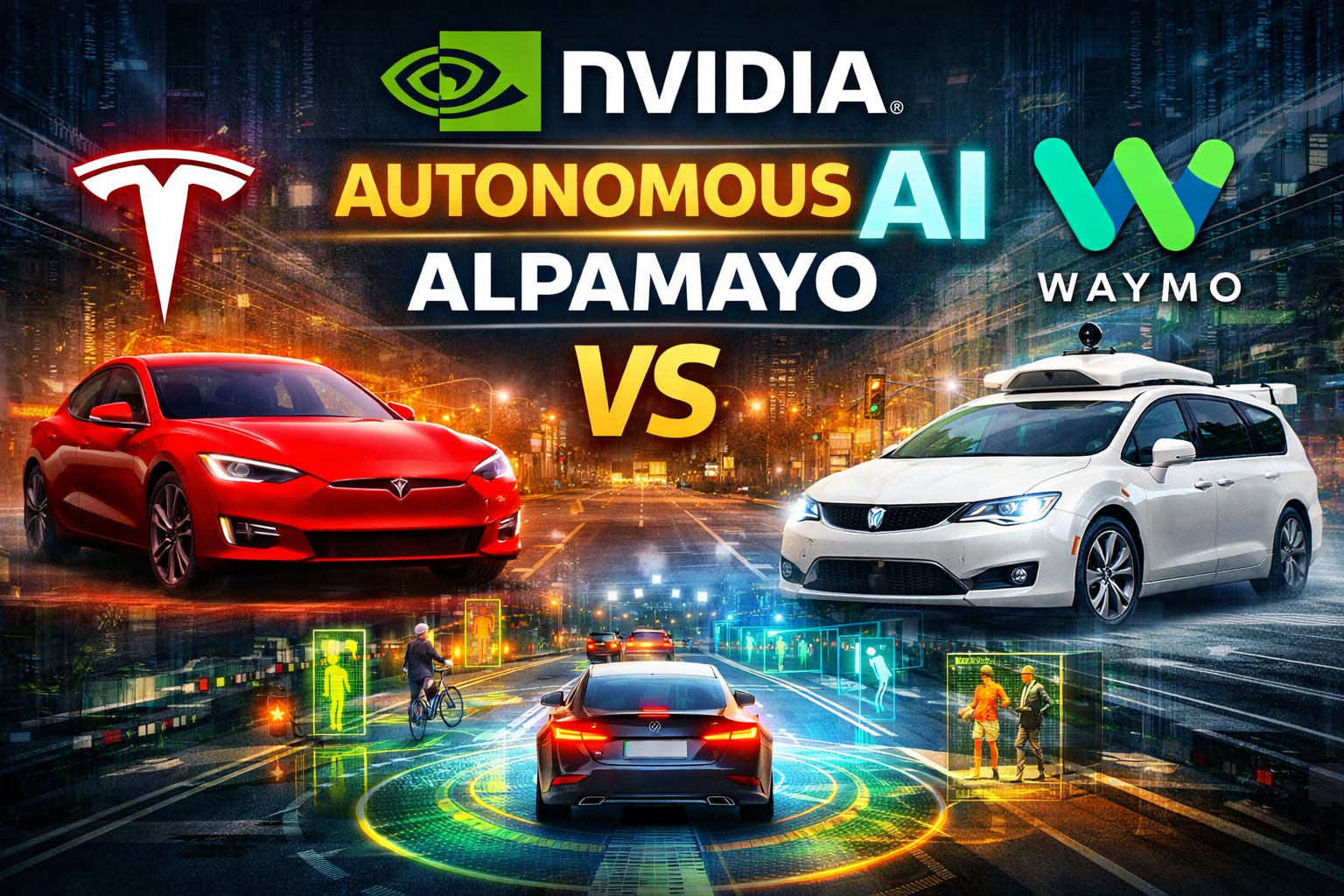
At CES 2026, NVIDIA unveiled Alpamayo, a new open portfolio of autonomous driving AI models, simulation tools, and datasets designed to accelerate reasoning-based Level 4 autonomy. The headline idea is simple but important:
Instead of AV systems that only perceive and then react, NVIDIA is pushing AV AI that can reason through rare edge cases (the long tail) and explain why it chose an action - a capability that matters for safety validation, debugging, and regulation.
This is not “NVIDIA builds robotaxis.” It’s “NVIDIA wants to become the default autonomy toolchain the entire industry builds on.” And if that happens, it directly affects how quickly competitors can close the gap with Tesla’s robotaxi ambitions - and how Waymo defends its lead.
What exactly did NVIDIA launch?
NVIDIA describes Alpamayo as an open ecosystem with three pillars - models, simulation, and datasets - built to help teams train, test, and validate autonomy systems faster.
1) Alpamayo 1 - a chain-of-thought “vision-language-action” model
The core model is Alpamayo 1, a 10B-parameter vision-language-action (VLA) model that takes video input and generates driving trajectories plus reasoning traces (the “why” behind decisions). NVIDIA is positioning it for the AV research and developer community with open weights and open-source inferencing scripts.
A key detail: NVIDIA explicitly says Alpamayo models are meant to act as teacher models that developers can fine-tune and distill into smaller runtime models that actually ship in-vehicle.
2) AlpaSim - open-source, closed-loop AV simulation
Alpamayo also includes AlpaSim, an open-source simulation framework for high-fidelity, closed-loop testing (simulate traffic, sensors, weather, edge cases at scale). The goal is to reduce real-world miles needed for iteration and validation.
3) Physical AI Open Datasets - 1,700+ hours of driving data
Finally, NVIDIA released Physical AI Open Datasets with 1,700+ hours of driving data across diverse geographies and conditions, explicitly targeting rare and complex edge cases that break autonomy systems.
A preview of where this goes: Alpamayo-R1 and explainable autonomy
Ahead of CES, Alpamayo-R1 was described as having “think aloud” behavior: the system can describe what it sees (like a bike path) and how that affects its plan. That kind of transparency is a big deal for debugging and safety audits.
Why this matters: the industry is shifting from “driving software” to “driving foundation models”
For years, autonomy debates focused on architecture:
Modular stacks (separate perception, prediction, planning)
End-to-end learning (one big model mapping sensors to controls)
NVIDIA’s framing is that we’re entering a third phase: reasoning + foundation-style models that can generalize better to the long tail and provide interpretable decision logic, supported by standardized simulation and datasets.
That “open toolchain” angle matters because it can:
standardize benchmarks and evaluation across the industry
speed up iteration for companies without massive internal autonomy orgs
help regulators and safety teams audit decisions (or at least demand auditable artifacts)
In short: Alpamayo is an accelerator for everyone who isn’t Tesla or Waymo.
What it means for Tesla
Tesla’s autonomy strategy has always been unusually vertical:
fleet data flywheel
heavy neural-network focus
tight integration with Tesla hardware and software
But there are three near-term implications NVIDIA’s move creates.
1) The “catch-up” problem gets easier for everyone else
If OEMs, Tier 1s, and AV startups can start from:
an open reasoning VLA model (teacher)
an open closed-loop simulator
a large open dataset
…they can potentially reduce years of foundational R&D. That shifts the playing field.
2) Explainability and safety validation pressure increases
Tesla’s Full Self-Driving is widely described as supervised and not full autonomy in current consumer deployments.
As more autonomy systems emphasize auditable reasoning traces and “why did the car do that?” tooling, regulators and the public may increasingly expect:
clearer explanations of failure modes
measurable safety validation workflows
more transparent testing evidence
Even if Tesla doesn’t adopt NVIDIA’s approach, the standard of proof may shift.
3) Tesla may still benefit indirectly (even if it never touches Alpamayo)
NVIDIA increasingly sits in the supply chain of “physical AI.” Even companies that build their own autonomy stack may still rely on NVIDIA for compute, training infrastructure, or parts of the tooling ecosystem.
What it means for Waymo
Waymo is coming into 2026 from the opposite position: it’s not trying to prove autonomy is possible - it’s trying to scale a working driver.
1) Waymo is already in the “foundation model” era
Waymo has described its approach as a holistic AI ecosystem centered on a foundation model direction (world-model style systems) designed to support safe deployment and continuous improvement.
So philosophically, Alpamayo is not a surprise to Waymo - it’s NVIDIA validating the direction the industry is moving.
2) NVIDIA may compress the “AV R&D gap” behind Waymo
Waymo’s edge has historically been:
deep autonomy stack maturity
safety and operational playbooks
real-world service experience
If Alpamayo helps more competitors reach “good enough Level 4” sooner, Waymo’s moat needs to be:
operational excellence
safety case quality
rapid expansion and cost control
In other words, Waymo wins by scaling, not by being the only one with strong ML.
3) Open models can influence regulators and the research community (even if Waymo doesn’t use them)
Because Alpamayo is open, it can become a shared reference point for:
what good evaluation looks like
how simulation should be run
what datasets should include
That can be helpful for Waymo if it raises the baseline quality of the ecosystem (suppliers, tooling, even public understanding). Or it can be threatening if it enables faster challengers.
The real winner: the “autonomy middle class” (OEMs and startups)
The biggest immediate impact of Alpamayo is not on Tesla or Waymo - it’s on everyone who wants Level 4 without spending a decade building a stack from scratch.
NVIDIA is effectively bundling:
an open reasoning model
an open simulator
an open dataset
and a story about safety and validation
…into a starting point that a lot of companies will adopt, customize, and commercialize.
That’s how platforms win.
Bottom line
Alpamayo is NVIDIA planting a flag in autonomy software, not just autonomy hardware. It’s a bet that:
the next leap comes from reasoning and foundation-style models
safety validation needs interpretability and repeatable workflows
the industry will standardize around open tools the way it standardized around CUDA for compute
For Tesla, it increases competitive pressure by making good autonomy R&D more accessible - and by nudging the industry toward explainability and auditability.
For Waymo, it’s validation of the foundation-model direction - but also a warning that the gap behind them could close faster than expected, making scaling and operations the real battlefield.