
Stack Overflow Is Shrinking - and AI Assistants Changed How Developers Get Answers
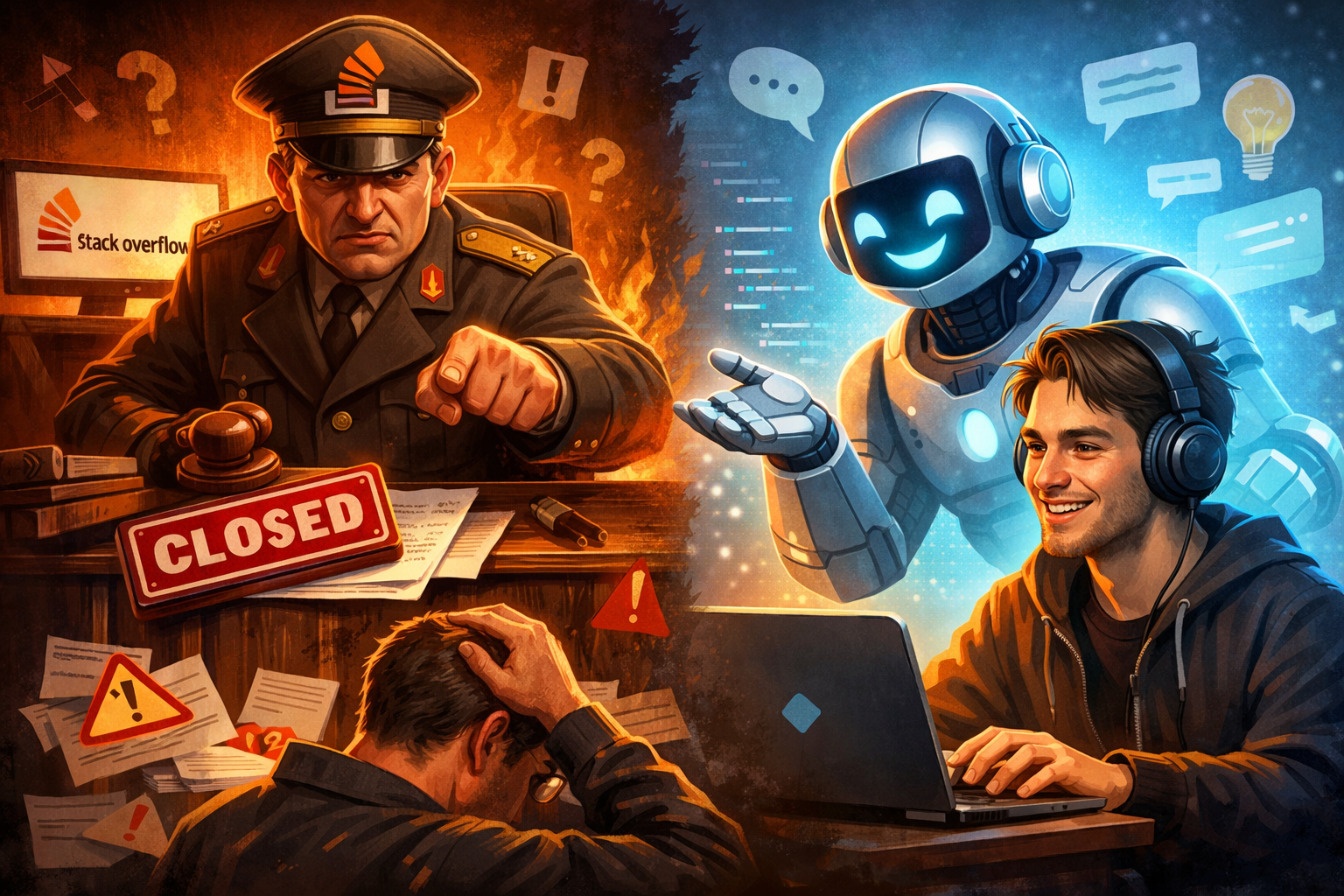
For most of the 2010s, Stack Overflow was the default “developer memory.”
You’d hit a bug, Google it, land on a thread, skim a few answers, and ship. The best posts turned into evergreen references that kept helping people for years. It wasn’t just a Q&A site - it was the public debugging journal of the entire industry.
But in the last couple of years, something obvious happened:
Developers didn’t stop having problems. They stopped asking Stack Overflow.
And the timing overlaps almost perfectly with the rise of AI assistants.
Recent reporting based on Stack Exchange data shows how sharp the drop is: new questions are down dramatically compared to previous years, with activity far below its peak from the late 2010s.
At the same time, Stack Overflow’s own developer surveys show that the vast majority of developers are now using or planning to use AI tools in their development process, with many professional developers using AI tools daily.
So this isn’t just “people got bored.”
This is a workflow shift.
This isn’t only about “AI being smarter” - it’s about friction
A lot of commentary frames the Stack Overflow decline like this:
“AI answers questions instantly, so Stack Overflow is obsolete.”
That’s part of it, but it misses the bigger point:
Stack Overflow lost because the experience of asking became high-friction - and AI replaced the interaction model.
Stack Overflow is built around:
public posting
strict formatting expectations
reproducibility requirements
topic boundaries
community moderation
and a reputation system
Those rules exist for a reason: they protect quality and keep the archive searchable.
But many developers (especially newer ones) experienced the culture like a courtroom:
You’re not “asking for help,” you’re “defending your question.”
A small mistake in formatting or scope can get you closed.
The emotional cost of posting often outweighed the benefit.
Stack Overflow has acknowledged for years that many developers experience the platform as intimidating or unwelcoming, and that tone matters just as much as technical correctness.
So when AI assistants arrived with a completely different UX, a lot of developers didn’t just “try AI.”
They switched.
The moderation problem: when quality control feels like gatekeeping
Let’s be fair to the moderators and high-reputation users:
Stack Overflow was never meant to be a casual chat room. It’s closer to a curated knowledge base.
Closing duplicates, enforcing clarity, and pushing for minimal reproducible examples does create better long-term answers.
But here’s the uncomfortable reality:
Even when the moderation is “correct,” it can still feel hostile.
And over time, many developers internalized a pattern:
Ask a question
Get downvoted or nitpicked
Get closed as duplicate
Get told to read the docs
Leave, and never ask again
You described it well: in recent years, some moderators felt like dictators, and it felt like there was pride in closing questions.
A more neutral way to frame this is:
Moderation started to feel less like guidance and more like judgment. Even when closures were technically justified, the experience felt discouraging - like the system optimized for archive quality over human learning.
That’s the key point:
Stack Overflow optimized for the library, but many developers needed a tutor.
AI assistants didn’t just replace answers - they replaced the conversation
Stack Overflow is a database plus rules.
AI assistants are interactive debugging.
The difference is huge in practice.
1) You can give context (without getting punished)
On Stack Overflow, too much context can get you told “too broad” or “needs details.”
With AI you can paste:
code
stack traces
configuration
constraints
what you already tried
…and you don’t get judged for it.
2) AI is iterative by default
The real debugging flow looks like this:
try a fix
hit a new error
narrow the scope
test again
Stack Overflow posts are static snapshots.
AI feels like a patient senior developer sitting next to you:
“Show me the error.”
“Ok, now show me the function.”
“What happens if you log this?”
“Try this alternative.”
3) The embarrassment tax goes to zero
A huge part of developer productivity is emotional.
Sometimes you don’t ask a question because you don’t want to look stupid in public.
AI removes that entire layer.
Ask “dumb” questions. Ask again. Ask the same thing five different ways.
No downvotes. No sarcasm. No public record.
4) AI gives explanations, not just solutions
Stack Overflow often gives the “what.”
AI gives the “why,” and can adapt the explanation:
explain like I’m junior
explain like I’m senior
show tradeoffs
offer alternative approaches
The irony: Stack Overflow bans AI-generated content - while developers use AI anyway
Stack Overflow has a strict policy against posting generative AI output.
That decision makes sense if your product promise is:
accuracy
reproducibility
long-term reference quality
Early AI-generated answers were (and still are) often wrong in subtle ways. Stack Overflow couldn’t afford a flood of plausible-sounding but incorrect answers.
But this also highlights the tension:
Stack Overflow wants human-verified knowledge
developers want speed
AI gives speed
So developers didn’t stop using Stack Overflow because it banned AI.
They stopped because AI moved the help experience into private, instant, iterative workflows - something Stack Overflow can’t fully compete with without changing what it fundamentally is.
Developers love AI tools - and still don’t fully trust them
Here’s the interesting part:
AI adoption is massive, but trust is shaky.
Surveys show that while most developers use AI tools, more developers actively distrust AI accuracy than fully trust it.
AI is winning even when developers don’t completely believe its answers.
That tells you this shift isn’t only about correctness.
It’s about:
speed
convenience
iteration
lower friction
Why Stack Overflow is declining (in plain terms)
The simplest explanation looks like this:
1) The archive is already massive
Most common questions already have answers.
So fewer people feel the need to post.
2) Asking became emotionally expensive
Even when you did everything right, you still risked:
closure
downvotes
hostile tone
being redirected to threads that didn’t fully match your situation
3) AI changed how developers “search”
Many developers no longer start with:
search engine
click results
read multiple threads
They start with:
paste error
get a tailored answer
That’s a completely different behavior loop.
4) Stack Overflow is pivoting because it has to
The company has openly discussed how generative AI created an existential threat, pushing it toward enterprise products, private knowledge bases, and AI-powered tools.
Why AI assistants are genuinely great (when used correctly)
Beyond the hype, AI provides real value.
AI is especially good at:
summarizing documentation
generating safe boilerplate
explaining unfamiliar concepts
offering multiple solution paths
narrowing down debugging hypotheses
translating between frameworks or languages
generating test cases and edge cases
AI acts as developer leverage.
Instead of spending 40 minutes searching through threads, you often get a useful direction in under a minute.
Even when the answer isn’t perfect, AI reduces the search space and helps you think more clearly about the problem.
The catch: use AI like a co-pilot, not an autopilot
Accuracy is still the weak point.
Here’s a workflow that actually works in real-world projects:
1) Ask AI for assumptions first
Have it list the assumptions it’s making about your environment and dependencies.
If those are wrong, the answer will be wrong.
2) Ask for minimal reproducible steps
This turns AI into a debugging assistant instead of a code generator.
3) Demand tests
Ask for test cases that would fail before the fix and pass after.
4) Treat security, auth, and payments as verify-only
AI can help brainstorm, but anything involving sensitive systems should always be verified against official documentation.
5) Use AI to compare solutions, not blindly pick one
Ask for multiple approaches and tradeoffs in performance, maintainability, and risk.
Where Stack Overflow still matters
Even if you love AI assistants, the internet still needs:
canonical answers
public, searchable references
human-reviewed explanations
linkable threads teams can cite
If everything moves into private AI chats, we lose the public knowledge base that helped millions of developers learn.
Ironically, AI systems themselves also benefit from high-quality public technical content.
The best future probably isn’t “AI replaces Stack Overflow.”
It’s:
AI as the interface
human-verified knowledge as the foundation
My experience
I talked about my own Stack Overflow experience years ago in a YouTube video, but the feeling hasn’t really changed.
Asking started to feel like stepping into an environment where closure was the default outcome, not learning.
That personal experience is part of why AI assistants feel like such a relief to many developers today.
Practical conclusion
Stack Overflow didn’t decline because developers got lazy.
It declined because:
asking questions became high-friction
AI assistants delivered a faster, friendlier feedback loop
modern development favors iteration over perfect question formatting
AI assistants are great not because they’re always right, but because they reduce friction, accelerate learning, and match how real development work actually happens.
The best developers do both:
use AI for speed
rely on human verification and trusted sources for correctness