
Why a “Perfect” Domain Name Doesn’t Guarantee a Successful Business
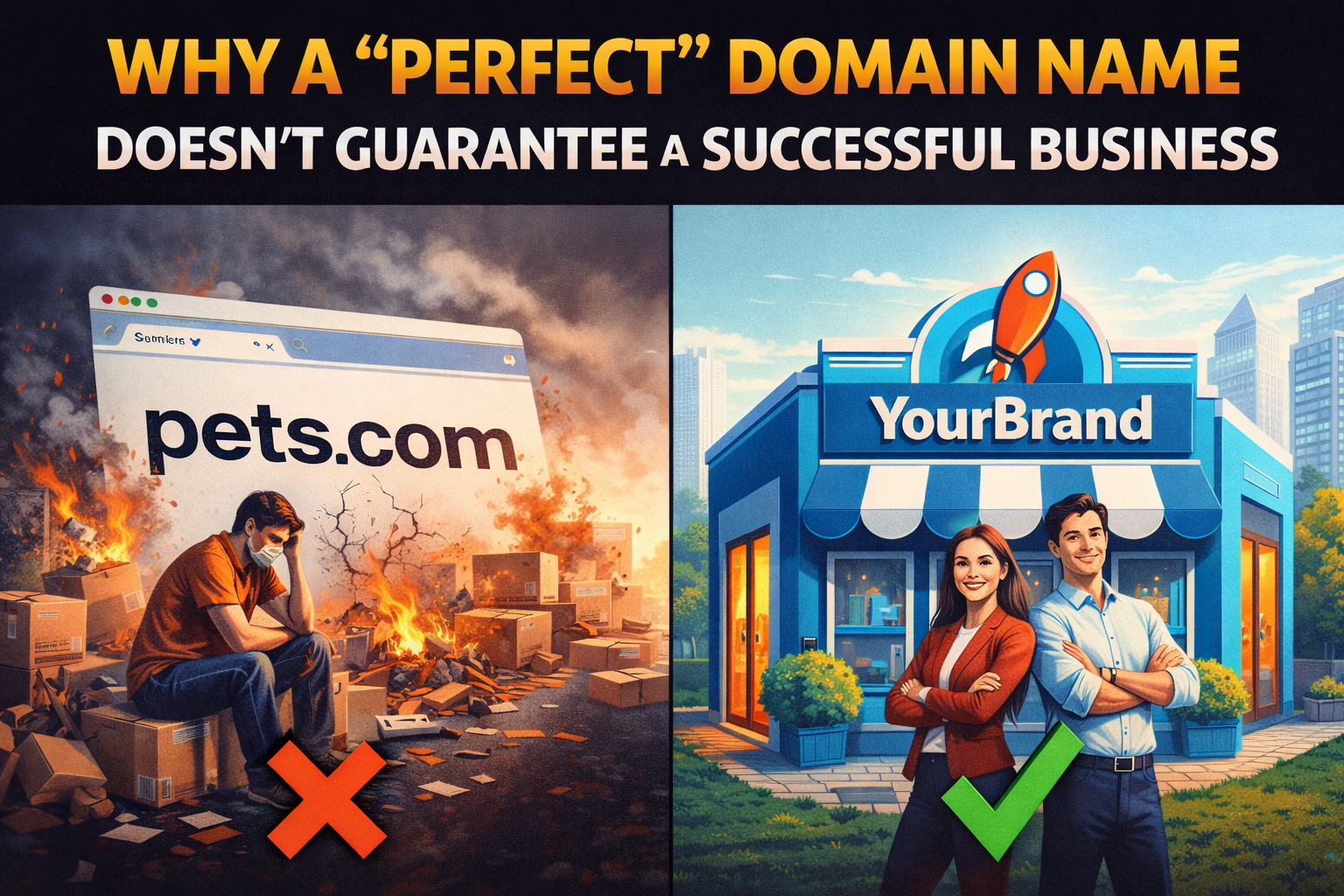
It’s easy to believe that a “natural” domain name — a common word, a category name, a short exact-match phrase — is a shortcut to success.
Something like:
pets.com
cars.com
hotels.com
tasks.com
ai.com
It feels like owning the category.
But reality is much harsher:
A great domain name can help marketing, but it cannot fix a weak product, weak economics, or weak execution.
We’ve seen this play out repeatedly.
One of the most famous examples is Pets.com — a domain name that sounded like an automatic win, yet the business failed.
Meanwhile, some of the biggest winners in history built brands around “made-up” or non-generic names:
Google
Amazon
Facebook
Netflix
Shopify
So what’s the lesson?
The brand matters more than the domain.
Let’s break down why.
1) A domain name is not a moat
A lot of founders treat a strong domain like a competitive advantage.
But “advantage” only exists if it creates something competitors can’t replicate.
Here’s the problem:
Your domain name can’t:
make your product better
improve retention
lower your costs
increase your margins
create network effects
build distribution
fix churn
build trust
It’s a sign above the store.
If what’s inside isn’t good, the sign doesn’t matter.
2) Pets.com proved that “category ownership” doesn’t beat business fundamentals
Pets.com had:
a perfect domain
huge media attention
strong brand visibility during the dot-com era
But it ran into real-world fundamentals:
shipping heavy pet food is expensive
margins were thin
customer acquisition was costly
unit economics didn’t work
The domain didn’t save it.
A good name can make people click.
It can’t make the business profitable.
3) Generic domains often attract low-intent traffic
A common belief is: “If I own the category domain, I will get endless organic traffic.”
Sometimes you do get traffic — but it’s not always valuable.
Generic domains can attract:
broad, unfocused visitors
people shopping around
low-intent browsers
price-sensitive users
That traffic can convert poorly.
Meanwhile, branded names often attract:
users with intent
people looking specifically for the product
higher trust and stronger recall
So even if a generic domain brings more visitors, it might bring worse customers.
4) Brands win because they create meaning, not because they “own a word”
Look at the winners:
“Google” didn’t mean search until Google made it mean search.
“Amazon” isn’t “books.com,” but it became the default place to buy everything.
“Facebook” isn’t “socialnetwork.com,” but it became the identity layer of the internet.
They didn’t win by owning a domain category.
They won by:
being better
shipping faster
scaling distribution
building network effects
creating trust
becoming a habit
A brand is not a name.
A brand is a reputation.
5) Generic names are harder to defend long-term
Another uncomfortable truth:
A generic domain name is easy to copy in brand form.
If you run Pets.com, competitors can still launch:
Petly
PetHub
PawMart
PetZone
Chewy
You might own the domain, but you don’t own the category.
Consumers don’t choose you because your domain is generic.
They choose the product that works.
6) In 2026, discovery is shifting away from “type-in domains” anyway
The original value of exact-match domains was tied to older internet behavior:
type a category into the browser
or search exact-match keywords on Google
Today, discovery happens through:
Google search (but less reliant on exact match)
social media
YouTube
AI search assistants
app marketplaces
referrals
communities
So the strategic value of a generic domain has diminished over time.
A good domain helps, but it’s not the growth engine it once was.
7) The hidden downside: generic domains can feel less trustworthy
This surprises people.
Sometimes a generic domain feels:
spammy
affiliate-driven
“too good to be true”
like a directory, not a real product
A strong brand can feel more trustworthy because it feels intentional and distinct.
That’s why companies invest heavily in brand identity, design, and consistent messaging — not just domains.
8) A domain is a tool, not the business
Here’s the right way to think about it:
A great domain name is a marketing asset.
It can help with:
memorability
credibility (sometimes)
click-through rate
short links in ads
word-of-mouth
But it cannot replace:
product-market fit
retention
pricing power
distribution
execution speed
customer support
unit economics
Bottom line
A “natural” domain name can be nice.
But it doesn’t guarantee success.
Pets.com had the perfect domain and still failed.
Google, Amazon, and Facebook built global brands without owning the “perfect category domain.”
In modern business, success comes from:
building something people genuinely want
shipping better and faster than competitors
creating trust and retention
growing distribution channels
The domain name can support that.
But it can’t create it.