
The 10 Richest Tech Founders - and What They Actually Own in Their Companies (2026 Edition)
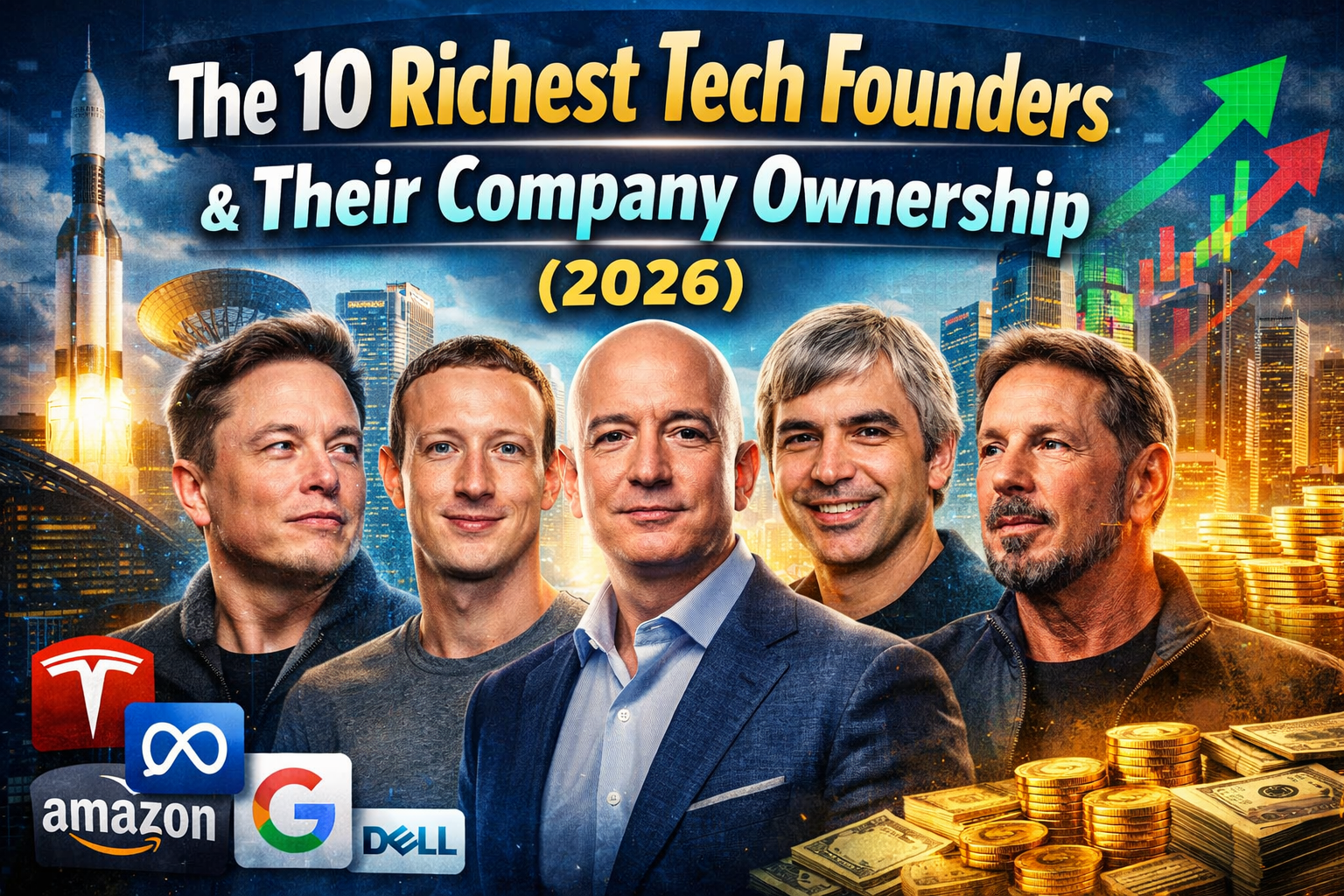
People talk about “net worth,” but ownership is the real power metric.
Because ownership answers the practical questions:
Who can’t be outvoted?
Who can’t be fired?
Who can pivot a $1T company without asking permission?
Who is still “all-in” on a single asset vs diversified?
Below is a verified, filing-based breakdown of the ownership stakes (economic % where possible, and voting control where relevant) for the most prominent ultra-rich tech founders/executives, using the latest available company filings and reputable reporting for private companies.
How this data is verified (and why “percent owned” is tricky)
For public companies (Tesla, Meta, Amazon, Alphabet, Oracle, Nvidia, Dell), the most reliable source is the company’s proxy statement (DEF 14A / PRE 14A) and related SEC filings.
Important nuance:
Some proxies emphasize “% of voting power” (especially dual-class companies like Meta and Alphabet).
Some give % of a specific class of shares.
For “true economic ownership,” you sometimes must compute it:
(shares owned) ÷ (total shares outstanding).
I explicitly label when a value is:
Direct from the filing, or
Computed from filing numbers.
Snapshot table: ownership + control (early 2026 view)
1) Elon Musk — Tesla (public) + SpaceX (private)
Tesla (economic ownership, from proxy):
Tesla’s 2025 proxy materials state Musk beneficially owned 19.7% of Tesla common stock as of August 29, 2025, using Tesla’s defined methodology (and with specific inclusions/exclusions around award shares).
Note: Tesla’s proxy is unusually detailed because it’s tied to CEO award structures; the 19.7% figure is explicitly stated, not an internet estimate.
SpaceX (private ownership):
SpaceX ownership is not disclosed via SEC proxy filings (private company). Reputable reporting commonly cites Musk owning ~42% of SpaceX (economic stake).
Treat this as best-available reporting, not SEC-filing-level certainty.
2) Mark Zuckerberg — Meta (public, dual-class control)
Meta’s 2025 proxy shows Zuckerberg holds:
342,606,985 Class B shares (Meta’s super-voting class) and 141,000 Class A shares
~61.0% of total voting power
The proxy also gives total shares outstanding (Class A and B), enabling an economic estimate.
Meta economic ownership (computed from proxy totals):
Total shares outstanding at April 1, 2025: 2,181,270,402 (Class A) + 343,179,151 (Class B)
Zuckerberg total shares listed: 342,606,985 (B) + 141,000 (A)
Computed economic stake ≈ 13.58% (but voting control is the headline: ~61%)
This is exactly why Meta is a case study in:
“own ~14% of the economics, control the company anyway.”
3) Jeff Bezos — Amazon (public)
Amazon’s proxy shows Bezos beneficially owned 912,912,482 shares, representing 9.6% of Amazon’s outstanding common stock (as of the proxy’s ownership date).
4) Larry Page — Alphabet (public, dual-class control)
Alphabet’s proxy reports Page’s Class B voting shares and voting power:
389,051,160 Class B shares
27.1% of total voting power
Alphabet economic ownership (computed):
To estimate economic ownership, we need total shares outstanding across Alphabet’s classes, which Alphabet discloses in periodic filings:
As of Oct 22, 2025: 5,818M Class A, 842M Class B, 5,407M Class C shares outstanding.
Using those totals and Page’s Class B share count from the proxy, Page’s economic ownership computes to ~3.22% (ballpark), while his voting power is far higher due to 10-votes-per-share Class B.
5) Sergey Brin — Alphabet (public, dual-class control)
Alphabet’s proxy reports Brin’s Class B voting shares and voting power:
362,766,628 Class B shares
25.2% of total voting power
Alphabet economic ownership (computed):
Using the same Oct 22, 2025 outstanding share totals, Brin’s economic ownership computes to ~3.01%, again with much higher voting influence.
Together, Page + Brin remain a textbook example of:
minority economic ownership + majority-like control behavior via dual-class voting.
6) Larry Ellison — Oracle (public)
Oracle’s 2025 proxy states Ellison beneficially owned 1,158,232,353 shares, equal to 40.6% of Oracle’s outstanding common stock (as of Sept 19, 2025).
This is one of the most extreme “founder still owns the company” positions among mega-cap tech names.
7) Jensen Huang — Nvidia (public)
Nvidia’s proxy lists Jensen Huang as beneficial owner of 922,922,938 shares, which the proxy states equals 3.77% of Nvidia common stock.
At Nvidia’s scale, “single-digit percent” can still mean hundreds of billions in value during AI supercycles.
8) Steve Ballmer — Microsoft (public)
Microsoft does not typically present Ballmer as a >5% holder in the same way as founders in dual-class companies, so the clean approach is:
Use a reputable share count for Ballmer and the company’s reported shares outstanding, then compute percent.
Bloomberg widely reports Ballmer owning roughly 333,154,193 Microsoft shares.
Microsoft’s 10-K reports its shares outstanding (used as the denominator for a computed %).
Computed ownership: ~4.5% (approx., depends on the exact outstanding share count date).
9) Michael Dell — Dell Technologies (public, multi-class)
Dell’s proxy shows Michael Dell’s “Percentage Ownership of All Outstanding Dell Technologies Common Stock” = 41.4%.
That is an enormous retained stake for a modern large public tech company—very “old-school founder ownership.”
10) Bill Gates — Microsoft (public, but stake not precisely disclosed in proxies like founders)
Gates’ Microsoft ownership today is widely described as well under controlling levels and below major reporting thresholds (he sold down for decades). Because it’s below 5%, you don’t get the same clean “% of class” line in a proxy table like you do for Bezos/Ellison/Zuck.
The most accurate way to present Gates in an “ownership %” article is:
<1% of Microsoft (commonly cited), and
emphasize that his wealth is primarily held through diversified vehicles rather than Microsoft equity.
(If you want, I can rewrite the Gates section to focus on the concept—“the founder who doesn’t own the company anymore”—without forcing a fake precision number.)
The big pattern (what this ownership data really says)
1) There are two kinds of tech empires
Type A: “Control empires” (dual-class voting)
Zuckerberg (Meta): ~61% voting power
Page + Brin (Alphabet): 27.1% + 25.2% voting power respectively
They can hold single-digit economic stakes and still have strategic veto power.
Type B: “Ownership empires” (one-share-one-vote, but massive % retained)
Ellison (Oracle): 40.6%
Dell (Dell Technologies): 41.4%
These are rare in modern mega-cap tech.
Disclaimer (important)
All ownership values above are as-of specific filing dates (record dates / ownership measurement dates). They can change due to:
stock sales,
buybacks,
option exercises,
new compensation grants,
or share class conversions.