
Why Companies Prefer NVIDIA GPUs (Even With AMD, Intel, TPUs, and AWS Trainium Around)
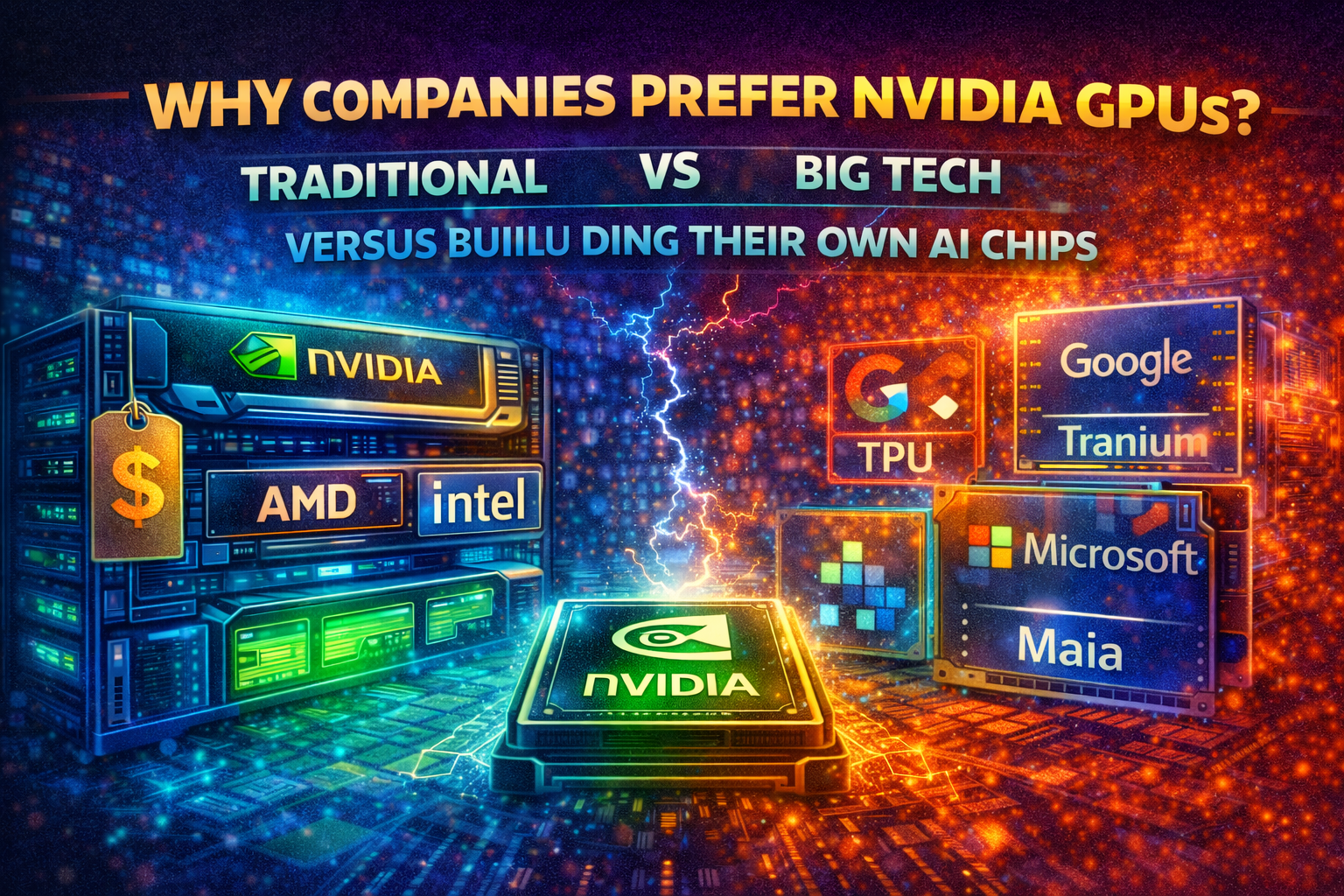
If you look at modern AI infrastructure, one pattern repeats everywhere:
Most companies still default to NVIDIA GPUs.
Even when alternatives exist — AMD Instinct, Intel Gaudi, Google TPUs, AWS Trainium/Inferentia, and Microsoft Maia — NVIDIA remains the “safe default” for training and serving serious production AI.
At the same time, the biggest tech companies are clearly sending a signal:
They don’t want to be dependent on NVIDIA forever, so they’re building their own chips.
Both things can be true.
Let’s break down why NVIDIA is still preferred, what the alternatives are actually good at, and why hyperscalers keep investing in custom silicon.
The real reason NVIDIA wins: software, not hardware
Yes, NVIDIA chips are fast. But speed alone doesn’t create dominance.
NVIDIA’s biggest advantage is the full-stack ecosystem: CUDA + libraries + tooling + deployment pipelines + vendor support + enterprise maturity.
This matters because the cost of AI is not just “GPU price.”
It’s also:
engineer time
debugging time
migration risk
framework compatibility risk
performance tuning effort
uptime and reliability
ability to hire people who already know the stack
NVIDIA reduces all of that.
1) CUDA is the default “language” of AI infrastructure
Most major frameworks and the broader ML ecosystem have been optimized around NVIDIA for years.
NVIDIA’s ecosystem includes:
containers and reference images
monitoring and profiling tools
datacenter deployment workflows that are already standard
So even when a competing chip is “good on paper,” teams often choose NVIDIA because:
existing code works with minimal changes
libraries are stable and battle-tested
bugs and edge cases are well-documented
performance tuning knowledge already exists
hiring engineers is easier
2) Multi-GPU scaling is a system problem — and NVIDIA sells the system
Training serious models isn’t about one GPU. It’s about:
many GPUs in one node
many nodes in a cluster
high-speed interconnects
communication libraries
predictable distributed training
NVIDIA invested heavily in:
high-bandwidth interconnects inside nodes
reference architectures designed for scale
optimized communication libraries for distributed training
This is a major reason enterprises choose NVIDIA: they want predictable scaling with fewer surprises.
3) Time-to-production beats cheaper hardware
Most companies don’t buy GPUs because they love hardware.
They buy GPUs because they want working AI features.
If NVIDIA lets a team ship in 4 weeks instead of 12, the ROI can easily outweigh lower hourly pricing from alternatives.
For many teams, speed and reliability matter more than raw cost.
Why AMD still isn’t the default (even if the hardware is competitive)
AMD has made real progress with its accelerator hardware and software stack.
But adoption friction still exists:
fewer teams have deep experience with the ecosystem
more “unknown unknowns” during migration
smaller third-party tooling ecosystem
higher risk when porting CUDA-first pipelines
That doesn’t mean AMD can’t win deals — it does — but it explains why NVIDIA remains the default choice.
Why Intel Gaudi is interesting, but niche
Intel’s Gaudi strategy focuses on:
open software approaches
standard Ethernet-based scaling
cost-performance positioning
Gaudi can work very well in specific environments, especially where organizations want alternatives to GPU scarcity.
But again, the ecosystem gap matters:
fewer production playbooks
fewer engineers with hands-on experience
less “it just works” confidence
Why TPUs aren’t everywhere (and why that’s changing)
Google’s TPUs are powerful and efficient.
Historically, the biggest limitation wasn’t capability — it was developer workflow compatibility:
many teams are PyTorch-first
much of the AI ecosystem evolved around CUDA
That’s why improving PyTorch compatibility for TPUs is such a strategic move. Lowering that barrier directly attacks NVIDIA’s biggest moat: software.
Why AWS Trainium exists (and why it’s growing)
AWS built Trainium and Inferentia to:
reduce dependence on NVIDIA supply
improve cost-performance for customers
keep workloads inside AWS
AWS pairs the hardware with:
its own SDK and tooling
tight integration into AWS infrastructure
The trade-offs are real:
AWS-specific stack
more vendor lock-in
extra compilation and tooling steps
For customers with massive AI bills, those trade-offs are often worth it.
Why Microsoft built Maia (and still buys NVIDIA)
Microsoft’s Maia chips are designed to optimize AI workloads inside Azure.
But Microsoft also continues to deploy NVIDIA and AMD hardware extensively.
This reflects the hyperscaler reality:
custom chips for cost control and leverage
third-party hardware for ecosystem compatibility
a hybrid approach to reduce risk
No hyperscaler wants to bet everything on a single vendor — including their own silicon.
The real reason Big Tech builds its own AI chips
1) Cost control at scale
At hyperscale, even small efficiency gains matter enormously.
2) Supply chain independence
Scarcity can derail product roadmaps.
3) Workload specialization
Big tech can design chips around:
inference-heavy workloads
specific model architectures
internal networking assumptions
power and cooling constraints
4) Negotiation leverage
Having credible alternatives changes pricing and allocation conversations — even if NVIDIA remains a major supplier.
Bottom line
Companies prefer NVIDIA GPUs because NVIDIA offers the lowest-risk path from idea to production AI, thanks to its software ecosystem and proven scaling infrastructure.
Big tech builds custom chips because AI compute has become a strategic resource, and owning part of the stack improves cost, control, and independence.
In 2026, the landscape isn’t “NVIDIA vs everyone else.”
It’s more like:
NVIDIA as the default for most companies
hyperscalers building alternatives for leverage and economics
competition shifting from hardware specs to developer experience
That shift — from silicon to software and tooling — is where the next real battles will happen.