
Why We Probably Won’t See Truly Useful Humanoid Robots in the Next 5 Years
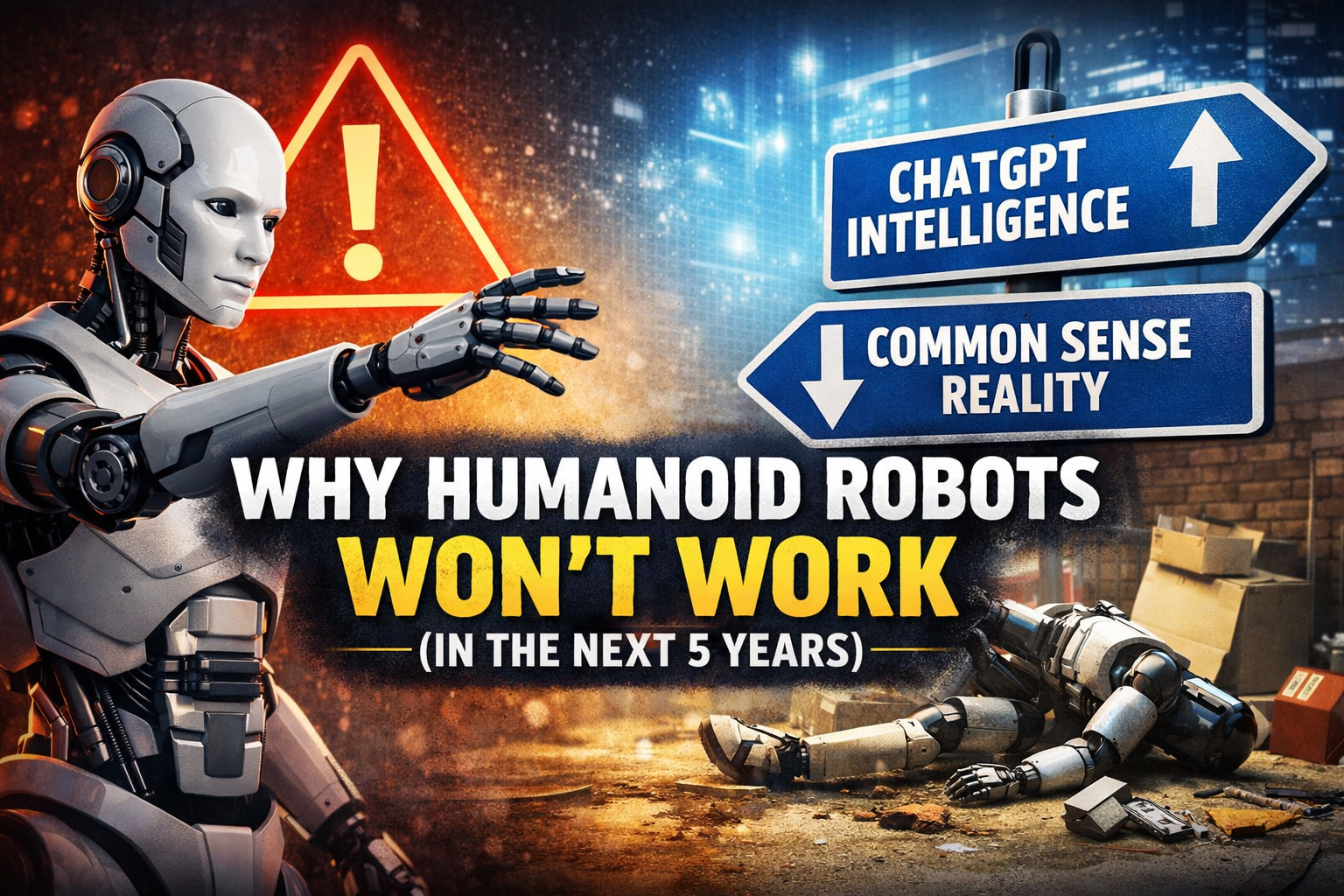
Humanoid robots are having a moment again. The videos look better, the walking is smoother, the hands look more “human,” and every few months a new company claims it’s close to putting robots into factories, warehouses, and eventually homes.
But there’s a big gap between a convincing demo and a safe, reliable, affordable humanoid that can work in the real world—all day, every day, with minimal supervision.
In the next five years, we’ll absolutely see progress (and more pilots). We’ll likely see humanoids doing a few narrow tasks in controlled environments. But the sci-fi idea—general-purpose humanoids that operate like humans, with human-level common sense in the physical world—almost certainly won’t arrive on that timeline.
Here’s why.
1) ChatGPT-level “text intelligence” is not physical-world common sense
Large Language Models are impressive at language: summarizing, writing, reasoning in text, and following instructions. That creates the illusion that “intelligence” is basically solved.
Robots don’t live in text.
A humanoid robot needs embodied intelligence:
understanding messy real environments (occlusion, lighting changes, clutter)
predicting physical outcomes (friction, weight shifts, slip, deformable objects)
planning actions that work with imperfect sensors and imperfect control
recovering when things go wrong—without breaking itself, the object, or the human nearby
In plain terms:
ChatGPT can be confident and wrong in text. A robot that’s confident and wrong in a factory or home is a liability.
2) The “sim-to-real” gap is still brutal
A lot of robot learning happens in simulation because collecting real-world robot data is slow, expensive, and risky. But simulation is never perfect, and transferring skills to the real world is still one of the hardest problems in robotics.
This matters because humanoids need to handle:
thousands of object types
endless edge cases (weird placements, unexpected contact, partial failures)
environments that were never “trained” for
The world is the ultimate adversarial dataset.
3) Hands and manipulation are still far from “human useful”
Walking is hard, but working is harder.
Most real jobs (and home tasks) require reliable manipulation:
picking objects that vary in shape/weight/material
handling deformables (bags, cables, clothing)
operating latches, doors, drawers, tools
doing it quickly, repeatedly, safely
This is the “humanoid paradox”:
The human form is great… because humans have incredible hands, proprioception, and adaptive control.
4) Hardware is improving, but it’s not close to “human-level practicality”
Even if the software was perfect tomorrow, humanoids still have physical constraints:
Actuators and joint performance
Human muscles are quiet, strong, efficient, and durable. Robots need motors, gearboxes, and actuators that can match that across the whole body—without overheating, wearing out quickly, or becoming unsafe around humans.
Power and runtime
Batteries are heavy. High-torque motion costs energy. More runtime usually means more weight, which increases safety risk and mechanical stress.
Reliability and maintenance
A humanoid is an extremely complex machine—many joints, many failure points. In real operations, reliability and maintainability matter more than athletic demos.
5) Safety, regulation, and liability will slow everything down
A general-purpose humanoid isn’t just a machine—it’s a machine moving near humans, often carrying objects, sometimes with significant force.
In warehouses and factories, the first deployments often happen in isolated zones or constrained workflows specifically to reduce risk—because uncontrolled interaction is still too dangerous and unpredictable at scale.
Now imagine the home: pets, kids, stairs, clutter, glass, liquids, tight spaces… and zero tolerance for “oops.”
6) The demos are real progress—but many are still not fully autonomous
One of the quiet truths of humanoid robotics today: a lot of “wow” moments rely on:
teleoperation (humans remotely assisting)
carefully staged environments
selective editing and best-case runs
That doesn’t mean “fraud.” Teleoperation is a valid tool for training, data collection, and bridging capability gaps. It just means we’re not at “drop a robot into reality and it figures it out” yet.
7) What we will see in the next 5 years: narrow deployments, not humanoid “humans”
This is the important nuance: humanoids are already entering pilot deployments—but in limited, industrial scenarios.
My bet:
In 5 years, the winning “robot worker” won’t necessarily be a perfect humanoid. It will be:
a purpose-built mobile manipulator
operating in a constrained workflow
monitored like a piece of industrial equipment
sold as robots-as-a-service
and still not “human common sense” autonomous
A realistic definition of “we won’t see humanoids”
To avoid playing word games, here’s what I mean by “we won’t see humanoid robots”:
Not “there will be zero humanoids.”
But we likely won’t see mass adoption of humanoids that are:
general-purpose
safe around humans without cages
reliable enough for daily work
cost-effective vs. alternative automation
truly autonomous (not quietly teleoperated)
Until the physical-world intelligence, manipulation, safety, and reliability stack gets dramatically better, humanoids will remain mostly pilots, prototypes, and narrow industrial deployments.
Closing: Software intelligence is accelerating—hardware reality is slower
ChatGPT showed the world what’s possible when intelligence lives inside text. Humanoids will show the world the opposite lesson:
The physical world is harder than the internet.
Progress is real. But human-level usefulness in a human body-shaped machine is a mountain—especially on a five-year timeline.
If you want a practical takeaway: watch for humanoid deployments where the environment is “made robot-friendly.” That’s where the real commercialization will happen first—long before your robot folds laundry at home.