
Why X Competing With YouTube Creator Payouts Is Hard (Even If Elon Wants It)
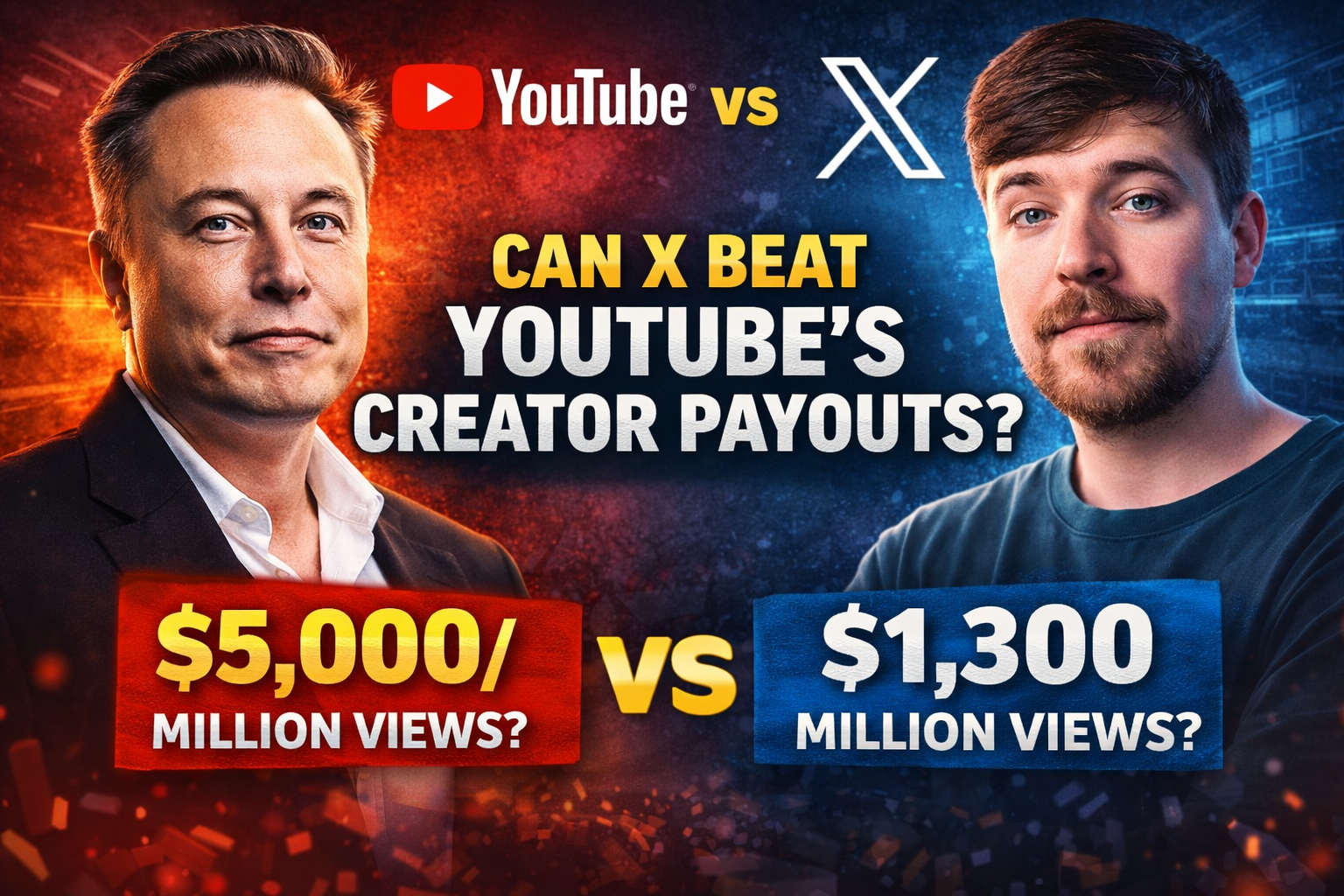
Every few months, the creator economy replays the same debate: “What if another platform simply pays more than YouTube?”
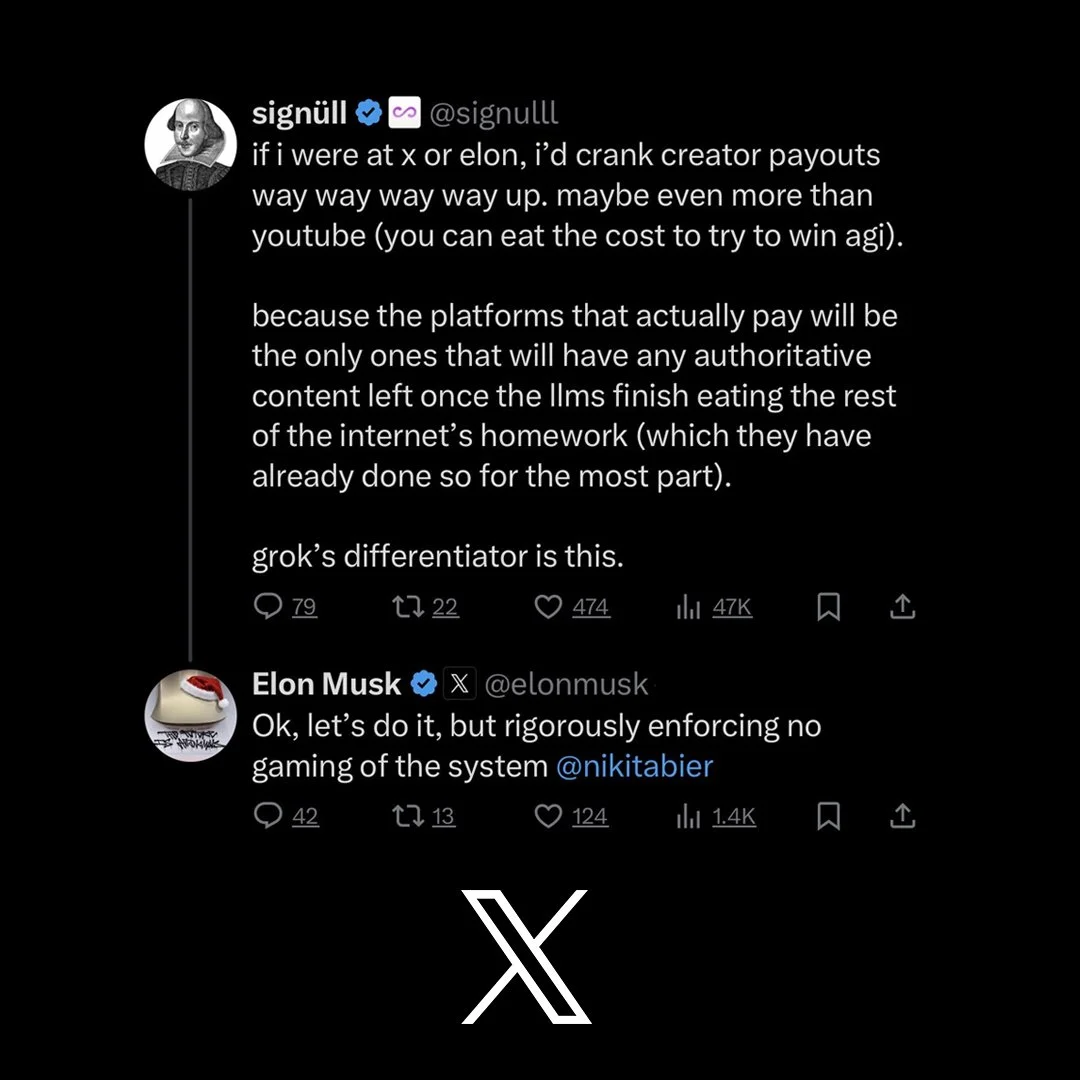
This week, the conversation got fuel because Elon Musk publicly agreed with a suggestion to crank X creator payouts way up — potentially even higher than YouTube — with one condition: it has to be enforced in a way that prevents gaming the system.
On paper, it sounds simple:
Pay creators more.
Attract better content.
Win attention.
Become the place where “authoritative” content survives while AI models remix the rest of the internet.
In reality, YouTube payouts aren’t just a “decision.” They’re the result of a machine that took nearly two decades to build.
What Elon Musk actually committed to (and why it matters)
The creator who tagged Elon wasn’t just talking about a “nice-to-have” bonus. The argument was strategic:
Once LLMs consume and repackage the web, platforms that reliably pay for original content become the only places where people still bother creating high-effort work.
Elon’s reply was basically: yes, do it — but only if it’s tightly protected against abuse.
That “no gaming” part is important, because payout systems are magnets for:
engagement bait,
bot networks,
coordinated reply farms,
content designed to trigger comments instead of inform.
If the incentives are wrong, you don’t get “authoritative content.” You get whatever prints money.
MrBeast’s response: YouTube is the best ever at this
MrBeast put it bluntly: competing with YouTube revenue is hard because YouTube is the best platform to ever exist at monetization.
And he’s not saying it as a commentator — he’s saying it as someone who’s produced massive ad revenue on YouTube.
That’s the key difference:
YouTube payouts are not a “feature.” They’re a byproduct of the strongest video ad marketplace and distribution engine on the internet.
Beating that means beating YouTube at advertisers, viewer intent, watch time, targeting, measurement, and brand safety — all at once.
Why YouTube prints money (and why X doesn’t—yet)
1) YouTube captures “high intent” attention
YouTube is where people go to:
learn something,
watch long-form content,
follow creators episodically,
sit through multiple ads in a session.
That’s premium attention for advertisers.
X is mostly:
fast scrolling,
mixed content quality,
short-lived posts,
volatile timelines.
Even if a post gets huge impressions, the advertiser value per impression can be radically lower.
2) YouTube has a consistent revenue split and predictable math
Creators can roughly estimate earnings because the monetization model is mature:
revenue share is known,
RPM/CPM patterns are relatively stable,
long-form inventory is deep.
X payouts have historically been less predictable because the system has shifted. That makes “creator planning” harder.
3) YouTube has breadth: ads + memberships + premium + commerce
YouTube has multiple income streams stacked on top of the same audience:
ads,
Premium revenue share,
memberships,
shopping,
brand deals that happen because YouTube proves performance.
X can absolutely build more monetization layers — but it’s not enough to “pay more” once. It has to be sustainable.
Rough payout comparison (US creator): YouTube vs X
These are rough numbers because every niche, audience, and format changes the result — but the gap is still useful to understand.
YouTube (long-form, US-heavy audience)
A common ballpark creators reference is ~$1,200 to $6,000 per 1 million views on long-form videos (with big variance by niche).
What matters: YouTube is predictable enough that creators can plan production budgets, editors, and posting cadence around it.
X (US creator)
X’s monetization isn’t as cleanly “per view,” and payouts can swing wildly.
One famous example: MrBeast posted a video on X and reported earning about $263K from it — but he also warned the result is misleading and not representative for typical creators, because premium ad targeting and special circumstances can inflate the effective rates.
He cited a very large CPM gap between “what he got” and what’s normal, implying the average can be dramatically smaller.
So when someone says “X should pay more than YouTube,” the real question is:
Pay more… funded by what?
If it’s funded by advertising: you need advertiser demand and brand trust at YouTube scale.
If it’s funded by subscriptions: you need a large paying user base and a payout formula that doesn’t get exploited.
If it’s funded by subsidies: you can do it temporarily, but it becomes a burn-rate strategy.
The “no gaming” problem is the whole game
Elon’s reply highlighted the hardest part: paying creators is easy.
Paying creators without creating an incentive to destroy your platform’s signal quality is extremely hard.
If payouts correlate with replies, you risk rage-bait.
If they correlate with impressions, you risk bots.
If they correlate with paid engagement, you risk reply-farms.
The payout mechanism becomes the content strategy of the entire platform.
YouTube solved this by:
anchoring payouts to advertiser value,
measuring watch time and viewer satisfaction,
building an ecosystem where high-quality content tends to win long-term.
X will need its own equivalent “truth metric” that can’t be cheaply manipulated.
What would it take for X to seriously compete?
If X wants to compete with YouTube payouts in a meaningful way (not just a headline), it likely needs:
A stable, transparent payout model creators can predict
A brand-safe video ad product advertisers trust
Anti-fraud enforcement at scale
A strong long-form viewing experience
Creator tooling that makes production, analytics, and rights management easy
Until then, X can absolutely produce occasional huge payouts — but “occasional” doesn’t beat YouTube.
Bottom line
Elon saying “let’s do it” is interesting, because it signals intent.
MrBeast saying “YouTube is the best ever at this” is the reality check.
YouTube isn’t winning because it decided to be generous.
It’s winning because it built the strongest monetization engine for video attention on the internet.
X can compete — but it’s not a payout tweak. It’s a multi-year rebuild of incentives, ad demand, and trust.